aaron.viets@LIGO.ORG - posted 14:42, Tuesday 01 November 2016 (31074)
Updated Kappa Comparison between SLM tool and GDS pipeline with minor bug fix
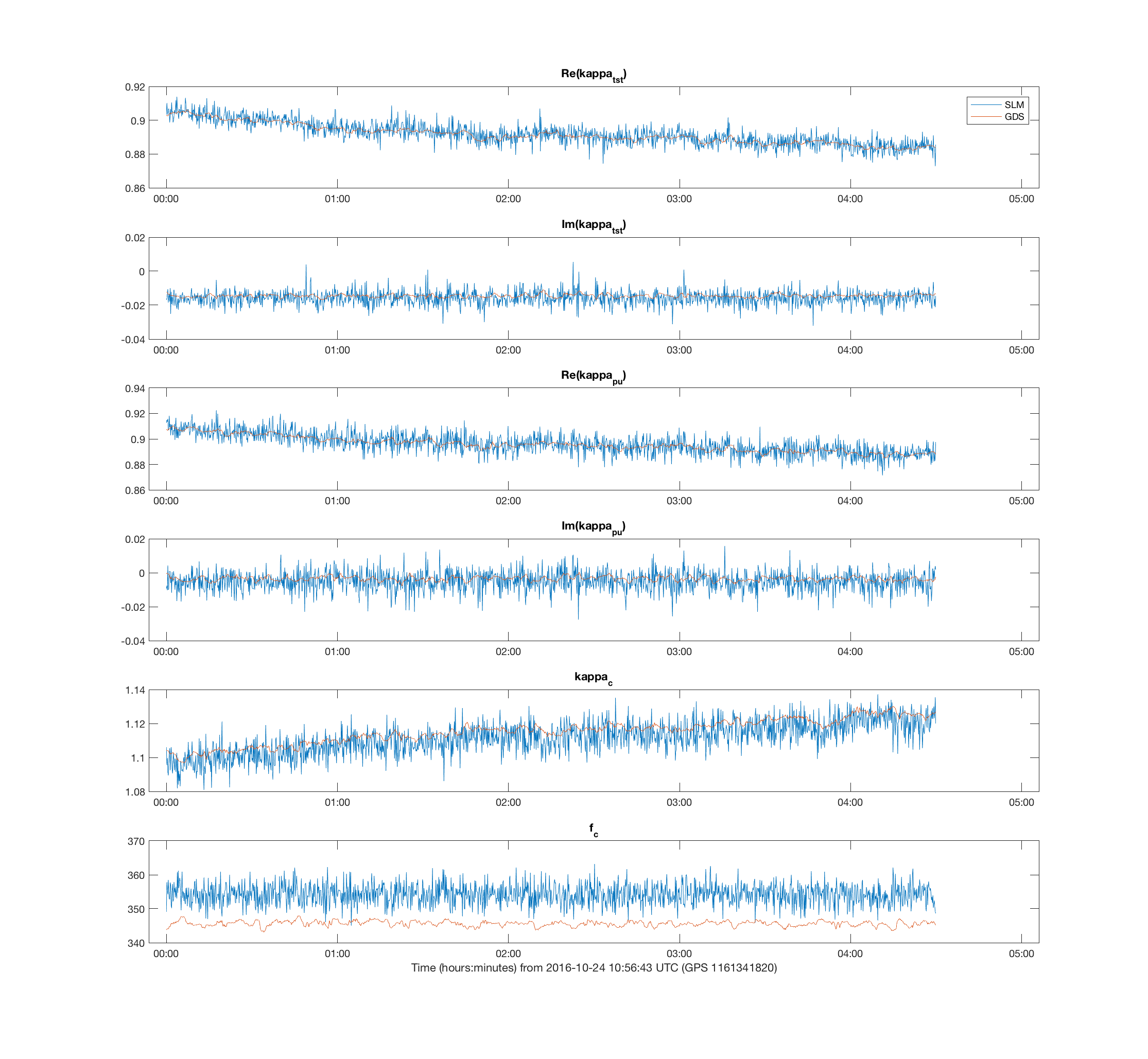
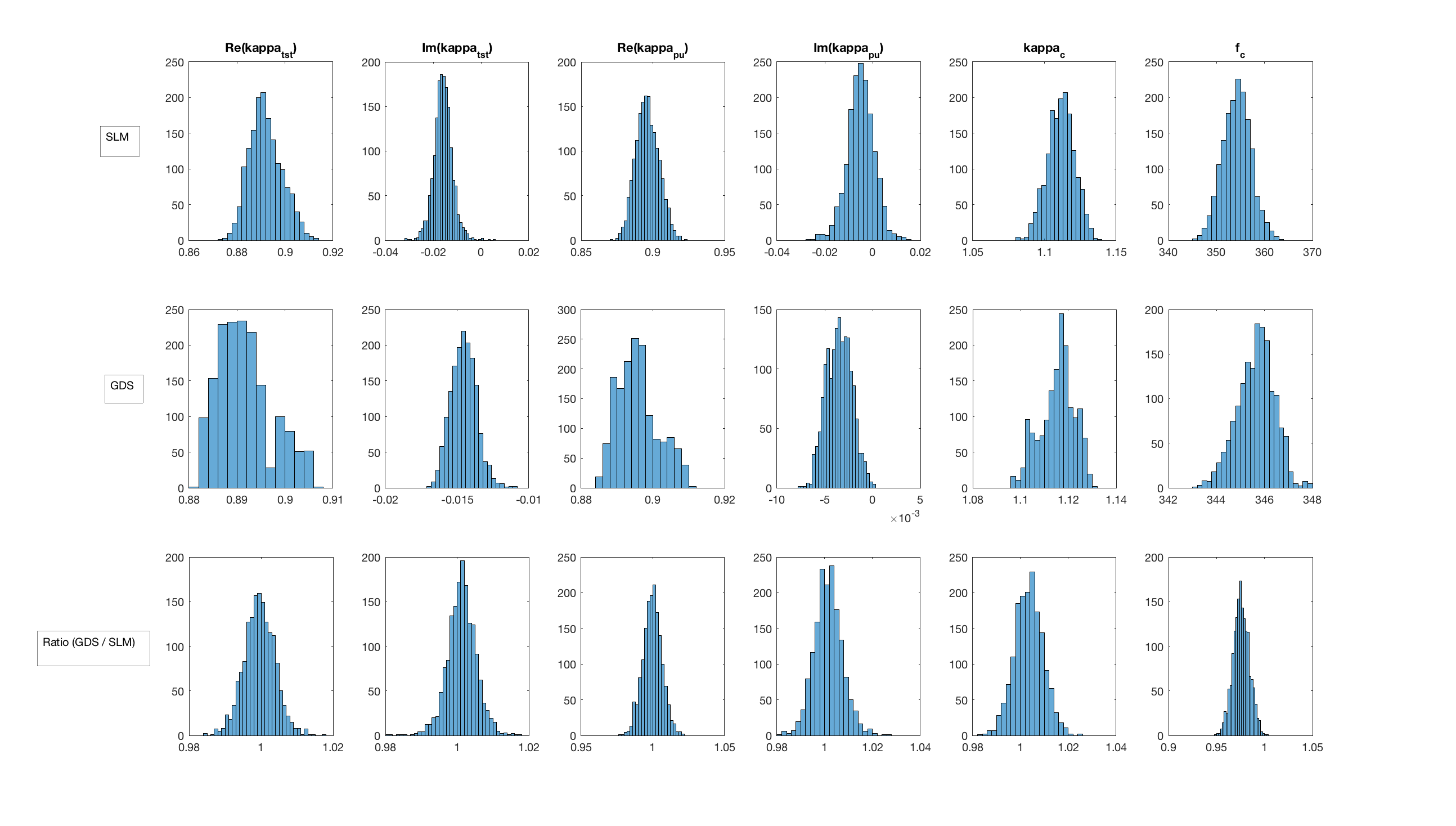
I applied a bug fix suggested by John Zweizig in the demodulation routine in the GDS pipeline that reduces error due to finite machine precision. After this, it appears that the kappas as computed by GDS, especially the cavity pole, are significantly less noisy, but still not in agreement with the SLM tool (See this aLOG for reference: https://alog.ligo-wa.caltech.edu/aLOG/index.php?callRep=30888).

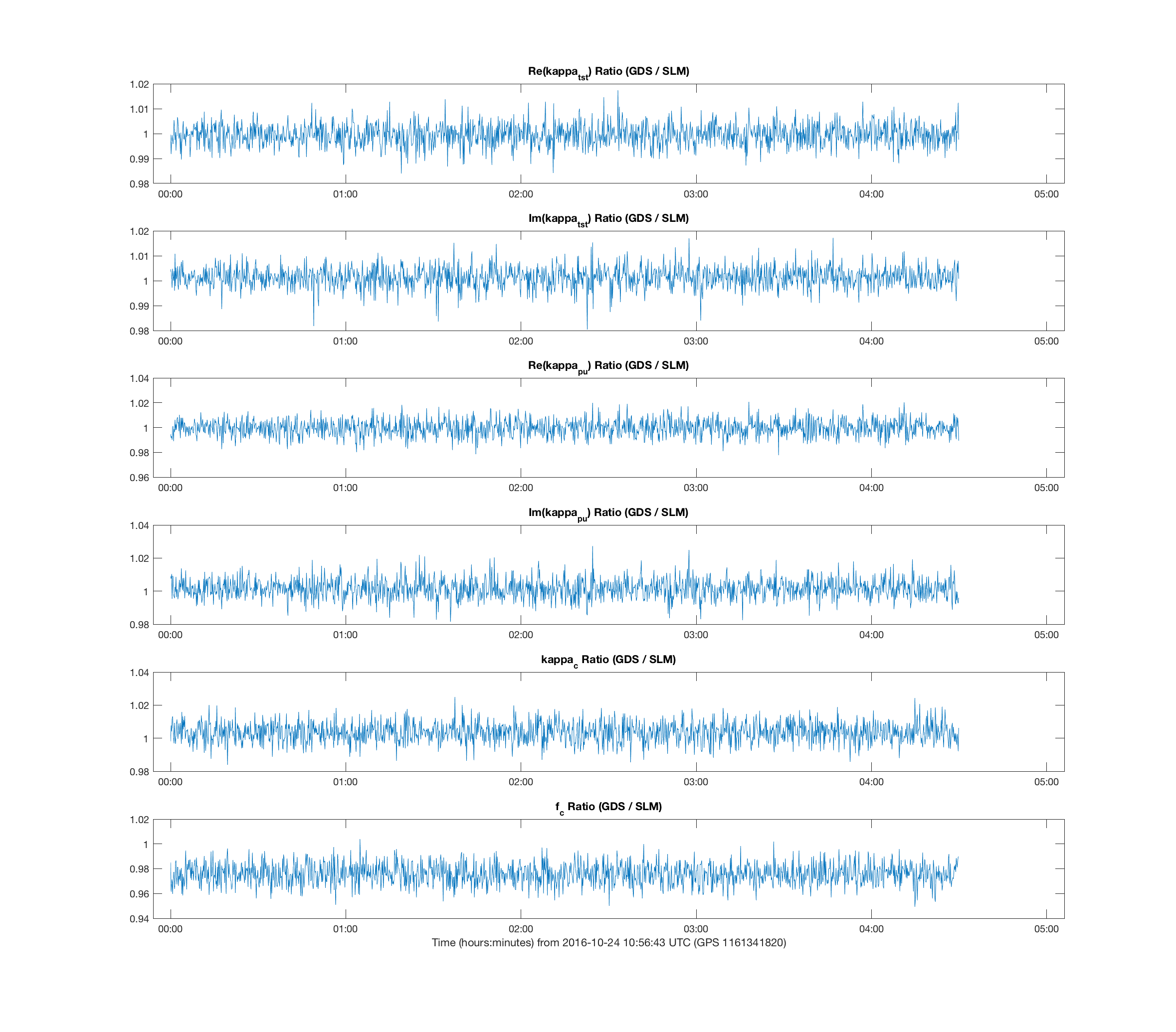
Below is a table of mean and standard deviation values for the data taken from GDS, SLM, and the ratio GDS / SLM:

                                   SLM mean         SLM std          GDS mean          GDS std             ratio mean            ratio std

Re(kappa_tst)             0.8920              0.0068            0.8916                0.0056              0.9995                  0.0043

Im(kappa_tst)             -0.0158             0.0039            -0.0145               0.0008882       1.0013                   0.0041

Re(kappa_pu)             0.8961              0.0080            0.8958                0.0057              0.9997                  0.0065

Im(kappa_pu)             -0.0050            0.0056            -0.0035              0.0013               1.0015                   0.0059

kappa_c                      1.1115                0.0094            1.1154                 0.0072               1.0035                  0.0060

f_c                               354.2338         2.9305            345.6435           0.7686               0.9758                  0.0084

Here are covariance matrices and correlation coefficient matrices between SLM and GDS:

       Covariance                          Correlation

Re(kappa_tst)
1.0e-04 *
    0.4615    0.3157                  1.0000    0.8238
    0.3157    0.3181                  0.8238    1.0000

Im(kappa_tst)
1.0e-04 *
    0.1506    0.0007                  1.0000     -0.0216
    0.0007    0.0079                  -0.0216    1.0000

Re(kappa_pu)
1.0e-04 *
    0.6387    0.3113                 1.0000    0.6866
    0.3113     0.3219                 0.6866    1.0000

Im(kappa_pu)
1.0e-04 *
    0.3139    -0.0036               1.0000    -0.0490
   -0.0036    0.0174               -0.0490    1.0000

kappa_c
1.0e-04 *
    0.8895    0.4815               1.0000    0.7118
    0.4815    0.5144                0.7118    1.0000

f_c
    8.5876   -0.0023               1.0000   -0.0010
   -0.0023    0.5908              -0.0010    1.0000

Plots and histograms are attached.
Images attached to this report