This is a follow up to log entry 41558 concerning the activation of a valved-in NEG pump on BSC6 south door at end-Y station and the release of unwanted gases in main vacuum volume.
I compiled RGA scans into one plot in the attached spreadsheet booklet (raw RGA files in zipped folder). In short, the release of gases for the <1 minute the heated pump was valved into main volume quickly recovered and all partial pressures are currently below the baseline recorded last week on April 19.
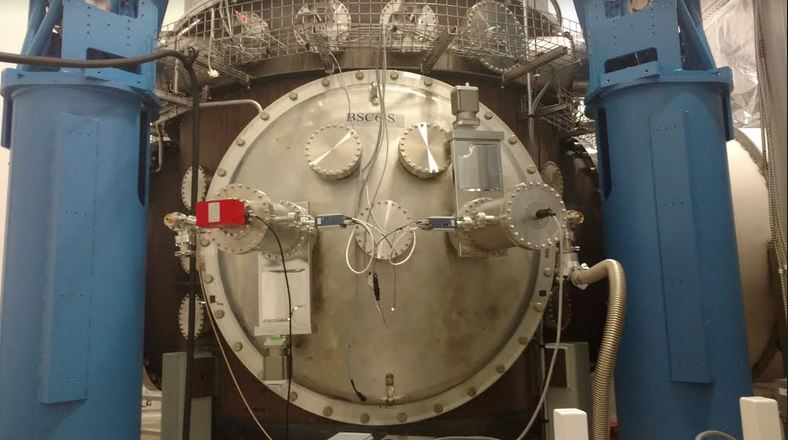
To recap, we activated for the first time a new type of "high vacuum" NEG pump: HV1600-10 NexTorr hybrid (includes 10 l/s ion pump behind NEG cartridge) mounted to BSC6 south door, furthest away from test mass (in BSC10) and beam tube (red body in photo). Activation includes heating the pump to 500C for at least one hour, and cooling to nominal operating conditions. In the case of this new type of NEG, the nominal operating temperature is 180C, unlike the other NEGs we use which are not heated in normal operating conditions. The advantage of this ZAO material is that the pump can be activated at pressures as high as e-4 Torr and not saturate as quickly from nitrogen. The NEG pump was valved into main volume for a short period (~ 1 min or less) during the start of activation, until we noticed partial pressures in RGA scan rising. We quickly isolated the NEG and connected an aux turbo cart to its housing to continue activation and pump away unwanted gases.
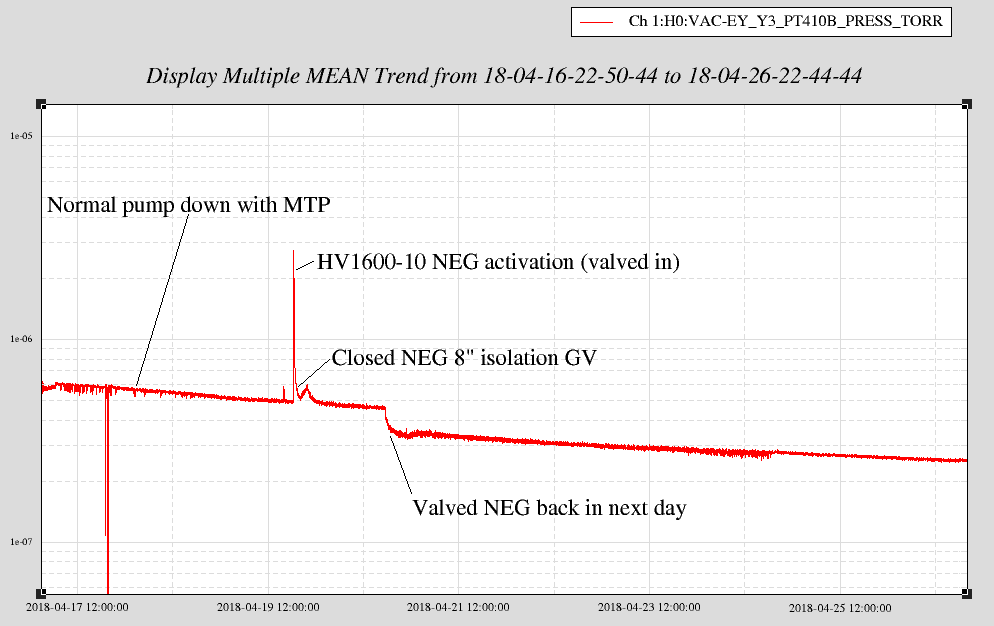
Total pressure attached, trended from PT-410B, cold cathode pressure gauge mounted to top of BSC10. The pressure before activation was 5e-7 Torr, peaked at 3e-6 Torr during activation (on main volume side, before valving out NEG), and recovered to mid e-7 Torr. The following day we valved NEG back into main volume (its local pressure had dropped to e-9 Torr); pressure fell from 6e-7 Torr to 3e-7 Torr. No change in slope.
EY main volume is being pumped by the main turbo pump following a many month long vent. RGA is Pfeiffer Prisma Plus.
Lesson learned: VALVE OUT ALL NEG PUMPS DURING ACTIVATION


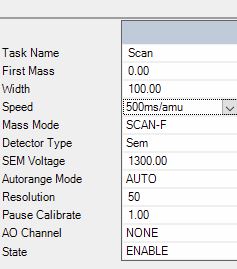
RGA settings
What is the torr/ion ampere ratio for this RGA at some popular gas such as amu 28. My guess is the RGA is in Faraday mode
for which the typical ratio is around 1000 to 10000.

Sorry, I did not see the rga parameter file when I asked this question. It looks like the rga is in sem mode. Is there some idea for the ratio at any one of the
hydrocarbon groups?
Rai, I'm not sure how valid this is, but adding up all partial pressures (AMU 0-100) gives 3.3e-5 amp; the total pressure reading at that time was 5e-7 Torr, which yields 0.015 Torr/amp. This is a Pfeiffer Prisma Plus model which gives a much different ratio from the SRS models, based on what I've seen with oven bake load data. Kyle has found that typically the water contribution to total pressure is 20%, which would yield ~0.1 Torr/amp. All RGAs have N2 and Kr calibration gases, so I can get an accurate ratio for you at N2 peak.