E1200836 lists all the Optical Lever Length to Angle cross-couplings for the detector optics. All these factors are unsigned and so one might assume they are all positive. But the sign depends on what is moving and therefore what is the sign of the path length change. E1200836 indicates no path length change sign and as it geometrically dependent, it would be unreasonable for them to all be positive. One might assume the length change is from the Optic moving, not the detector or laser; that make sense to me. So to determine the sign is just a geometric exercise, right up my alley. A quick look at D0901467 confirms that the local coordinates in E1200836 used to position things are signed like the global system (what I assumed) and so if the Optic is displaced +Y and the path length change therefore is also positive, the beam on the detector moves -X. This displacement on the detector is equivalent to -RZ (-Yaw) and this is why I say the sign of the ETMY L2Y factor should be negative. A quick visualization for the pitch x-coupling would have one conclude the sign is positive but that depends because the HR normal is pointing -Y. The sign is important as the OpLev length to yaw coupling could be hiding the HEPI to RZ coupling.
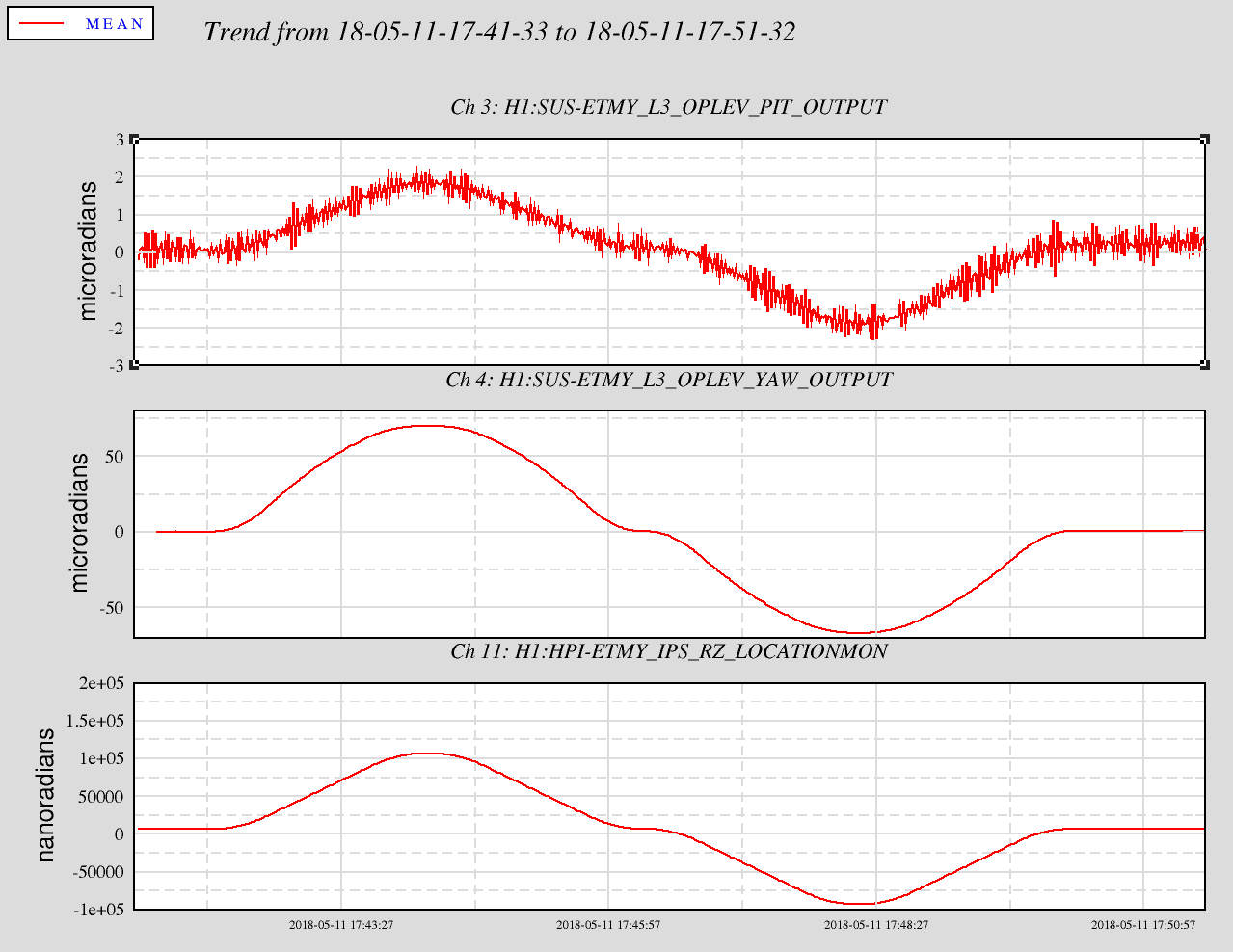
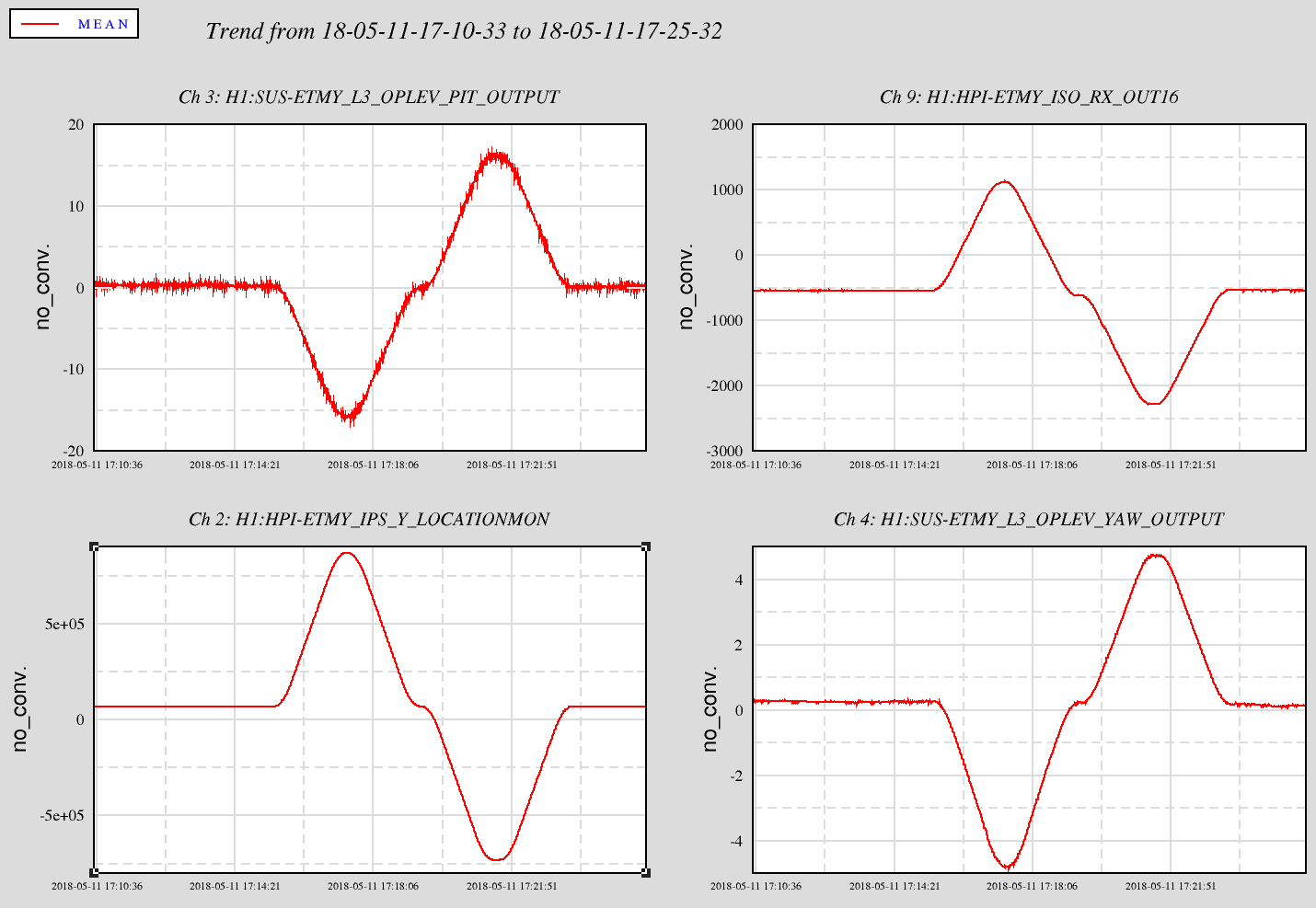
To confirm that the sign for RZ is as I say, I drove the HEPI in RZ and looked at the Oplev. See T1000388 for the details of the SEI team (FabriceM) getting our local to cartesian transformations into the LIGO global coordinate system. The first graph attached shows a 100urad stroke on HEPI and the Oplevs output. The YAW response of the Oplev is correct in that as the HEPI yaws+ so does the optic according to OpLev. The PITCH response here is just the HEPI x-coupling to tilts so can't say anything about that from this plot. But, while a Y stroke may have some tilting (see the ISO_RX output,) the 3rd attachment shows the OpLev PITCH sign is incorrect when the Y is stroked: see in your mind's eye the Optic moving away from the low mounted OpLev LASER and the beam reaching the higher detector. Clearly the beam moves up, and I think of this as the Optic pitching up. However, since the normal to this HR surface is pointing toward the -Y direction, maybe to the ISC etc group, this is a negative pitch.
Regardless of the sign of pitch on the optical lever or the sign of the length to pitch cross coupling on E1200836, HEPI can't do anything about Optic Pitch directly so I'll don't need to know it.