Frequency Stabilized and Fiber Coupled He-Ne laser: Performance as Oplev light source.
Motivation:
The Diode-laser sources (Fermion II ) that are presently used in aLIGO suffer from power glitches due to mode-hops within the laser. These glichtes inject broadband noise into the PIT and YAW oplev signals and presently limit the use of oplevs to initial damping of suspensions. If these glitches were not there, oplevs could potentially be used for damping angular motion during high power operation and/or adverse weather/seismic conditions.
Hypothesis:
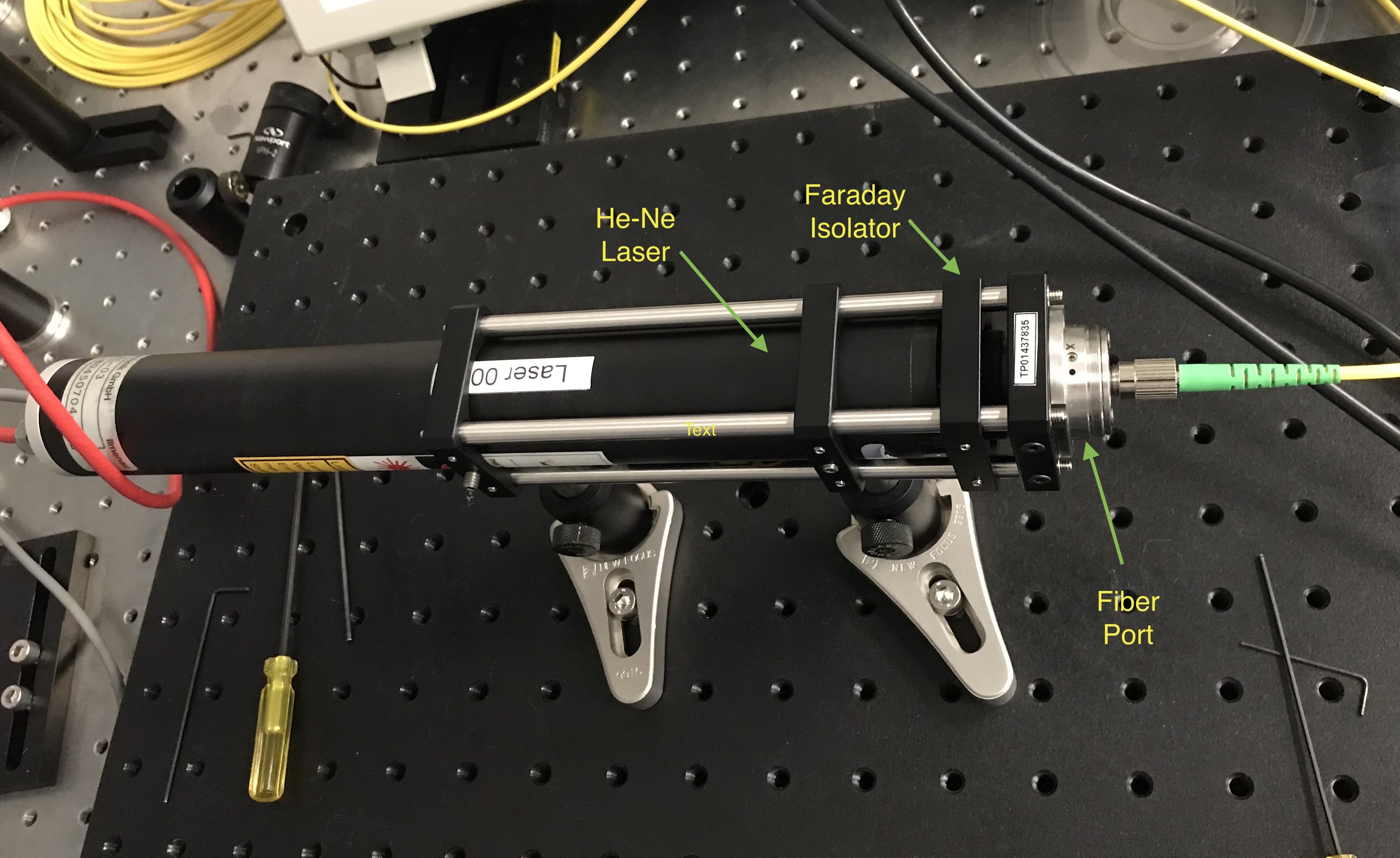
Frequency stabilized He-Ne lasers have a constant mode content as the active feedback controls the temperature (and therefore the length) of the plasma tube such that the output is locked to a mode. This ensures that the laser operates in a mode-hop free manner. This light is coupled into a single mode optical fiber, which serves to reduce any higher order mode content in the laser output further. To minimise optical feedback into the laser from the Fiber Coupler a Faraday-Isolator is inserted between the laser output and Fiber Coupler. With this assembly it is expected that we would obtain glitch free optical lever signals.
Test Set-up:
A 0.8mW He-Ne laser (SL 03 from SIOS) was fiber coupled using a PAF-X-2-A Fiber Port and a IO-2D-633-VLP Faraday Isolator (both from Thorlabs). These parts were rigidly mounted onto the laser body using a standard 30mm cage system also from Thorlabs. The assembly was installed on ETMY optical lever on 21st (see logbook entry 42104 by Jason). There is a whitening gain of 39dB on the QPD signals.
Observations:
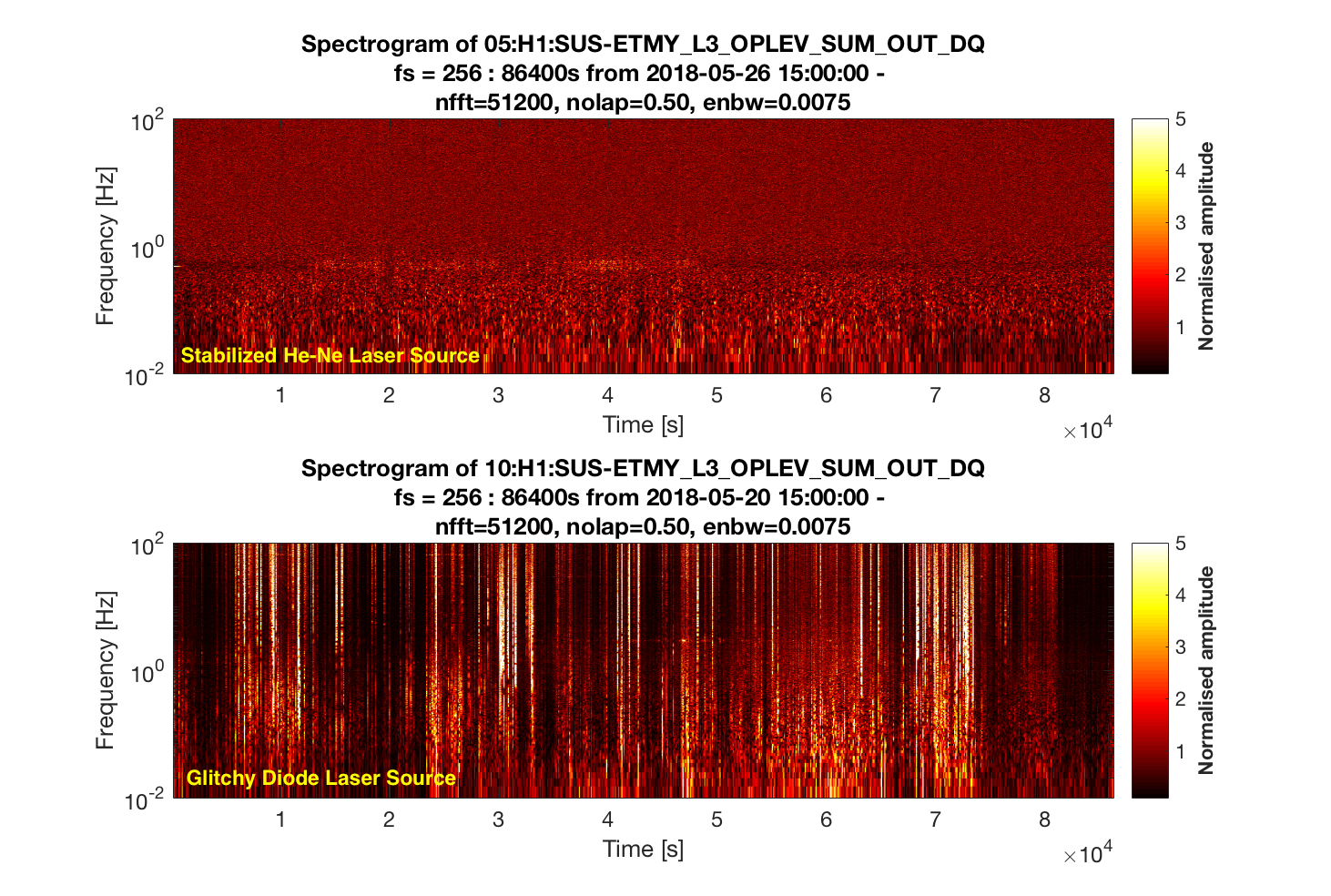
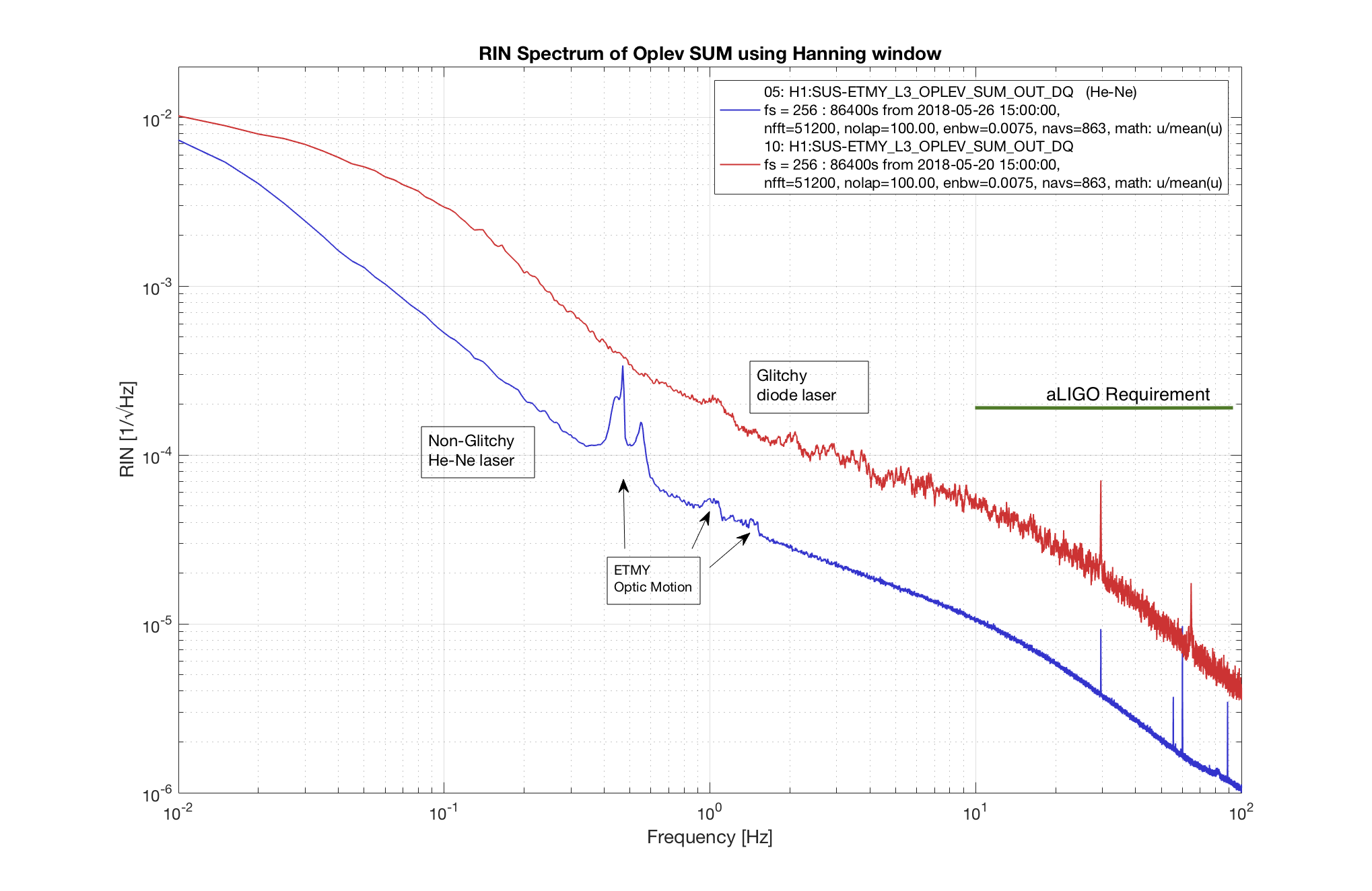
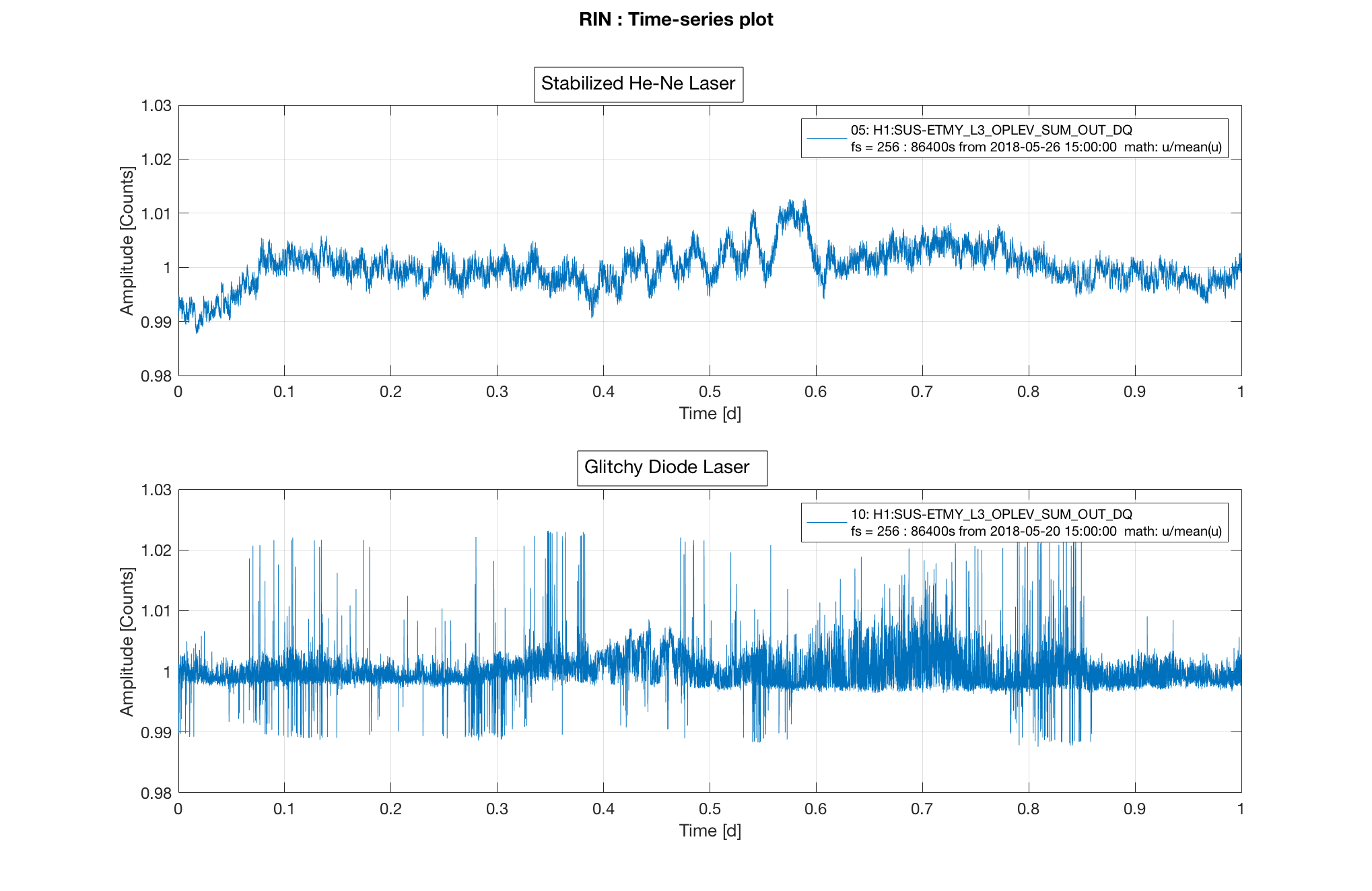
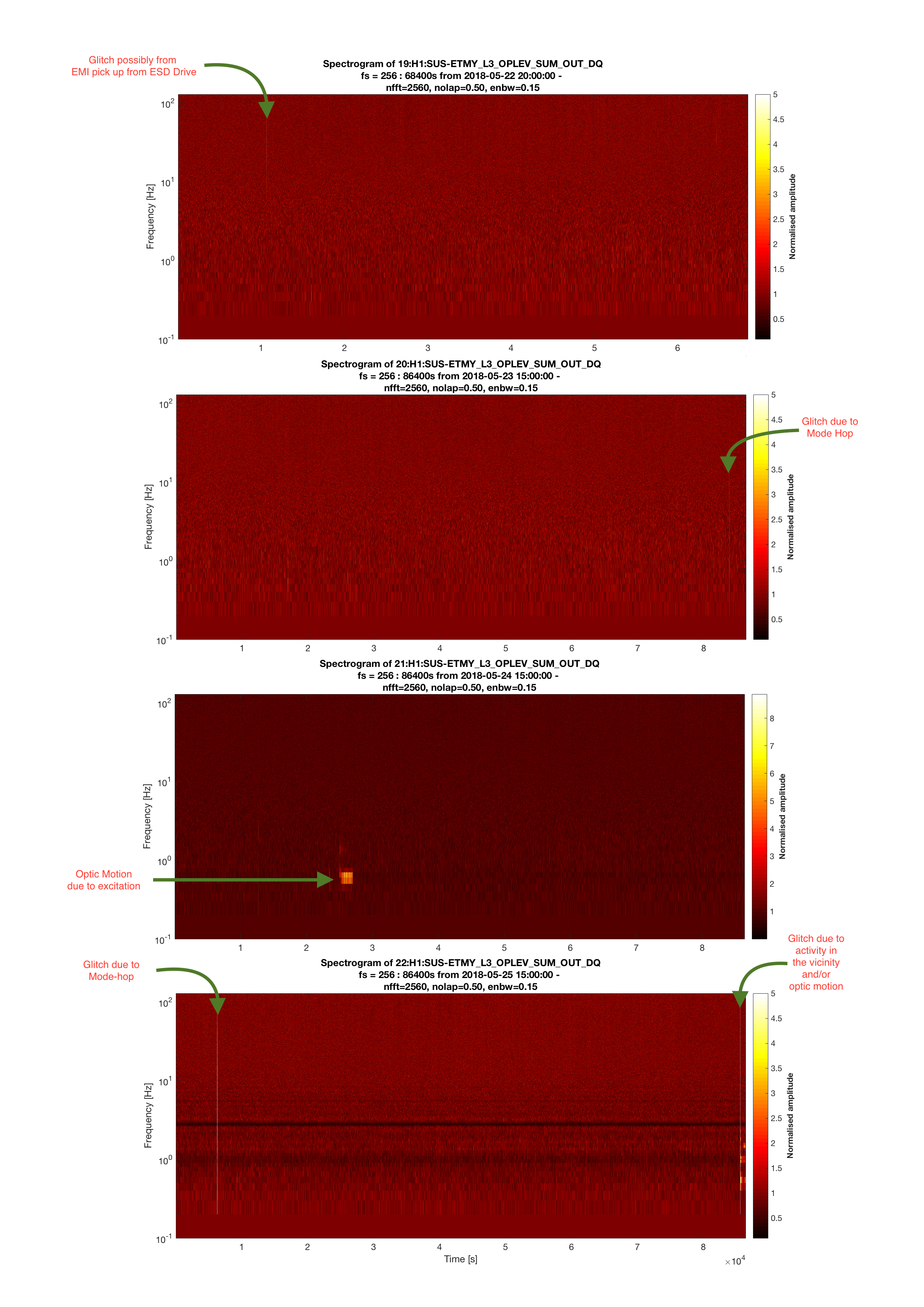
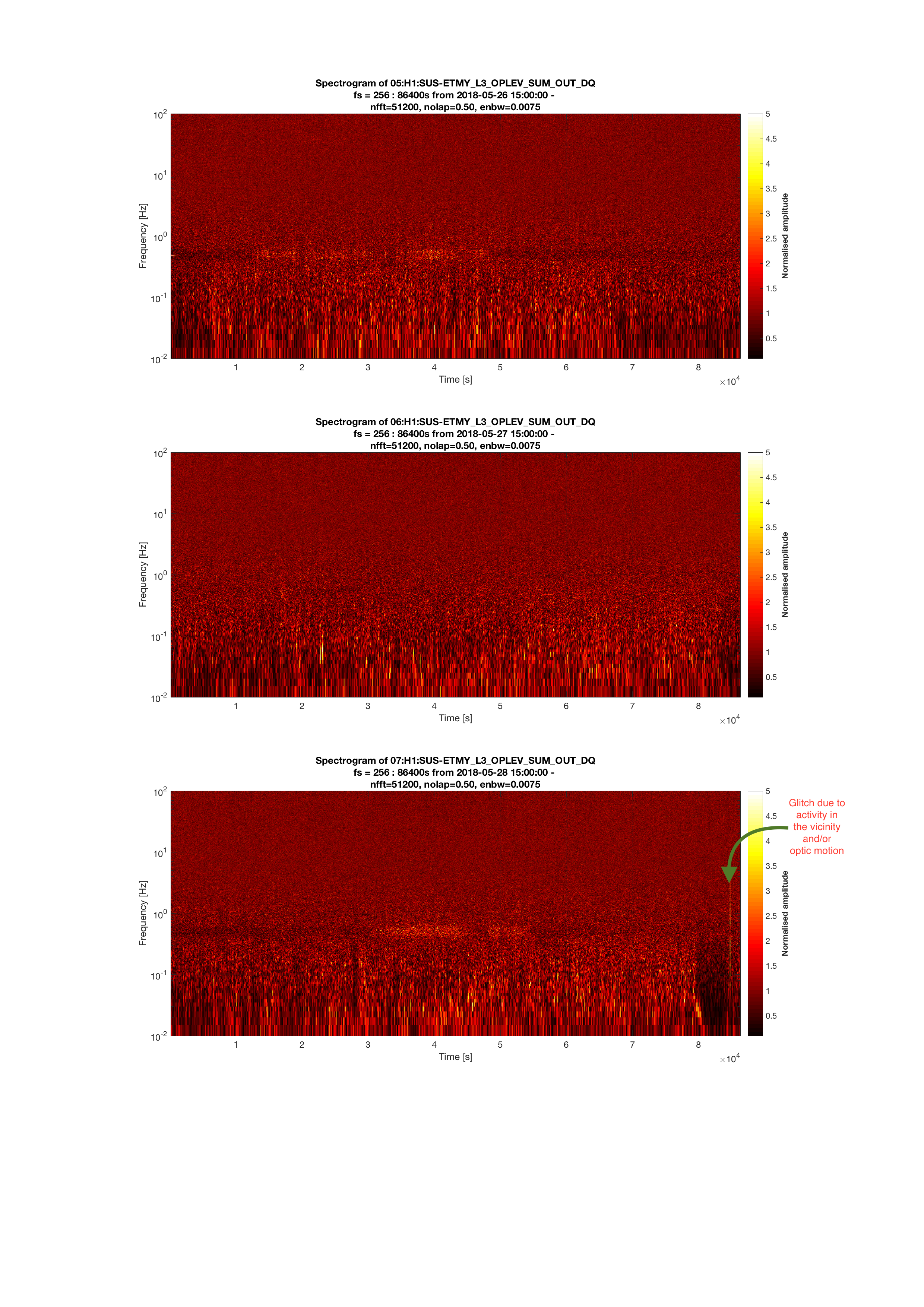
Dataset: 22nd - 29th May 2018. See attached figures: time-series, spectra and spectrograms.
1) Four glitches were seen over the observation period of 7 days (22nd, 25th, 26th and 29th). All of them occurred while people were testing the ESD drives, Hartman Sensors and/or were working in the vicinity. Two of these are clearly related to optic motion and are not laser related. Two seem to be mode hops induced by human activity. During the long weekend of 26-28th no glitches were seen.
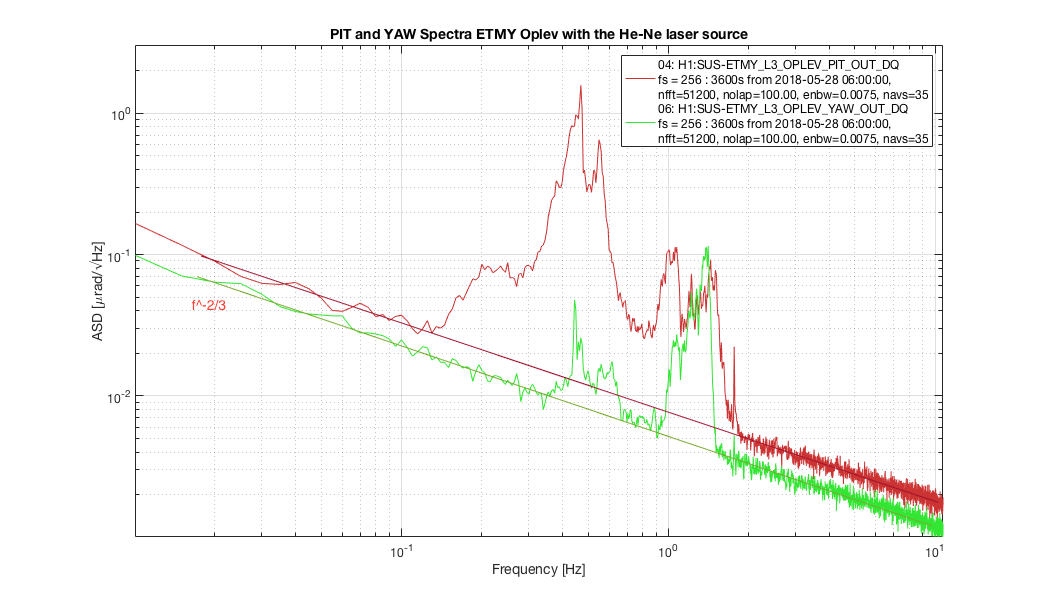
2) Pitch sensitivity is about 8nm/sqrtHz and Yaw sensitivity is about 5nm/sqrtHz at 1 Hz with a slope of f^(-2/3) in the range of 0.01 to 10 Hz.
Conclusions:
1) The stabilized fiber coupled laser source operates without glitches for several days at a stretch. In the absence of human acvitivity in the vicinity it is quite likely that we may have glitch free oplev signals lasting several weeks.
2) The sensitivity of PIT and YAW signals during this test are limited by electronic noise due to the whitening high gain. Some improvement is likely if a higher power laser were used such that about 4mW of light ( limit imposed by the RIN see T1000390 ) is incident on the test mass.