craig.cahillane@LIGO.ORG - posted 20:22, Wednesday 30 May 2018 - last comment - 00:04, Thursday 31 May 2018(42250)
Electric Field Meter Characterization (EFM1)
Craig, GeorgiaEFM Electric Field Measurements:
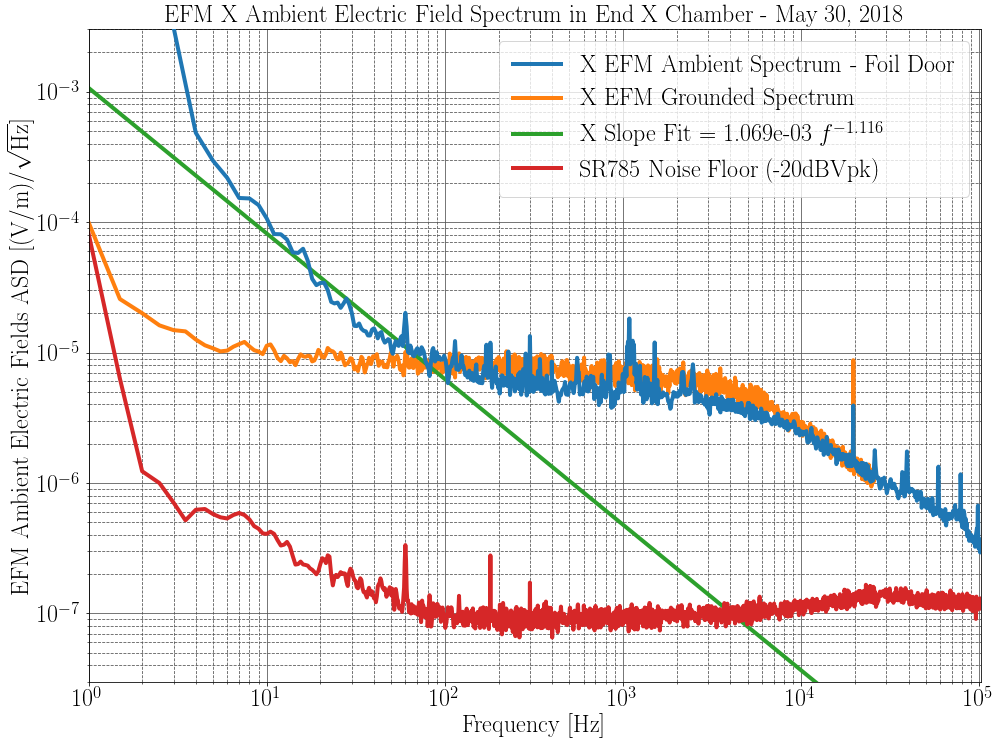
Today we installed the EFM (alog 42245), and measured the ambient electric fields with it. Plots 1 and 2 show the X and Y ambient electric fields with the grounded EFM circuit noise measurements. All SR785 measurements had -20 dBVpk attentuation, 25 averages. There is a distinct difference between the grounded EFM and ambient electric field measurements between 10 and 100 Hz. This could be due to the grounding of some upstream op-amp or it could be actually due to ambient electric fields in chamber. Again, I will suggest creating a LISO model of the EFM circuit and running a simulation with the sensor plates grounded and ungrounded. I probably can take on this task using my old creation pyliso, which has been recently improved by Kevin Kuns.Other measurements taken today:
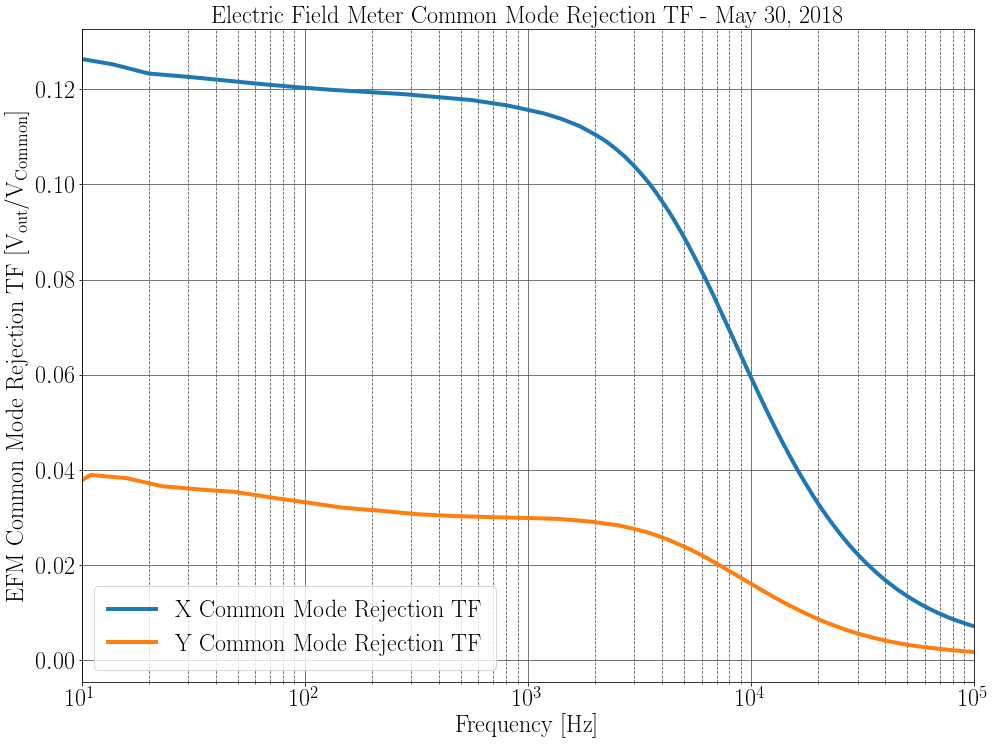
Distance between calibration plates and sensor plates = 5/8 inches Distance between sensor plates and EFM body = 1 inch X+ Cal to Sense Plate Capacitance = 8.0 +- 0.2 pF X- Cal to Sense Plate Capacitance = 8.1 +- 0.2 pF Y+ Cal to Sense Plate Capacitance = 8.4 +- 0.2 pF Y- Cal to Sense Plate Capacitance = 8.4 +- 0.2 pF X+ Sense Plate to Body Capacitance = 15.7 +- 0.5 pF X- Sense Plate to Body Capacitance = 15.5 +- 0.5 pF Y+ Sense Plate to Body Capacitance = 17.7 +- 0.5 pF Y- Sense Plate to Body Capacitance = 16.2 +- 0.5 pF X Cal Volts to Electric Field = 37.38 (V/m)/Vcal Y Cal Volts to Electric Field = 37.43 (V/m)/Vcal All Calibration TFs (Vout/Vcal) ~ 11.4 dB (See plot 3) X Common Mode Rejection = -17.96 dB Y Common Mode Rejection = -28.45 dB (See plot 4) The X common mode rejection is not so great. Unfortunately we cannot adjust this with EFM1, we'll have to make do with what we've got. Also, when taking the ambient electric field measurements we saw several glitchy combs pop up regularly, mostly at high frequency. Could be suspension resonances, since the EFM is held up by a (slightly bent) threaded rod we had just been touching.
Images attached to this report


Comments related to this report
Note: we left the foil door on the chamber (over the soft cover) so we can take new spectra tomorrow, but if anyone needs access to the chamber feel free to remove the foil.