Gabriele Sheila Georgia
The spectra we took yesterday were taken with the ISS unlocked. We have retaken the IMC-WFS and IMC-IM4_TRANS spectra with the ISS locked and conclude that we are not currently seeing excess jitter as, if it was, we should be able to see it in IM4_TRANS.
The first attachment shows the WFS (pink, green, cyan, brown traces) and IM4_TRANS spectra (blue, red traces), uncalibrated, both measured with the IMC and ISS locked. The coherence between the WFS and IM4_TRANS (bottom plot) is now dramatically reduced compared to alog 42362, i.e. the peaks we see in the WFS are not on the beam entering the interferometer. This plot suggests that the noise is coming from IOT2. The peaks in the IM4_TRANS pit and yaw spectra are also present in the sum output of the PD.
The second attachment shows the beam-widths-calibrated spectra from alog 42373, with the IMC locked at 10 W for the IM4_TRANS (yellow, black), bullseye PD (red, blue), and unlocked for the WFS spectra (pink, green, cyan, brown traces). The low frequency IM4_TRANS spectrum is quieter, and the coherence with the bullseye is no longer high. If the peaks in the IMC-WFS spectra were due to beam jitter they should be visible in IM4_TRANS.
Also note for these plots we have not yet addressed the sqrt(2) error in the bullseye calibration.
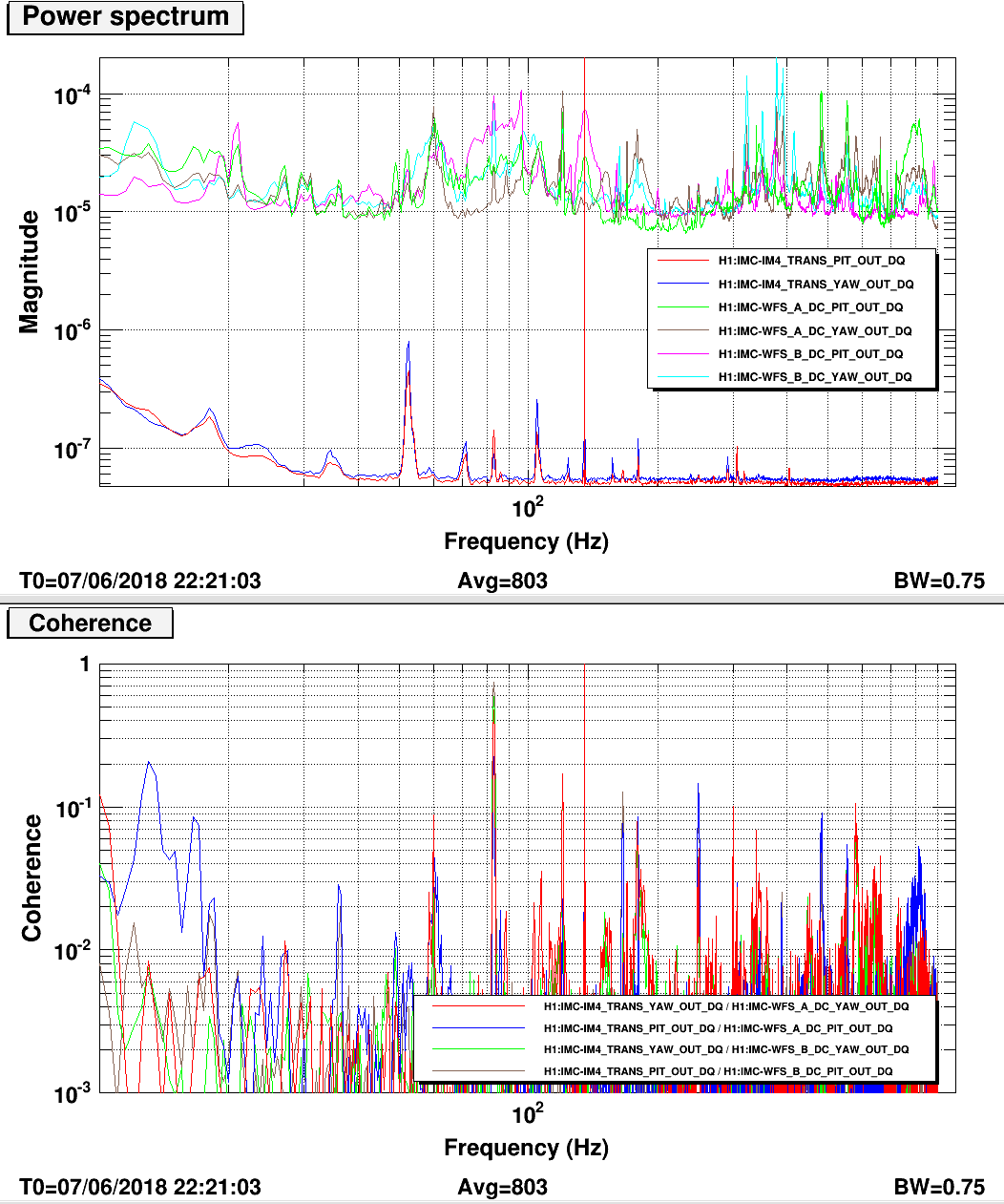
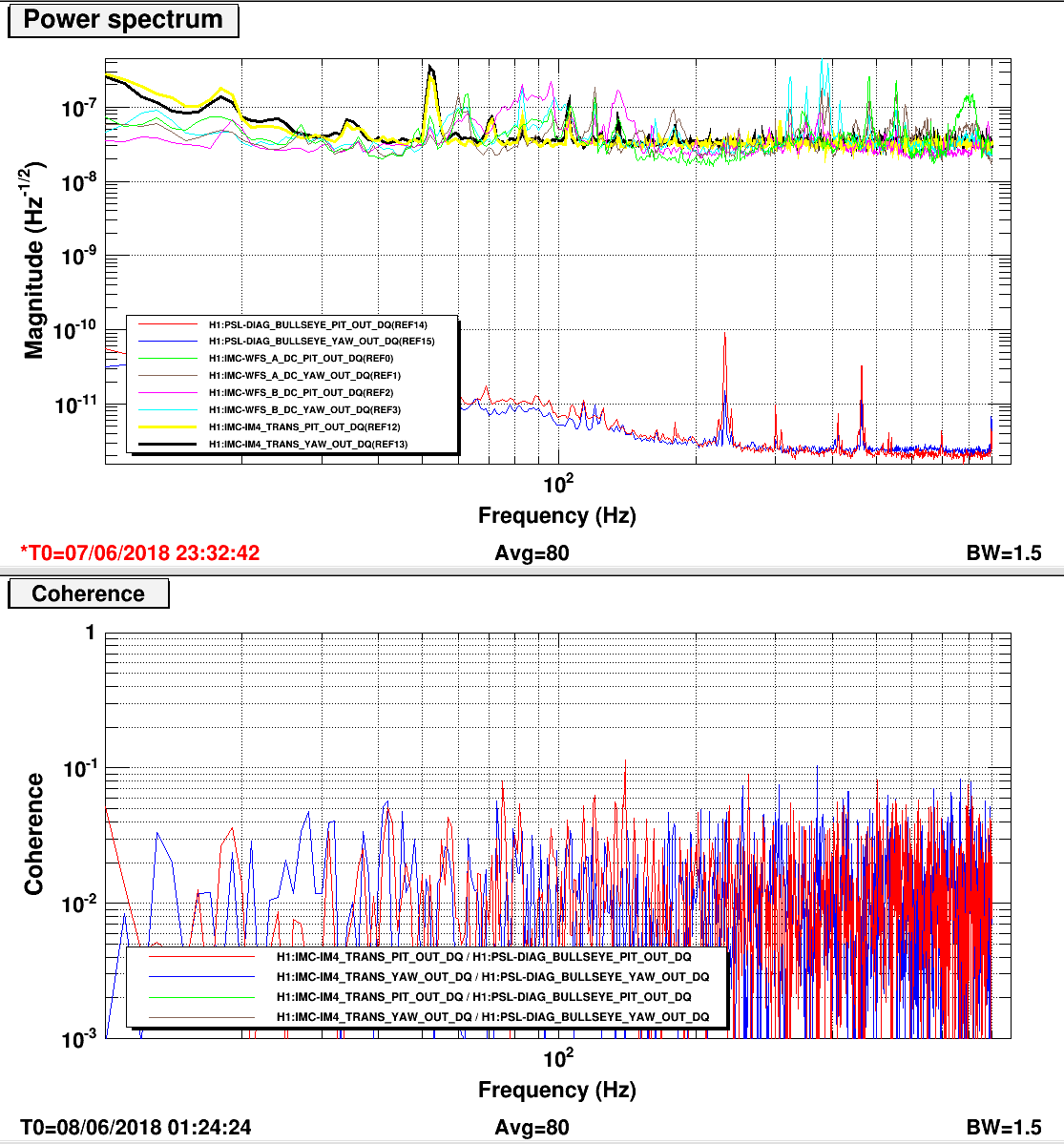
A few comments to have a reference for future memory:
- the IMC REFL WFS now show larger noise than during O2, regardless of the ISS state
- at the same time, when the ISS is properly engaged (first loop only), IM4_TRANS is almost everywhere limited by noise, which is likely sensing. The noise level is higher than the O2 reference, but that might simply be due to the fact that now we took the spectra at 10 W.
- there is low coherence of IM4_TRANS and the WFS signals, but that might be simply due to the poor SNR in IM4.
- we see a few new peaks in IM4_TRANS PIT and YAW, but they are visible also in the SUM signal, so they might be some residual intensity noise
- If we calibrate the WFS signals in the same units as the IM4 TRANS, by taking into account the IMC suppression, we end up with peaks that are much larger than what we see in IM4 TRANS. This is consistent with the hypothesis that all we see in the WFS is generated somewhere on the IOT2L table or nearby, and it's not "real" beam jitter that will go into the IFO.
All those results seem to point in the direction that:
1) almost all the noise we see in the WFS is not real beam jitter that will go into the IMC and the IFO
2) we do not have any evidence that the relevant beam jitter is now larger than during O2
3) but we don't have either any evidence that the beam jitter is significantly better
4) we can probably conclude that the beam jitter is not worse (except for a few peaks that are visible on IM4, but they might be residual intensity noise)