peter.king@LIGO.ORG - posted 07:07, Wednesday 13 June 2018 - last comment - 19:44, Wednesday 13 June 2018(42493)
TTFSS transient signals (part 2)
The following signals were measured directly from the TTFSS.  The input modecleaner was unlocked for this
series of measurements.

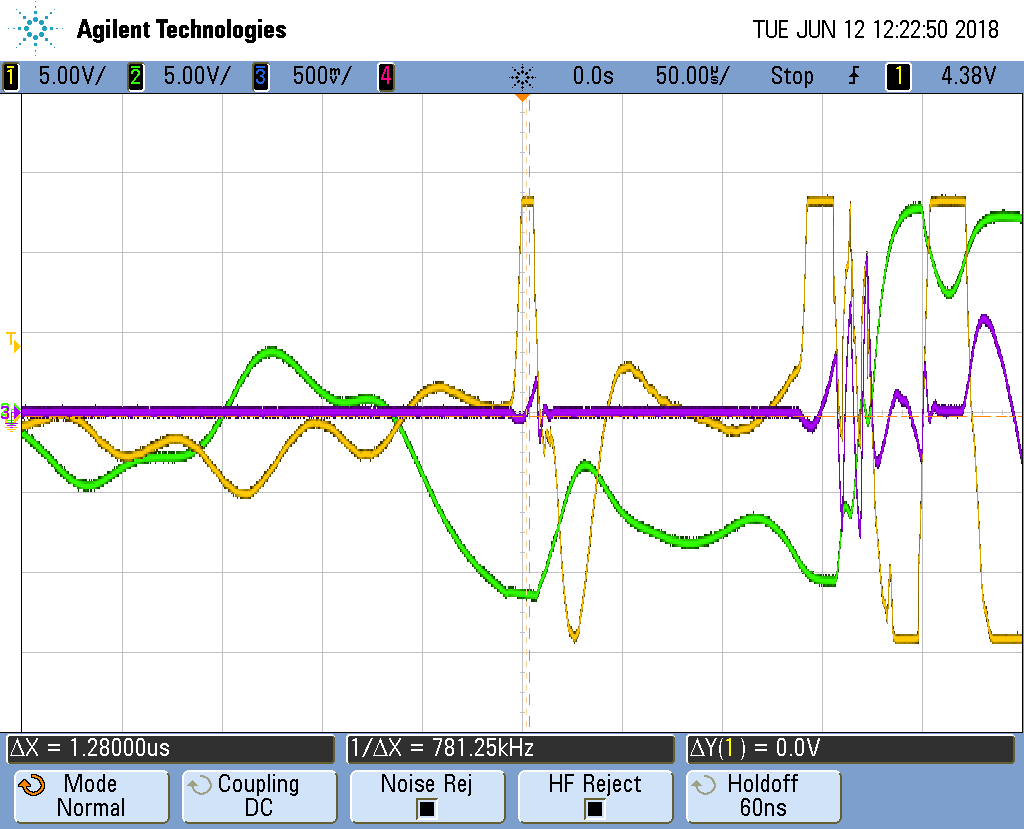
    scope_21.png shows the fastm (yellow), pcm (green) and mixer monitor (purple) signals.  The case of
the front end laser was knocked with a screwdriver.  In this case the NPRO PZT temporarily rails before
a short term recovery followed by it oscillating and saturating continuously.

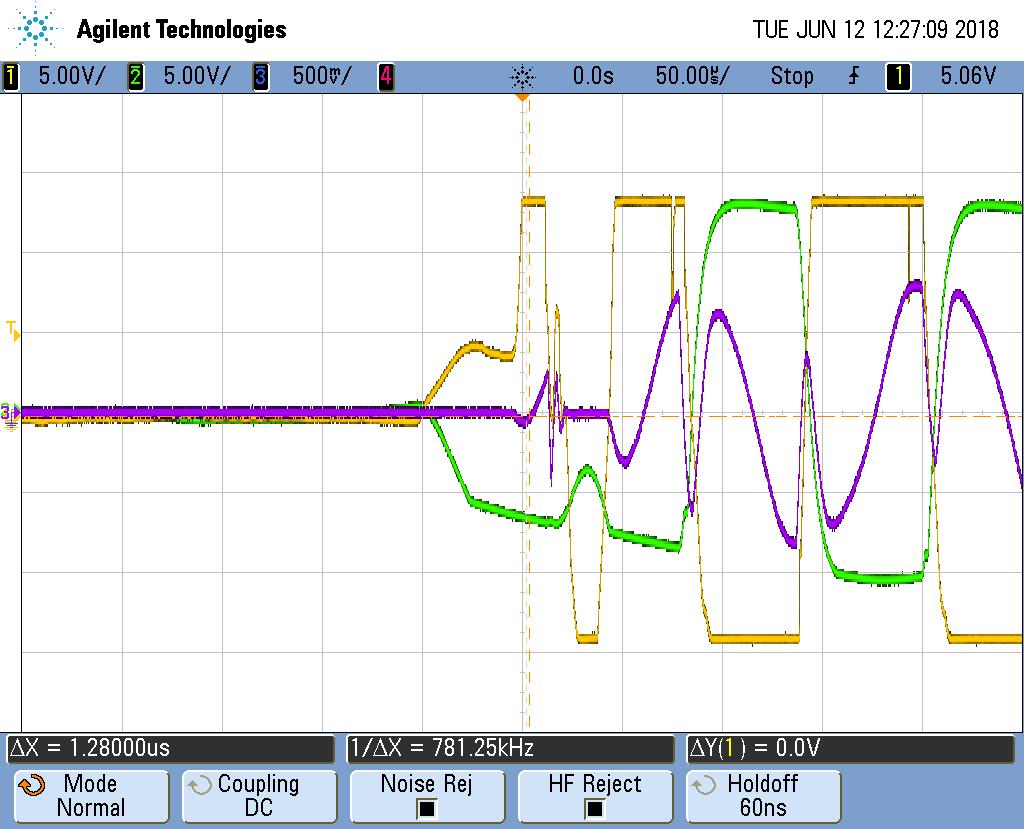
    scope_24.png is the same as described above except that there is no temporary recovery period.

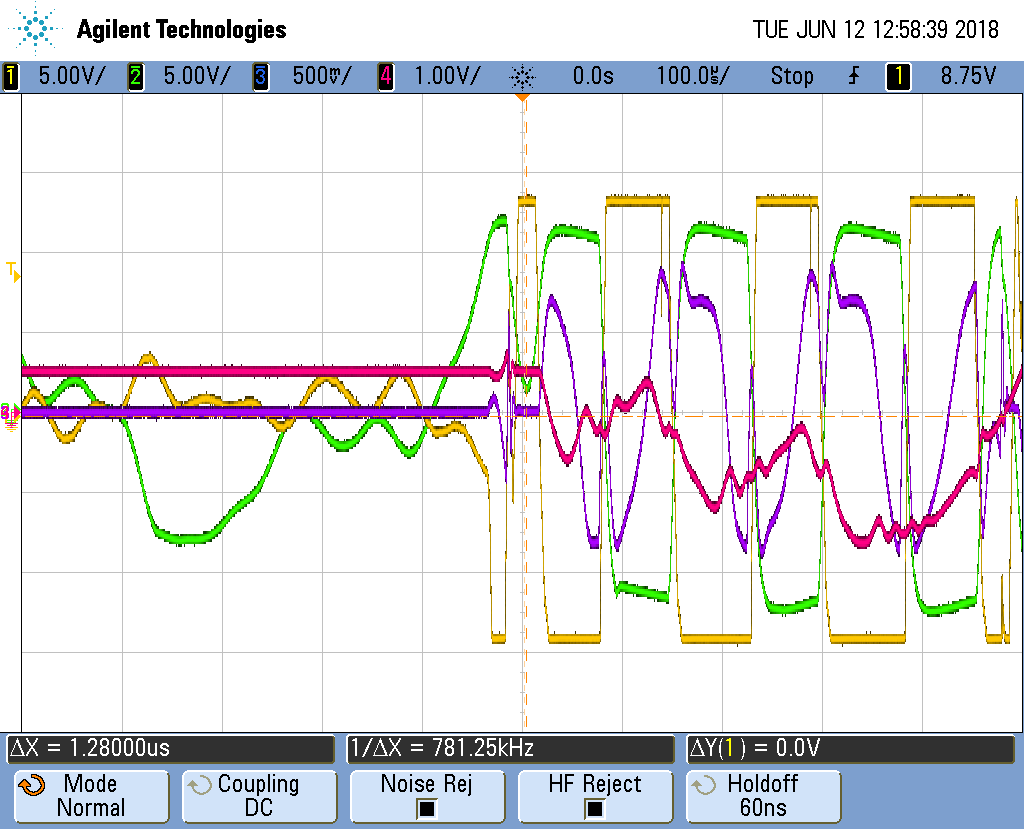
    scope_34.png also displays the output of the common mode servo to the tune input of the VCO that
drives the frequency shifting AOM in the PSL (magenta).  For this particular trace the breadboard that
the TTFSS sits on was knocked with a screwdriver.  Clearly the PZT starts railing before the Pockels
cell follows.

    This scenario would be partly alleviated by giving the PZT more dynamic range by the use of a high
voltage amplifier.  The PZT is capable of handling +100V or more.  The TTFSS only drives the PZT with
+/-10V.


  Rick / Peter
Images attached to this report
Comments related to this report
Correction For the newer Mephisto lasers, as this one is, the PZT voltage limit is +/- 65V.
For older versions it's +/- 100V.
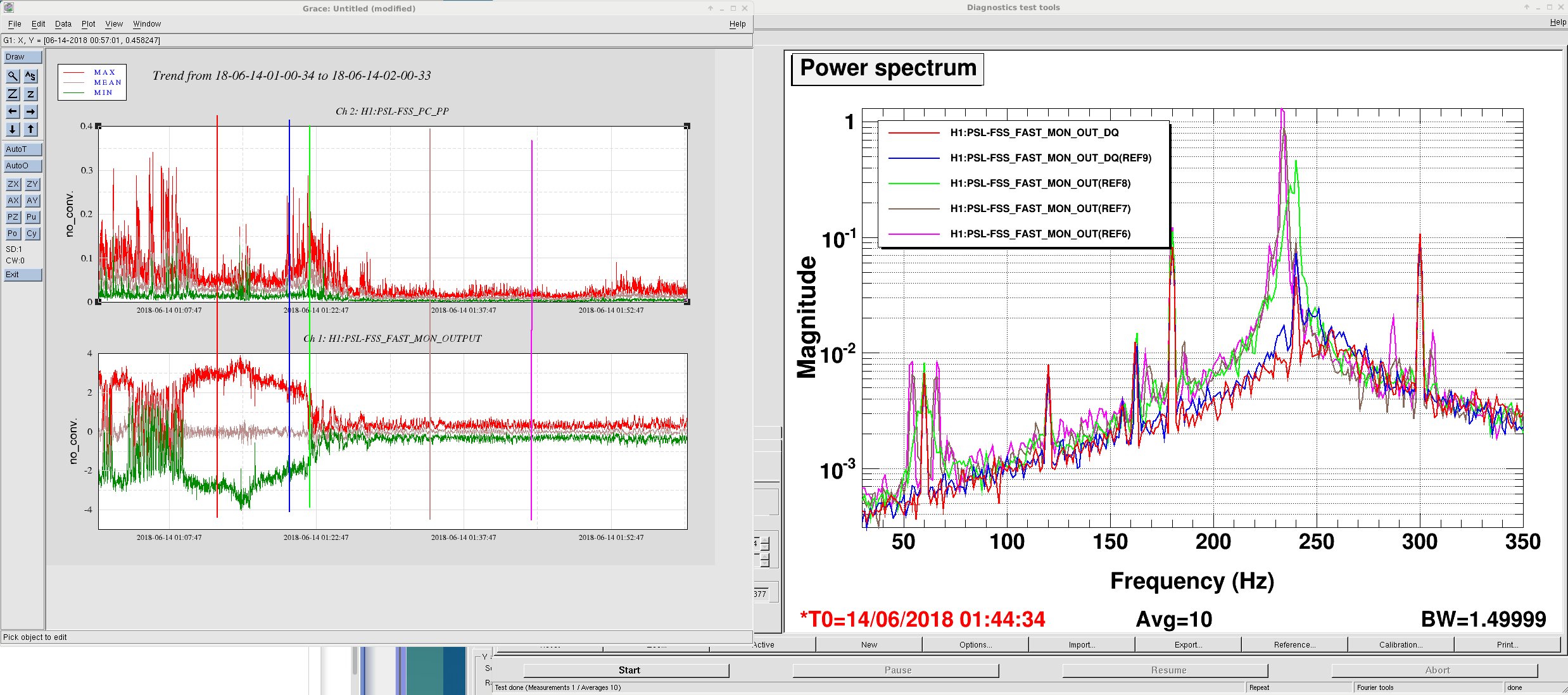
Attached is FSS FAST_MON_OUT spectrum taken at different times over ~30 minutes with the same FSS and IMC settings. From the oldest (pink) to the newest (red) trace, the oscillation changed from terrible to good-ish.
The offending peak started from about 233Hz and gradually moved to higher frequency with smaller amplitude, and in the red trace it's not a peak but a broad bump at around 260Hz or so.
If something is close to instability at ~240Hz or maybe ~65536+-240Hz or even in the vicinity of integer multiple of sampling frequency (65536 Hz), increasing the PZT range might reduce the frequency of lock losses but we'll suffer from huge frequency noise anyway.
Images attached to this comment