
J. Kissel

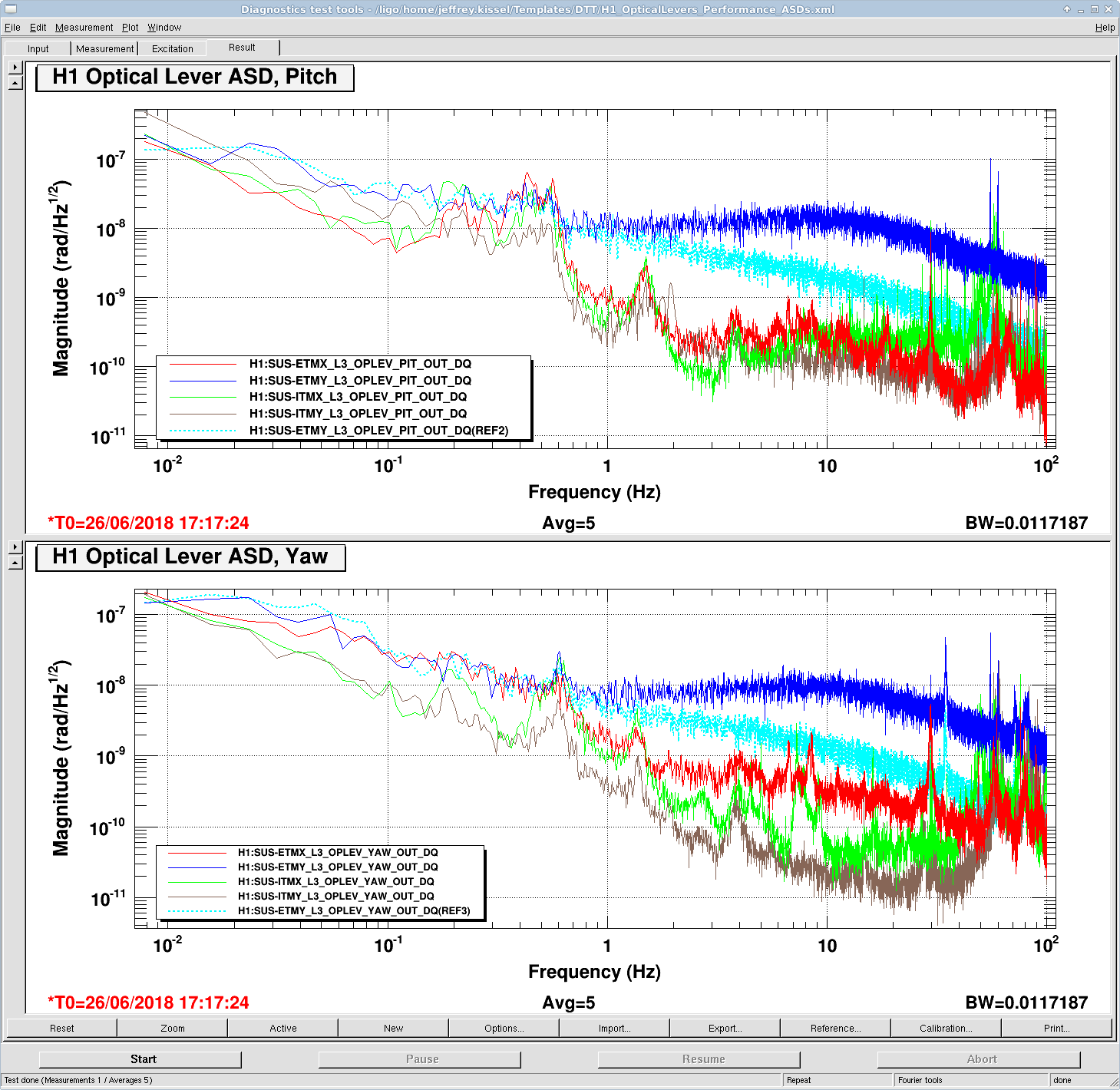
I was looking to do some coil balancing on ETMY this morning, and found that my signal to noise ratio at 4 Hz was very poor. So, I compared the performance of ETMY's optical lever against the three other test masses' lever performance, which confirmed that ETMY's lever is 1-2 orders of magnitude worse than any other optical lever, from 0.5 Hz to 10 Hz. I also found the digital compensation for the electronics in correct (and have subsequently fixed it).

This performance level makes the optical lever pretty unusable for any mid-to-high-frequency characterization. We should consider swapping the previous optical lever back into place. If not, at least consider turning on the third and final stage of whitening.

%%%%% Details %%%%%
Recall that ETMY's optical lever is of a new "glitch free" variety, as installed by Jason and Suresh back in May (see LHO aLOG 42104, and subsequent characterization in LHO aLOG 42249. One can see in the 5th attachment that the performance was comparably bad then as well.

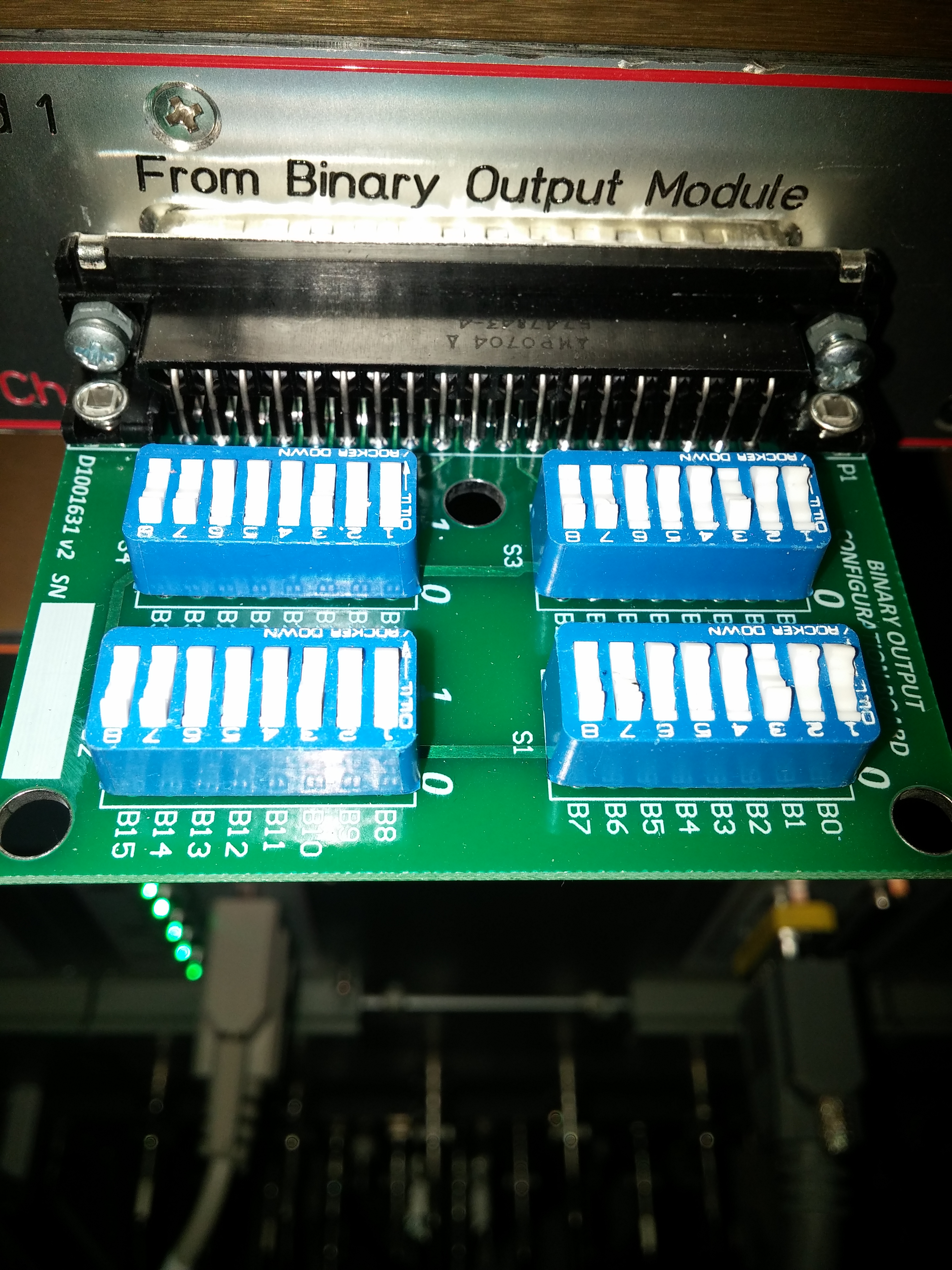
Comparing the newly changed whitening / gain settings on the daughter board against the bit map from when the gains were tune for the original optical lever (see LHO aLOG 14782)
Rack          Board      Optical Lever    Config Board  |------------------ Switch Status ----------------|
              Number                       Installed?    Board    Switch
SUS H1-R2       1          ETMY               Yes          B0       1       +24 [dB]     X            OFF
  (pg 4)                 (pgs 5-6)                         B1       2       +12 [dB]     X            OFF
                                                           B2       3       +6  [dB]     X            OFF
                                                           B3       4       +3  [dB]     X            OFF
                                                           B4       5       (1:10)            X       ON
                                                           B5       6       (1:10)            X       ON
                                                           B6       7       (1:10)       X            OFF
                                                           B7       8       Latch        X            OFF
                                                              Total ETMY TF = (1,1:10,10), G = 0 [dB]
which confirms what the daughter board was before the settings were changed (i.e. 4th attachment to LHO aLOG 42104),
and after it was changed (i.e. 5th attachment to the same aLOG) -- though the (z:p) = (1:10) whitening filters were not mentioned
Rack          Board      Optical Lever    Config Board  |------------------ Switch Status ----------------|
              Number                       Installed?    Board    Switch
SUS H1-R2       1          ETMY               Yes          B0       1       +24 [dB]          X       ON
  (pg 4)                 (pgs 5-6)                         B1       2       +12 [dB]          X       ON
                                                           B2       3       +6  [dB]     X            OFF
                                                           B3       4       +3  [dB]          X       ON
                                                           B4       5       (1:10)            X       ON
                                                           B5       6       (1:10)            X       ON
                                                           B6       7       (1:10)       X            OFF
                                                           B7       8       Latch        X            OFF
                                                              Total ETMY TF = (1,1:10,10), G = (24+12+3=) 39 [dB]

However, after revisiting the digital compensation for the whitening, I found that all three compensating filter modules are on, which is incorrect for the above filter settings.
I've subsequently turned *OFF* the third compensation filter in the H1:SUS-ETMY_L3_OPLEV_SEGn banks.

The attached performance ASDs show the comparison of performance (and shows ETMY in both the incorrectly compensated and correctly compensated filters). The correctly compensated optical lever indeed shows that the correctly calibrated performance is *even worse* than when mis-calibrated, showing an equivalent displacement noise 1.5 to 2 orders of magnitude worse than other test mass optical levers.

Note that all SUS in each chamber were DAMPED in this measurement, and the optical levers were centered on their QPDs. The chamber's seismic isolation configuration was FULLY_ISOLATED.

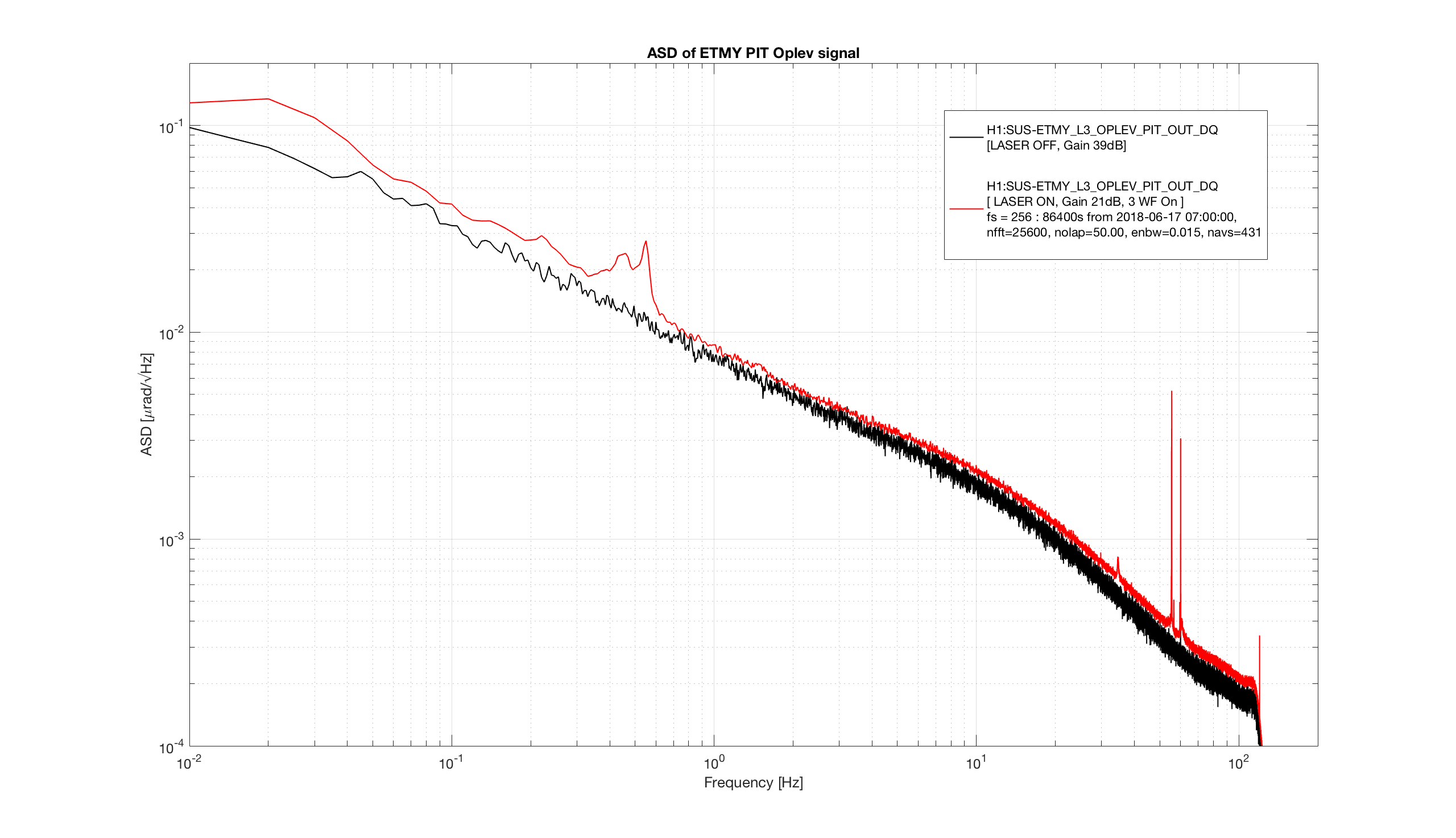
The ETMY oplev is presently dominated by dark noise from the electronics, as can be seen in the figure #1 attached.
Dark noise was low when the Whitening Gain was 0dB (that is when we had the diode laser).
When we increased it to 39dB after installing the glitch-free He-Ne laser, this dark noise floor increased by a factor of 10.
We did the following in our attempts to locate the source of this noise.
1) We lowered the gain to 21dB but it did not change the dark noise level. See attached figure #2
2) We switched on the third whitening stage (and the digital compensation) H1:aLOG:42370 to see if that makes a difference to noise shape or noise level. It did not.
The third whitening stage is still on and has to be compensated with a digital filter module. Or the third whitening stage could be switched off to return to normal configuration.
There is no reason to believe that turning on Whitening Gains should result in high dark noise. There are several other oplevs running with high whitening gains in the range of 9 to 21dB. None of them show high dark noise except ETMY. The source of dark noise in the ETMY oplev electronics seems to be either in the 12 dB or the 3 dB gain stages. Toggling these may show which is the culprit.
I tabulate below the present status of the H1 Oplevs:
Note: Transimpedance has to be updated. I have assumed this value to be the nominal setting.
| Oplev | Transimpedance | W Gain (dB) | W Gain factor | W filt stages |
SUM counts |
Light Power (µW) On QPD |
Spectrum | comment |
| H1:BS | 20000 | 9 | 3 | 1 | 9300 | 143.86 | good | |
| H1:ITMX | 20000 | 21 | 11 | 2 | 27550 | 107.05 | good | |
| H1:ITMY | 20000 | 21 | 11 | 2 | 29950 | 116.37 | good | |
| H1:ETMX | 20000 | 18 | 8 | 2 | 6720 | 36.88 | good | |
| H1:ETMY | 20000 | 21 | 11 | 2 | 1200 | 4.66 | bad | high dark noise |
| H1:PR3 | 20000 | 18 | 8 | 1 | 8.7 | 0.05 | bad | misaligned? |
| H1:SR3 | 20000 | 3 | 1 | 0 | 5 | 0.15 | -- | off |
ADC factor=10V per 2^15 counts
PD Q.eff=0.35 A/W

Thanks for the pointer regarding the 3rd whitening stage!

I've restored the 3rd stage of digital compensation, and accepted the change in SDF.
For the record, investigations / updates on this subject are being tracked in FRS Ticket 10964.