
Sheila, Hang, Jenne, Craig We are still baffled by our low PRMI gains according to POPAIR_B. We decided to do two OMC scans, one single bounce and one with PRMI locked, to get a second opinion of our PRMI alignment.Results
Measured 45 MHz Power Recycling Gain ~ 30 Modeled 45 MHz Power Recycling Gain = 48 This seems to indicate something is weird with POPAIR_B and not our alignment. Big if true.Details
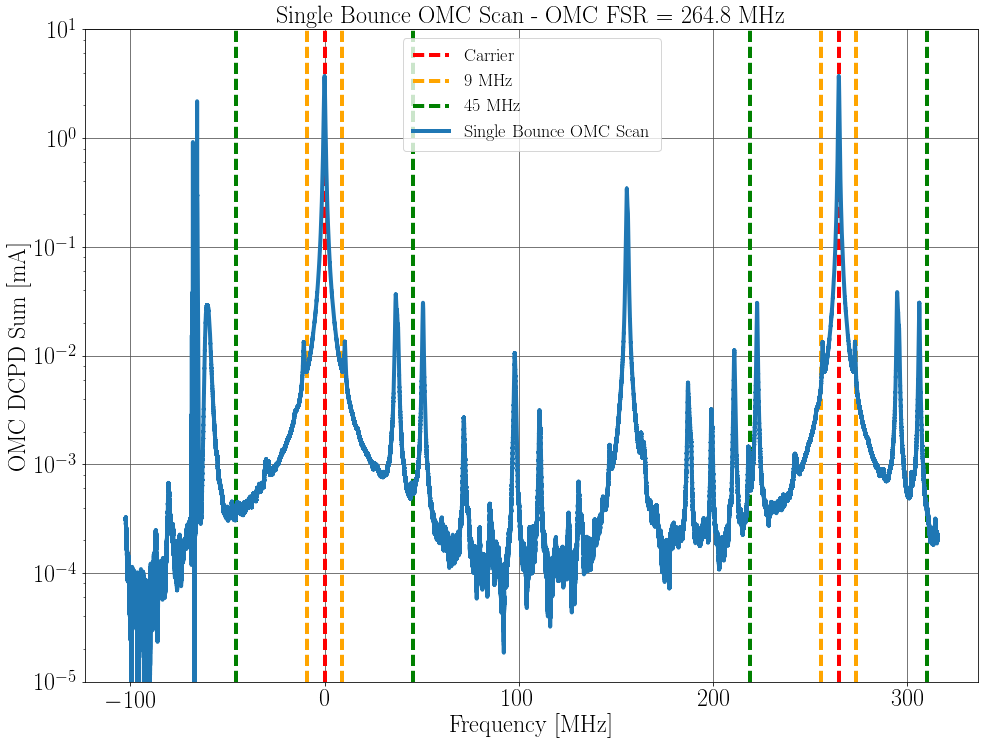
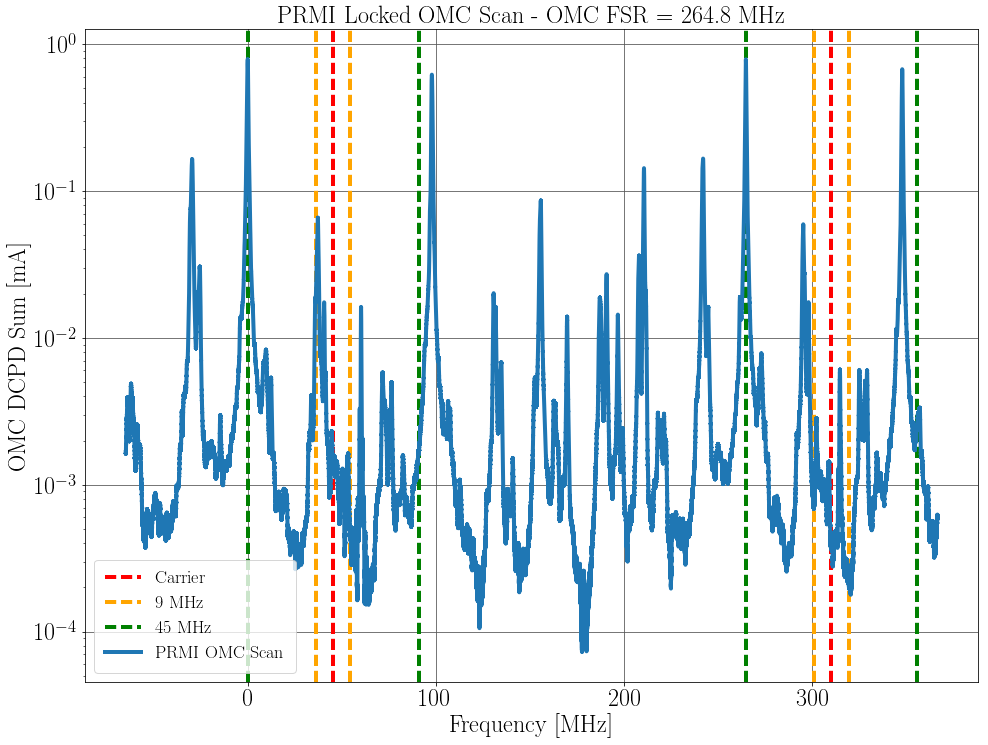
OMC facts can be found from Koji. The most important fact for us is OMC FSR = 264.8 MHz. Plot 1 shows our single bounce OMC scan, while plot 2 shows the PRMI locked scan. We scanned the OMC by moving the PZT rail-to-rail at a constant rate over 200 seconds and read out OMC DCPD SUM milliamps. Both plots are calibrated from time to frequency using the OMC FSR between the two largest peaks. The tall clean peaks in the first plot are carrier, with visible 9 and 45 MHz sidebands. The sideband frequencies don't quite match up with peaks but our PZT isn't exactly linear so close enough. The 45 MHz sideband appeared in the OMC DCPD with 0.03 mA. The peaks in the PRMI locked scan are the 45 MHz sidebands. They are not balanced: 54% of the 45 MHz power is in the lower sideband:PRMI Max OMC DCPD -45 MHz = 0.79 mA +45 MHz = 0.67 mAHere we calculated the PRMI recycling gain from first principles.where
Then we estimated our current recycling gain from the measurement ratio of PRMI 45 MHz/singleBounce 45 MHz:
For single bounce:
Some cavity math:
Yields:
Transmission Ratios:
PRMI -45 MHz/Single Bounce 45 MHz: 25.8351036066 PRMI +45 MHz/Single Bounce 45 MHz: 22.1094695082PRMI Power Recycling Gains:-45MHz = 33.36 +45MHz = 28.55
Conclusion:
There are three ways we can try to estimate PRMI gains: OMC scans (PRMI compared to single bounce), ASC POP sum/IM4 trans sum, and POPAIR B 2F signals. The OMC scan Craig describes above is the most reliable, and indicates that we have been fooled by POP90 into thinking that our recycling gain is much worse than it really is.
Details:
| May 26 2018 2:50 UTC | June 21 2018 10:00:00 UTC | July 25 18:07 UTC | |
| POPAIR B 18 I NORM (counts) | 50 | 27.5 | 7 |
| POPAIR B 90 I NORM (counts) | 75 | 40 | 19.4 |
| IM4 TRANS SUM (uW) | 54.9 | 272.3 | 279.6 |
| ASC POP A SUM/ IM4 TRANS SUM (uW/uW) | 4.7% | 6% | 2% |
| POP 18 demod RF MON (dBm at input to demod) | -49.5 | -41 | -49 |
| POP 90 demod RF MON (dBm at input to demod) | -46.2 | -38.4 | -46 |
ASC POP is unreliable because we are falling off the diodes. We don't want to pico to center ASC POP because this is one of our few alignment references from O2 that has not changed.
Yesterday's OMC scans indicate that we have 62% of the maximum possible build up for 45 MHz. This implies that something has gone wrong with POPAIR B (clipping, or something electrical) between May and now. If we scale the recycling gain measured last night to POP 90 we would infer that the recycling gain ifor 45 MHz in May was 115, or 2.5 times higher than what we think is the maximum possible.
Thanks to Anamaria for suggesting that we try the OMC scans.
Some clarification of the PRMI 45 MHz gain calculation: I referenced Kiwamu and Daniel's aLIGO paper for some numbers, in particular the Schnupp asymmetry of 4 cm. PR2 and PR3 transmission losses were not included. \approx 0.990)



