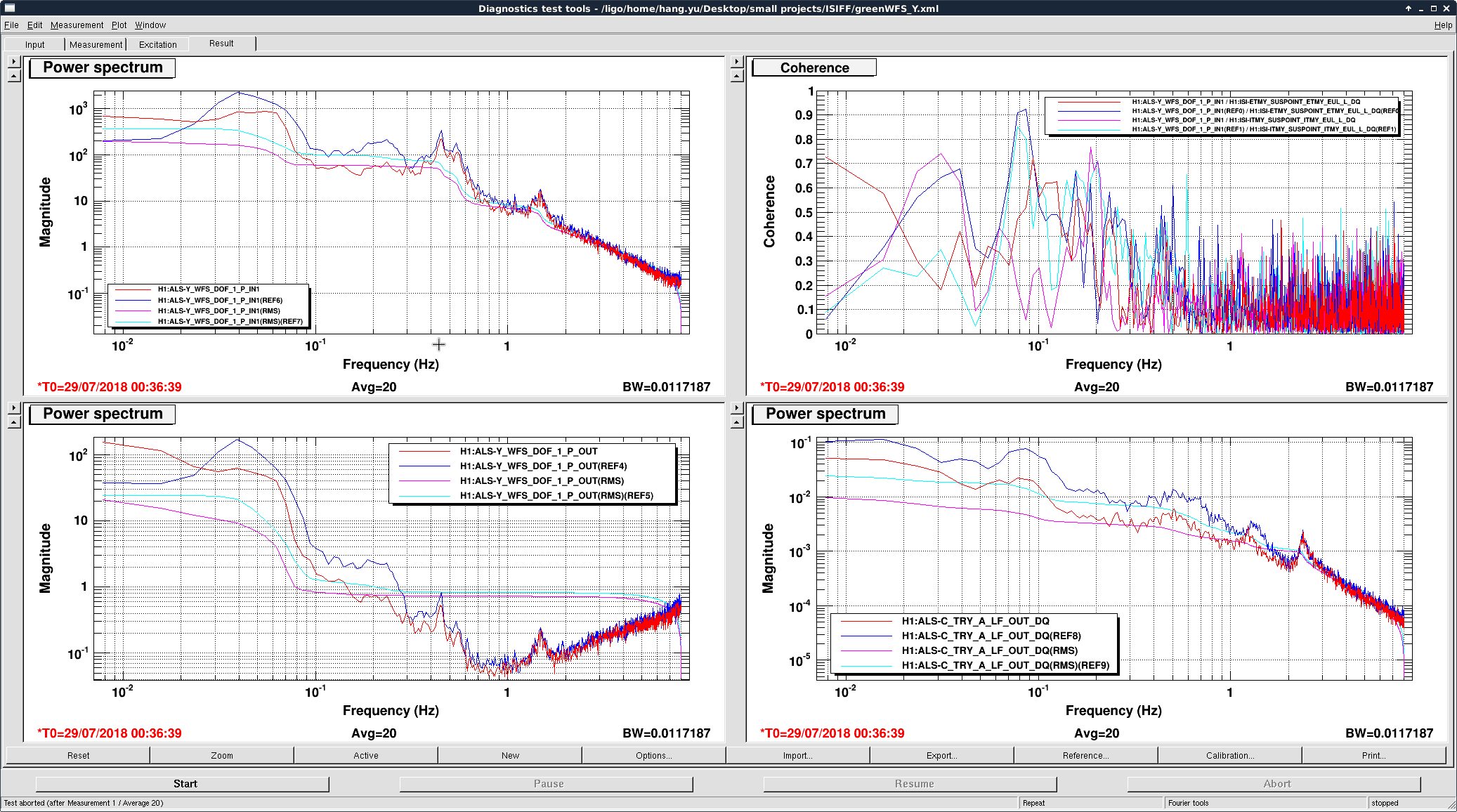
We tried to test the ISIFF (for a nice summary, see LHO:43020) performance with the ALS holding YARM locked. The Guardian state for the test was 'LOCKED_SLOW_W_GR_WFS_PUM'. In terms of the angular control, this state used the green wfs to control both the ETMY (actuating on M0 + L2; the UGF was <~ 0.1 Hz and was limited by the pitch-yaw cross coupling in the sensing side) and TMSY (even lower bandwidth). The measurement was done during an earthquake with the peak velocity along Y direction reaching ~ 1 um/s.
In the first attached image, the blue and cyan traces (the references) were measured without ISIFF, and the red and pink ones were with the IFISS on. The panels were: top-left: error point to the green WFS dof1 (which got feedback to ETMY), bottom-left: ctrl output of dof1, top-right: coherence between the error point and the ISI sus point, bottom-right: RIN in the YARM.
Some conclusions:
1. The ISIFF seemed to do a decent subtraction of the seismic motion in the 0.2-0.6 Hz band, covering the microseismic band and the suspension resonance. This did not significantly reduce the green ASC ctrl nor the residual rms because of the low bandwidth here. After transition to DHARD/CHARD loops with ~ 2-3 Hz bandwidth, the <0.1 Hz motion should be trivially suppressed and then reducing microseismic should become significant.
2. The ISIFF DID NOT work well < 0.2 Hz. In fact it made the residual angular motion worse in this earthquake band and thus a larger RIN fluctuation in the cavity. The sub-0.1 Hz improvement in the residual motion as well as in the RIN shown in the first image was a bit misleading because I used passive data and the ground just became quieter for the FF-on measurement, see the second attached plot. This was mostly my fault not carefully tuning the FF TF at this band. It should not be an issue in the D/CHARD loops because of the high bandwidth there. However, in the lock acquisition when the arms were held by the ALS with low bandwidth ASC, it could make the acquisition process harder.
I will try to retune the filters to see if we could make the subtraction work for a broader band. If not, we might only turn on the FF after we engage the main arm ASC.