Daniel, Haocun, Sheila, Nutsinee
Good news:
1) SQZ pump laser-to-PSL locking (with TTFSS) recovered. The alignment seems to have drifted over the past couple of months (probably since I left last time). With a bit of a tweak the beat note is back to -8dB. One of the beams was clearly larger and fuzzier than the other (I think this was the pick off beam from the pump laser, not the PSL). To get much more out of it we'd have to come up with a new mode matching solution.
2) OPO IS LOCKED! We feed the signal from fast path out of the common mode board to a VCO that's connected to LO input of the TTFSS. The signal from slow path now goes to OPO PZT1. We were afraid that VCO may not have enough range (it probably would have done just fine without). The loop hasn't been characterized or optimized yet.
Not so good news:
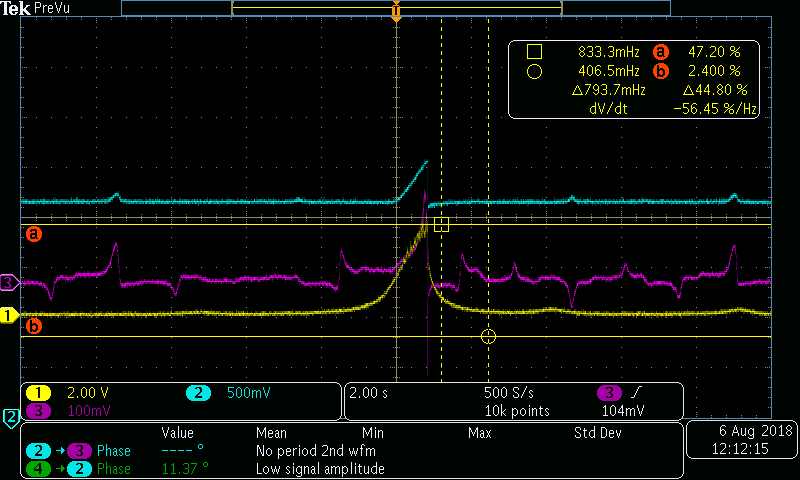
OPO scan looked funny on green. The transmission would peak up (or dip down on the refl) and then suddenly dropped (see attachment 3). So the trans, refl, error signal scans looked very asymmetry. This asymmetry also depended on whether you are ramping the PZT up or down (0-100V or 100V back to 0, sharp drops can happen on the left or the right of the peak). When the power was low enough this asymmetry disappeared (see attachment 1). The asymmetry started to show at 3mW green input to the fiber coupler on ISCT6. An idea we have (well, Daniel's idea) for what could have caused this was that the green heats up the crystal, increase the cavity length, and because the PZT would either increase for decrease the length of the cavity, we may have a sudden drop when the PZT is working against the crystal (in terms of getting the resonance) and suddenly cut the resonance short. This idea can be easily tested once we have red and green resonances lined up by tweaking the crystal temperature (next week to-do list). If the sharp drop was due to the temperature once the red resonance is overlapped with green we should see the cut off in red as well.
Note: I have a temporary set up on SQZT6 to look at the seed trans on the temporary thorlabs diode (I think this was a PD100A) and the camera. This set up was for the dual-resonance adjustment next week. Please do not disassemble.
Attachment:
#1 OPO green scan given 1mW input to the fiber coupler on the ISCT6
#2 OPO green scan given 3mW input to the fiber coupler on the ISCT6
#3 OPO green scan given 13 mW input to the fiber coupler on the ISCT6
#4 OPO seed scan given 2mW input to the fiber coupler on the ISCT6
#5 OPO locked on (pump) 00
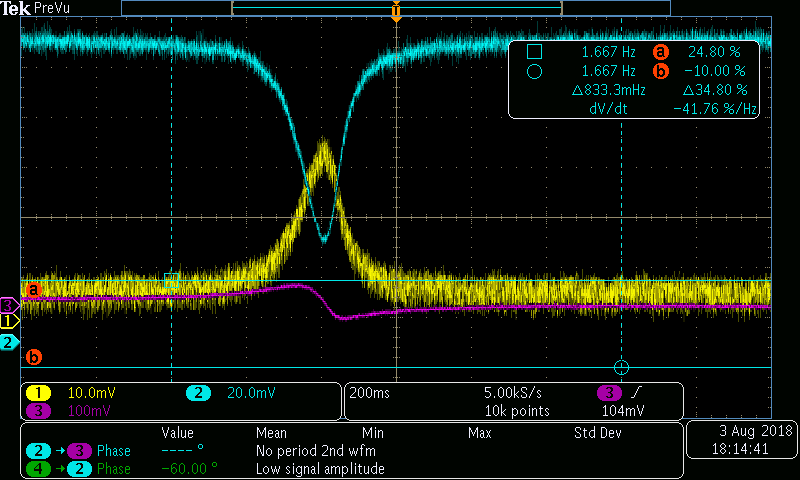
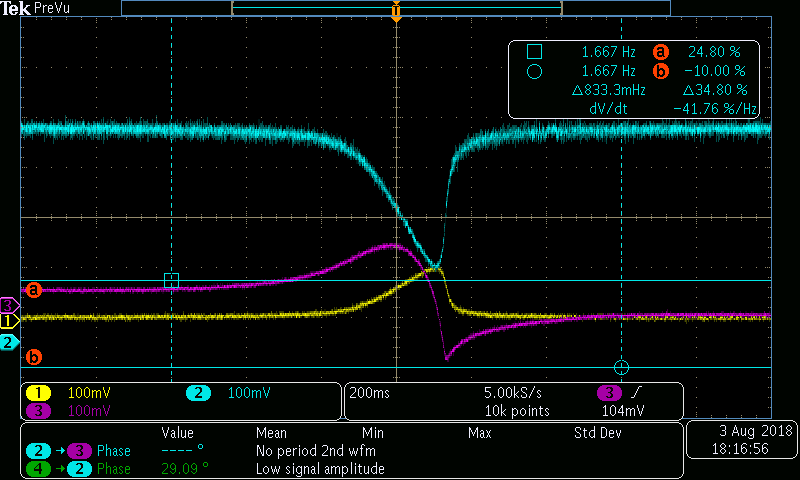
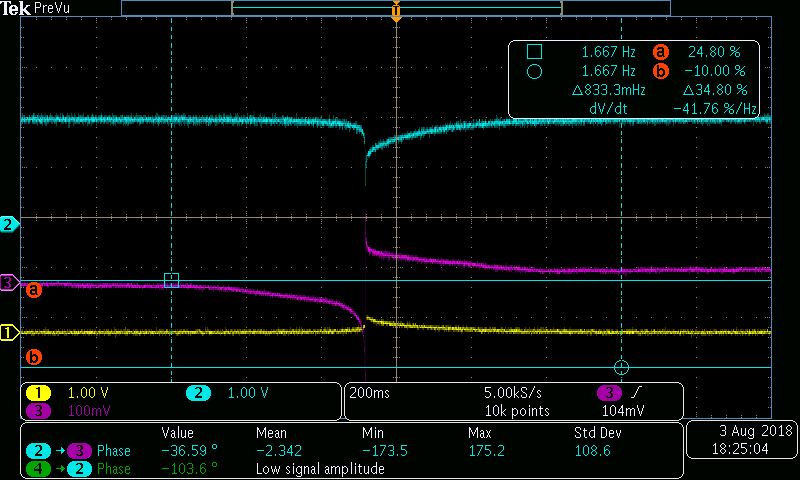
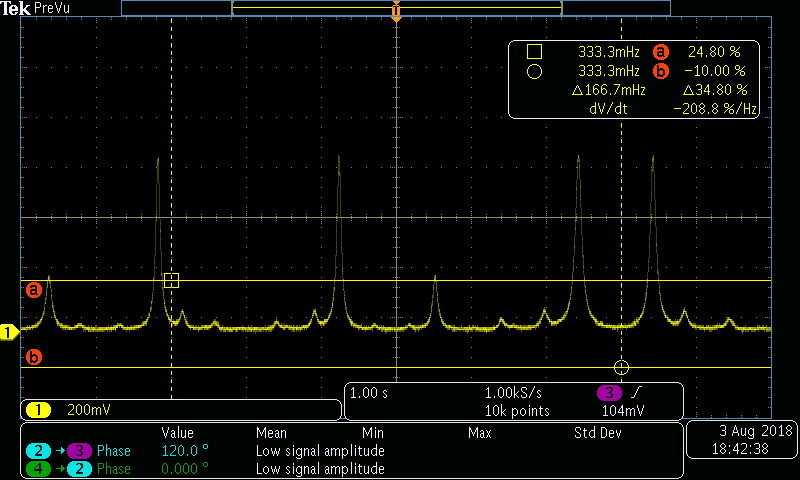

The hypothesis that the green absorption/crystal temperature causes the assymetry in the scan can also be tested by changing the scan rate. (The rate at which the green absorption changes the cavity length should be mostly independent of the scan rate. Haocun effectively did this test by moving the PZT offset slowly by hand to try to get the OPO to sit on resonance. I think that when she did this the transmitted power dropped off about as suddenly as during a PZT scan, but it might be worth a more careful test to compare the timing.
Haocun, Sheila, Nutsinee
We moved the crystal temperature such that red and green are co-resonance but had no nlg effect. Red resonance seemed to be cut short as well. We begin to believe this crystal heating theory now. Haocun is working on this length<->temperature model hoping to explain what we're seeing here.