J. Kissel
Using the lock stretch that Sheila called out in LHO aLOG 43263, I gathered data that shows the new violin mode forest after we've replaced ETMX, ETMY, and ITMX (with ITMY been exposed to air for ~9 months, which undoubtedly also changes the violin mode frequencies). Attached are comparisons of the Fundamental (~500 Hz), 1st Harmonic (~1000 Hz), and 2nd Harmonic (~1500 Hz) DARM ASDs from O2 (after the July 2017 EQ) and this most recent lock stretch.
I've begun to update the LHO violin mode table (Violin_Mode_Table_v2) in prep for identification of this new forest. I've used the in-air data from LHO aLOGs 40525, 42180, 38857.
So far, I can identify 29 of the fundamental 32 modes, with a 2 mHz resolution. They're tabulated below (and not yet in the table), since I've not yet associated them with a test mass (though some appear to be "obvious" given the large separation).
In hopes to identify the mode Sheila calls out as the worst, I've pushed a 503.085 Hz filter to all new test masses, on MODE 1. This way when we do get a decent lock stretch, we can identify the mass "passively" by turning on the filter with some small gain, to see on which test mass we get action. As before, we'll started by assuming the mode is controllable by driving in Pitch.
| Frequency | Potential Match w/ in-air |
| 501.553 | IY |
| 501.628 | IY |
| 501.692 | IY |
| 501.755 | IY |
| 502.784 | IX |
| 502.909 | IX |
| 503.085 | EY / IY |
| 503.198 | EY / IY |
| 503.676 | EY / IY |
| 503.733 | EY / IY |
| 504.143 | EY / IY |
| 504.176 | EY / IY |
| 504.606 | EY / IY |
| 504.719 | EY / IY |
| 504.850 | EY |
| 504.889 | EY |
| 504.942 | |
| 505.077 | |
| 505.186 | |
| 507.360 | EX |
| 507.493 | EX |
| 508.844 | EX |
| 508.938 | EX |
| 510.714 | EX |
| 510.723 | EX |
| 511.180 | |
| 513.405 | |
| 516.678 | EX |
| 516.778 | EX |
In order to gather this data, I just used the standard violin mode templates from O2 (see LHO aLOG 37921), which are linked off of the VIOLIN MODE monitor MEDM screen.
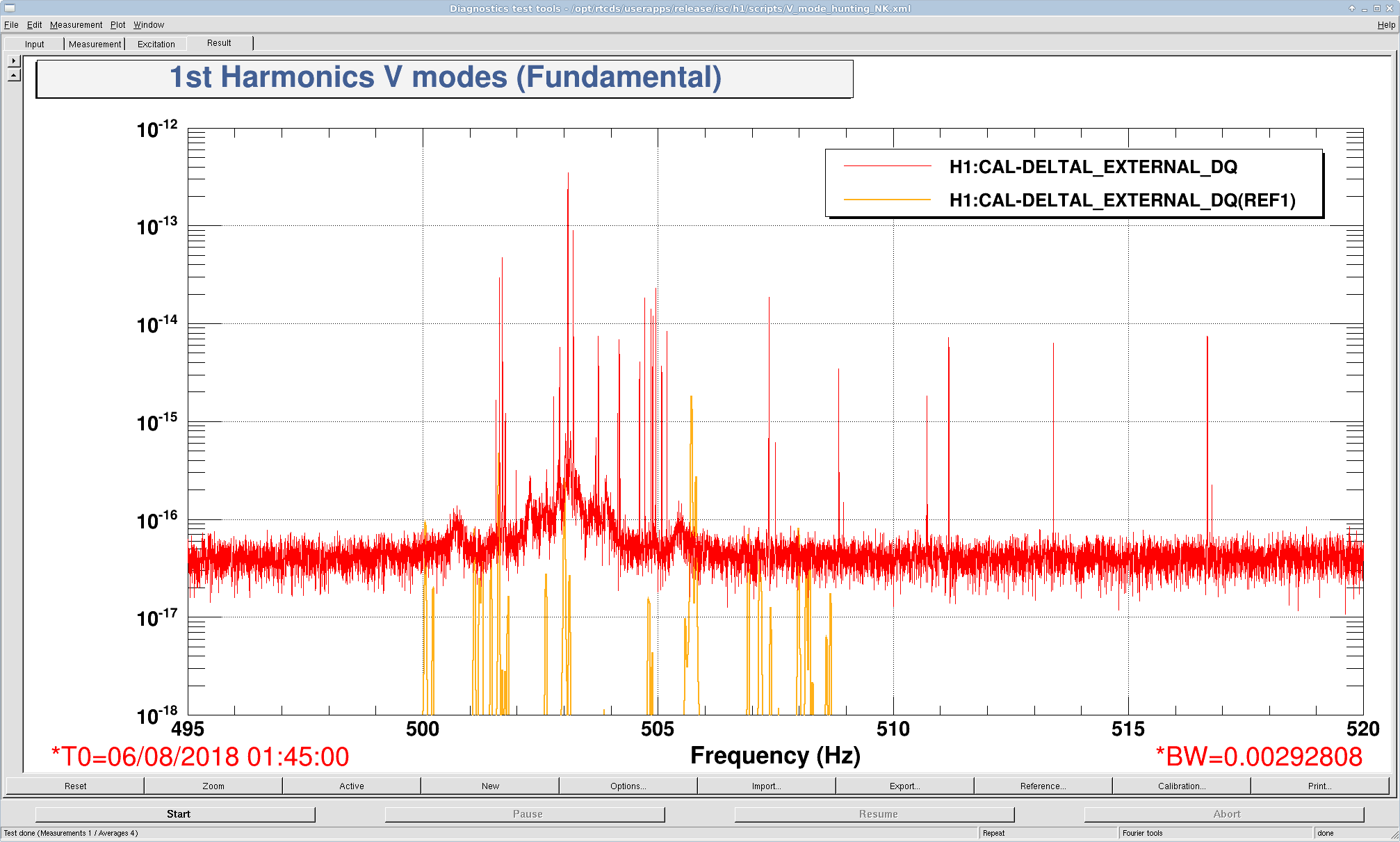
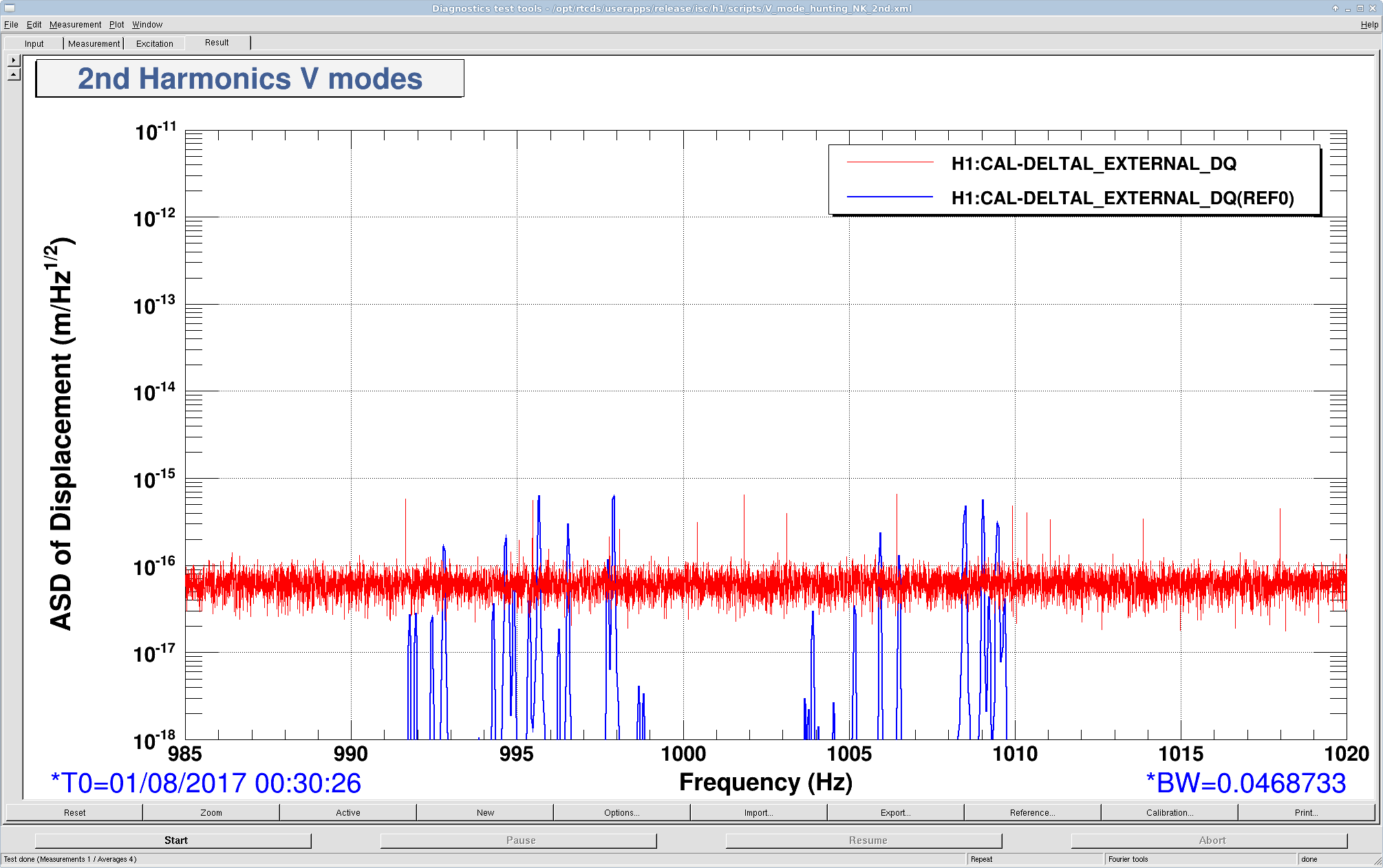

Remember, we tried to separate the mode frequencies between test masses, and cluster a given test mass, to make them more easily identifiable (see E1700342, G1701332), but the reality of implementing such a system didn't work out as planned (an already minimal supply of fibers, few sets of fiber breakages, changes in frequency after welding and annealing, etc.). See some details in LHO aLOGs 41216, 40292, and 38965, but most my memory of the failure of the plan is verbal from telecons -- perhaps others can retrace the steps.
I have started adding some violin mode bandpass filters for ETMX, but have not had a change to test them out yet.
I added bandpass, +60, -60 degree phase shifts for 508.36 Hz, 508.844 Hz, 510.714 Hz and 516.678 Hz, in the filter banks under Mode2, Mode 11, Mode 12, and Mode 13 respectively.
The 503.085 Hz mode is on ITMY, and has been damped with the MODE1 filter, with -70 gain, no extra phase ( this can definitely be tuned in the future though), and feedback to pitch.
Note: This comment should have appeared after Georgia's comment below.
The link to the wiki page above isn't working. Here is a link : Violin mode table v2
504.891 Hz is on ITMX, can be damped with a gain of -3 and a phase of -60 degrees. (FM1 in ITMX mode 1 is a 50 mHz wide filter centered at 504.891, this is narrower than our other filters because there is a nearby mode at 504.953 Hz.)
Unfortunately it looks like we have two modes on ITMY that are only separated by 4 mHz. I was able to damp a mode at 501.629 Hz on ITMY with the same MODE4 filter Georgia used to damp the mode at 501.625Hz, but with a negative gain and +60 degrees of phase. I was suspicious that these could be the same mode, so I compared a spectrum with a resolution of 2 mHz from 2:42 UTC today (before Georgia damped ITMY) with the lock at 5:09 UTC, and it looks like they are actually two modes separated by about 4mHz. (Screenshot)
To deal with this, I created a filter called doublet in MODE4 which has 0dB of gain and a phase of -31 degrees at 501.624 and -3dB with -147 degrees at 501.628 Hz. A brave soul might be able to engage this filter with the bandpass that Georgia made earlier and no additional phase shift to damp both modes at once.
Edit: I got to try the doublet filter but it isn't very effective at damping the higher frequency mode which is rung up at the moment.
I also tried to damp 501.755Hz, but I don't think this is on ITMY. I copied my filter to ETMX MODE3, and tried 2 phases of pitch, but we lost lock before I could try yaw or longitudinal for ETMX.


I added a few more violin mode damping filters for ITMY. I promise I'll update the wiki table with this information soon.
The 503.198 Hz mode (MODE5) is on ITMY YAW, and was damped easily with -10 gain (haven't optimised any of the phases yet).
I tried to tackle the ITMY forest around 501.6 Hz but had trouble with cross coupling, accidentally ringing up neighbouring modes. I narrowed the filters and had some success damping
- The 501.625 Hz mode in pitch with a gain of 15 (filter bank MODE4)
- The 501.555 Hz mode in yaw with a gain of 20 (filter bank MODE6)
- The 501.692 Hz mode had some success with a gain of -5, before we dropped lock for other reasons. Will come back to it (filter bank MODE7).
J. Kissel

We don't yet have enough long lock stretches to get more precise than 0.005 mHz resolution, but I attach a few 1 mHz BW ASDs in the recent lock stretches that Sheila mentions (and some that I've found / reported),
    - 2018-08-21 07:25 - 07:54 UTC,
    - 2018-08-21 02:43 - 03:11 UTC,
    - 2018-08-20 21:50 - 22:25 UTC,
    - 2018-08-15 19:19 - 20:48 UTC,
where, because the last from several days ago, was 1.5 hrs, I was able to get a 0.5 mHz BW ASDs.

The message -- I can concur with Sheila's assessment that these two modes at 501.625 and 501.629 are 4 mHz apart -- however, only in 1 of the 4 measurements is the lower, 501.625 mode rung up. Thus, I think (thus far, we're not yet on DC readout) this is a weakly coupled mode that was rung up by our damping exploration attempts, so if we can design a filter that only tackles 501.629, then we might be OK. (It may not even be ITMY, but the 4 mHz mode separation does smell very much like a barely-elliptic mode splitting.)

I think Sheila and Georgia are on the right track of refining the band-pass filter to be that much more narrow. Mode frequencies for these violins are stable to temperature and test mass alignment at the ~10 microHertz level, so I think plant inversion -- or at least a very narrow (0.5 mHz) band-pass -- might be OK (see second attachment; figure 2 from G1601163 and/or G1700038).


Updated the table with some gains and phases for modes 504.606 Hz, 504.719 Hz, 504.85 Hz, all on ITMX and requiring low gains (<~5). And 504.953 Hz on ITMY (high gain, -30).
Posting this screenshot as a message to all the other v-modes out there. Blue reference is before damping, red is after.

In response to Sheila's request to compare the two following locks:
Aug 21 2018 02:42:00 UTC > Aug 21 2018 03:11:00 UTC [1218854538 > 1218856278]
Aug 21 2018 05:09:00 UTC > Aug 21 2018 05:29:00 UTC [1218863358 > 1218864558]
I ran 1mHz resolution PSDs. Results are below.
LOCK Aug 21 2018 02:42:00 UTC
Freq. [Hz] SNR
501.3750 77
501.5556 33815
501.6251 10114
501.6913 2815
501.6972 184
501.7553 181884
501.8750 76
502.7849 21376
502.9092 185016
503.0863 111095
503.1984 8470
503.6779 36286
503.7335 82344
504.1442 1609
504.1778 6259
504.6075 19039
504.7205 103589
504.8516 8474
504.8900 26733
504.9529 33514
505.0786 29540
505.1875 230981
507.3609 143884
507.4945 1342
508.8452 783438
508.9403 590
510.7142 915952
510.7255 268
511.1820 147617
513.4059 398372
513.5119 159
516.6806 693925
516.7800 5140
Lock Aug 21 2018 05:09:00 UTC
Freq. [Hz] SNR
501.5540 147
501.6293 478058
501.6925 2127
501.7553 612669
502.7849 17214
502.9091 183754
503.0860 50717
503.1984 88
503.6779 48336
503.7335 45705
504.1442 5292
504.1778 17130
504.6075 45363
504.7205 529860
504.8516 386988
504.8900 1223
504.9529 534100
505.0786 50532
505.1875 238858
507.3609 269516
507.4945 1032
508.8452 459774
508.9404 271
510.7142 492155
510.7254 108
511.1819 184454
513.4059 193424
513.5119 159
516.6806 423031
516.7799 4596


I am sorry I have just noticed these round of violin modes alog entries.
I will investigate further but as a quick comment to add to the comments above:
Jeff suggested that the frequency separation of 4mHz of the two modes may indicate frequency splitting of modes associated to the same fibre. However based on the data we have from all fibres of both LIGO detectors this is very improvable. Frequency splitting observed so far is on the order of tens to hundreds of mHz, there only one case of about 1mHz separation at LLO ITMX and it is not certain to be associated to the same fibre.