Summary:
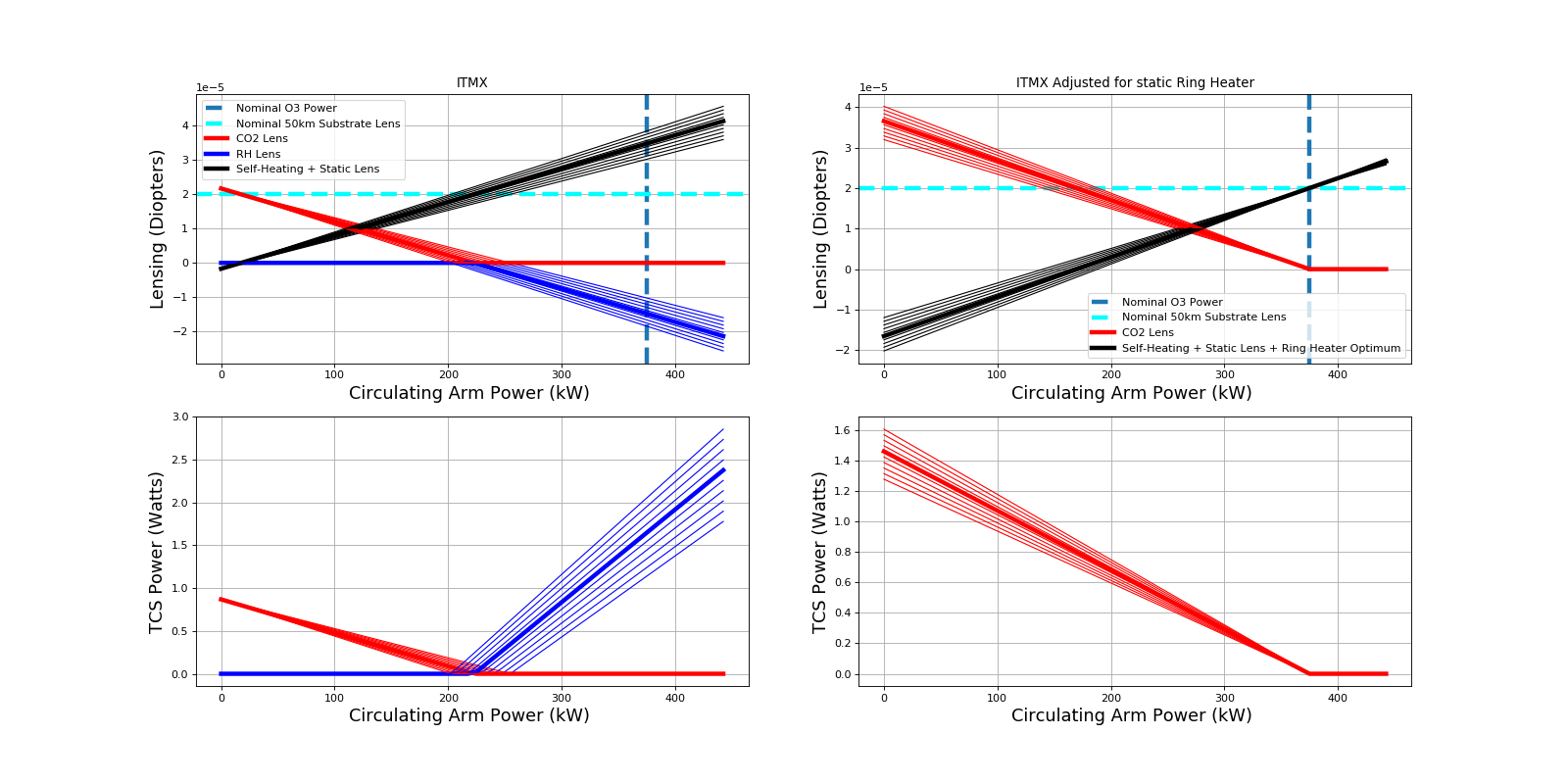
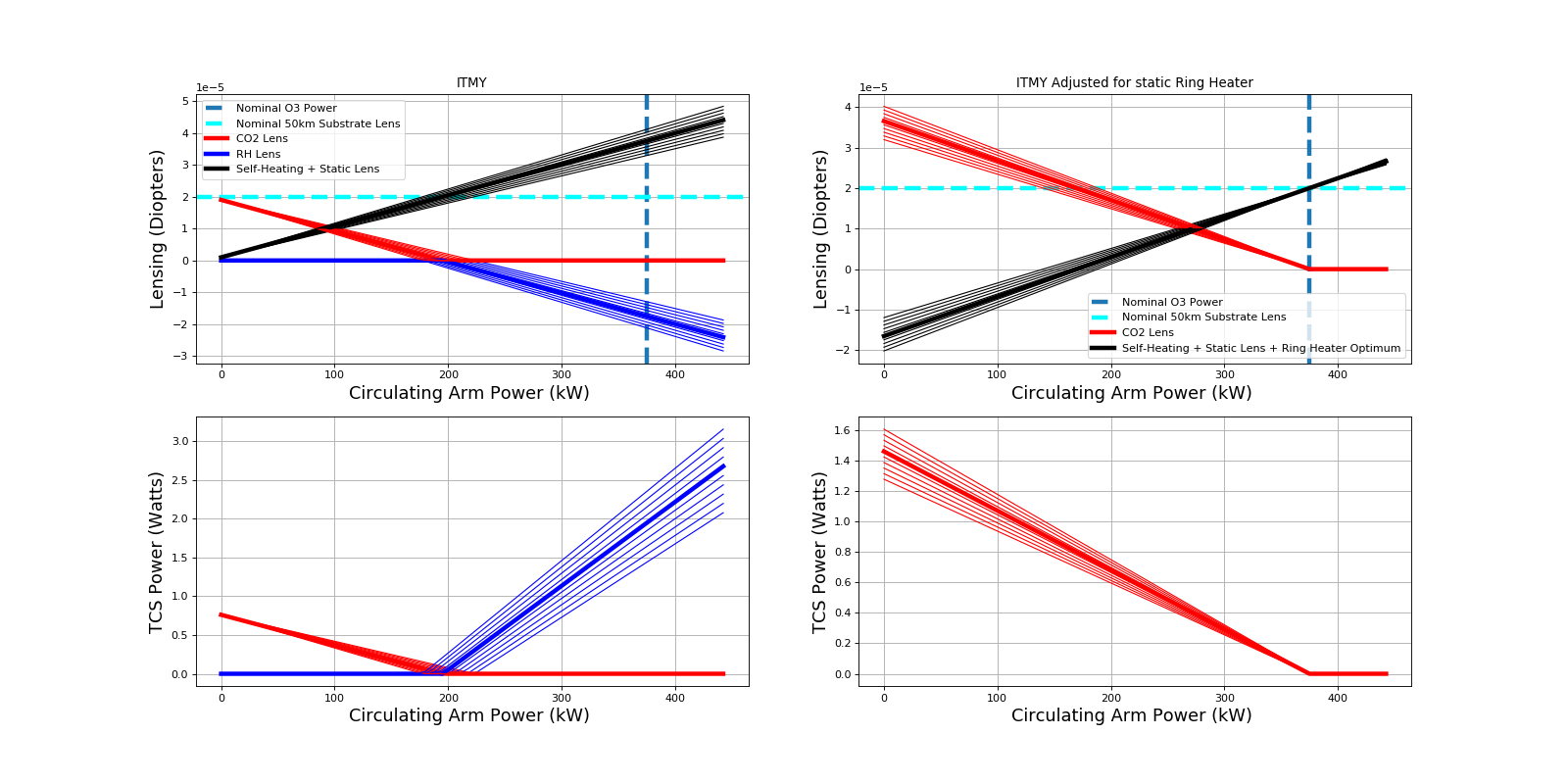
The nominal substrate lens is 50km and a combination of ring heaters and CO2 lasers are used to achieve this level while the interferometer powers up. At the operating point with 50 Watts of input power (375kW of circulating power), the required substrate lensing will need to be achieved with the ring heaters. However, because the thermal constant for the ring heaters is very slow, they will need to be turned on all the time. The CO2 lasers will have to compensate for the static lens, the self-heating lens, and the constant ring heater lens as the interferometer powers up. Using the radii of curvature from the galaxy page as well as the calibration parameters from the TCS_IFO_SIM MEDM screen, a decent starting point for the ring heaters and CO2 laser is given by:
ITMX |
|
Nominal Ring Heater Setting |
1.646 W |
Nominal CO2 Pre-heating power |
0.586 W |
ITMY |
|
Nominal Ring Heater Setting |
1.945 W |
Nominal CO2 Pre-heating power |
0.586 W |
ETMX |
|
Nominal Ring Heater Setting |
0.92 W |
ETMY |
|
Nominal Ring Heater Setting |
1.46 W |
Details:
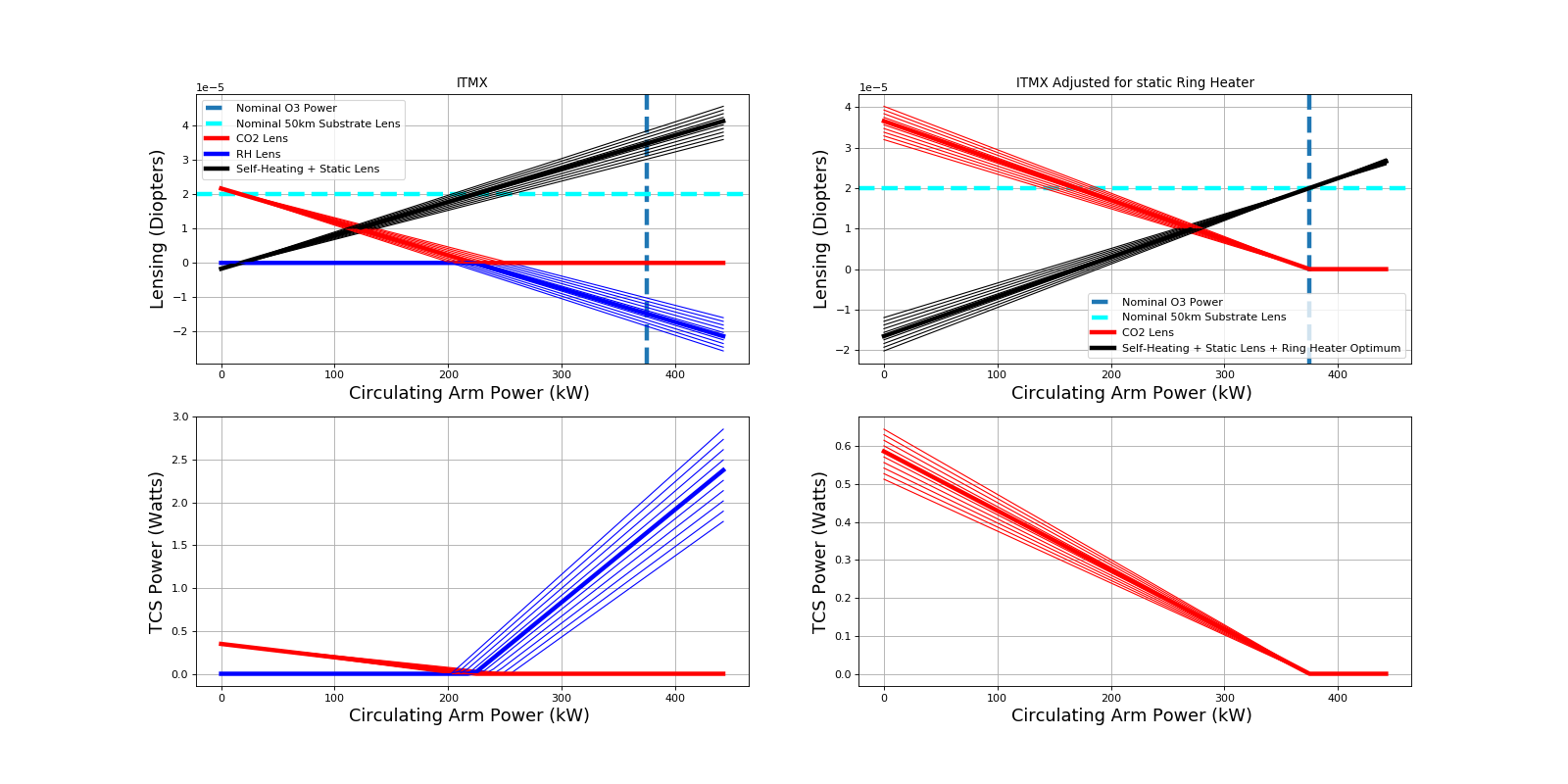
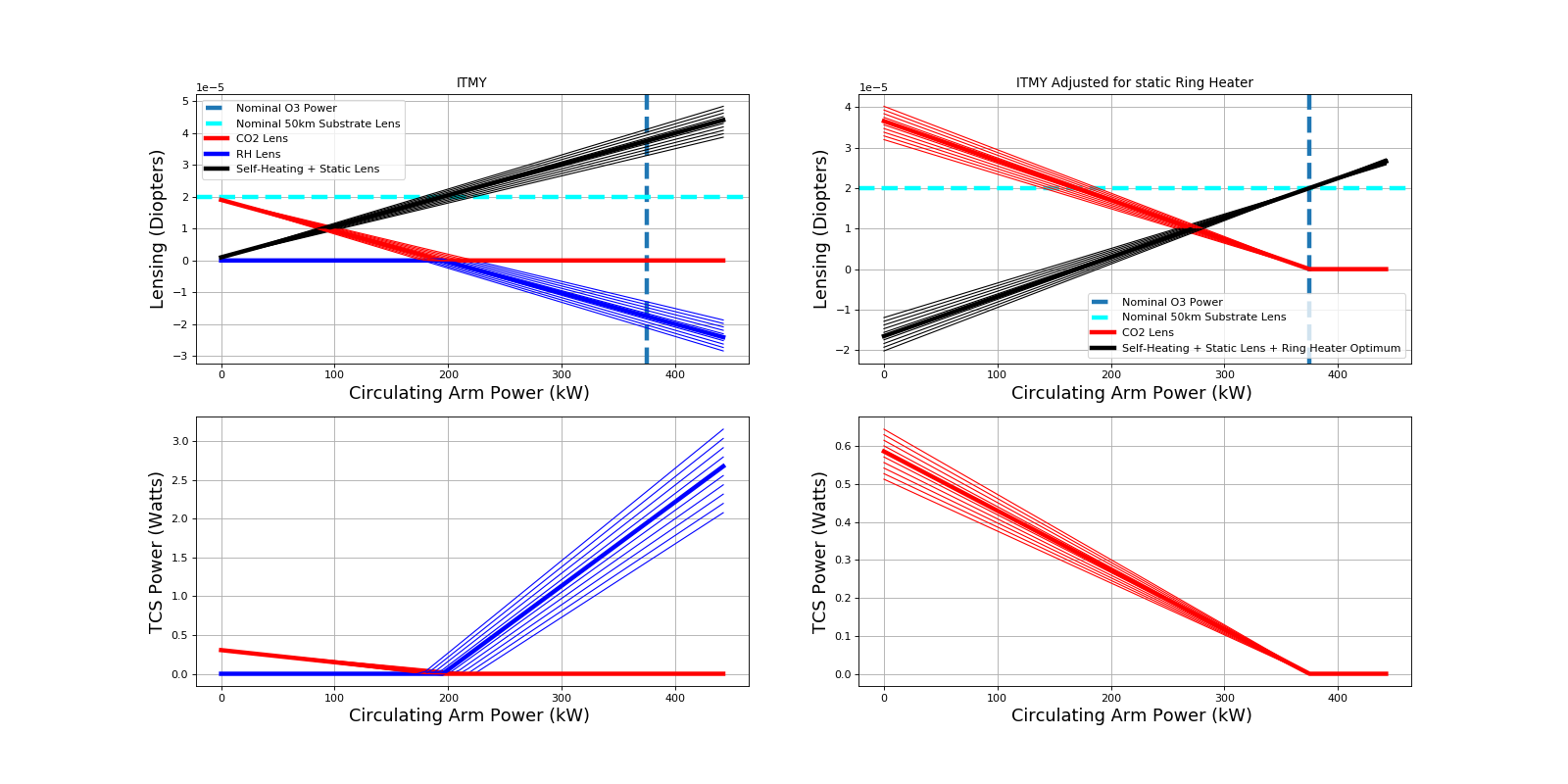
The power up graphs similar to Aidan's analysis, shows that the nominal circulating power will require annular heating which is mostly easily achieved with the ring heaters for varying absoprtion (.25ppm +/-0.025ppm). Because the ring heaters take so long to warm up they should always be turned on so that they are ready for full circulating IFO power (375kW), however, the CO2 laser will have to compensate for this static ring heater tuning in addition to adjusting for the static lens and self-heating from the absorption. The right plots shows the adjusted required CO2 central heating such that the CO2 laser power is scaled to zero once the interferometer has reached full power.
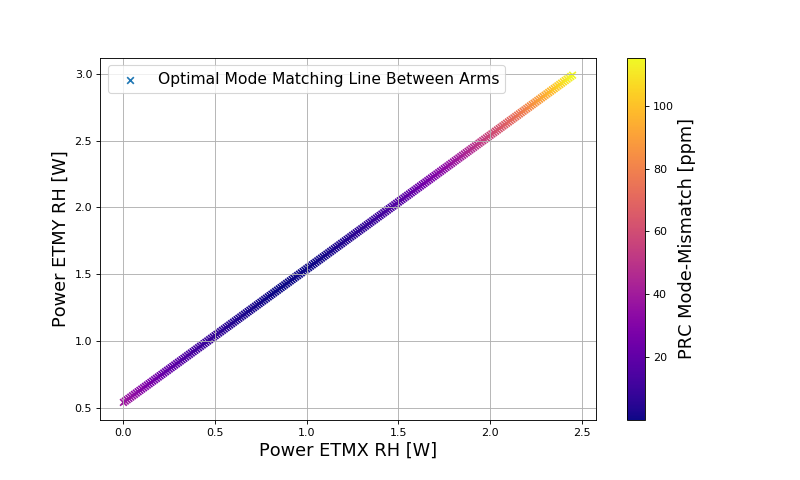
Now that we've used up the ITMX and ITMY ring heaters to adjust for the substrate lensing, this inherently changes the radius of curvature of the ITM HR surface, therefore it changes the modal content of the arm cavities. Assuming we have control over the ETM ring heaters (PIs effectively being solved by AMDs) we have to tune those heaters to modematch the arms to each other as well as the power recycling cavity. Using Finesse to calculate the PRC mode with a 50km lens in the substrate of the ITM and keeping the common mode lensing to keep the arms mode-matched to each other. This graph shows that a linear line that is a combination of ETM ring heater powers which keeps that arms well modematched to each other, and the color plotting shows which of those combinations gives the best possible PRC (the darker the better, notice the units of color are in mode-mismatch):
Of course, these calculations are just a good place to start assuming we have uniform absorption and that our estimate of absorption is good enough, more measurements with the HWS at higher power will refine the model.

Correction
The previous estimate of the actuation calibration for the CO2 lasers on the substrate was off by a factor of 3, this was due to the changing out the mask:
Old: 6.23e-5 diopters/watt
New: 2.50e-5 diopters/watt
That being said, the values for CO2 pre-loading changes but the algorithm remains the same:
The optimal setting for CO2 X and Y is close to 1.461 Watts on central heating.