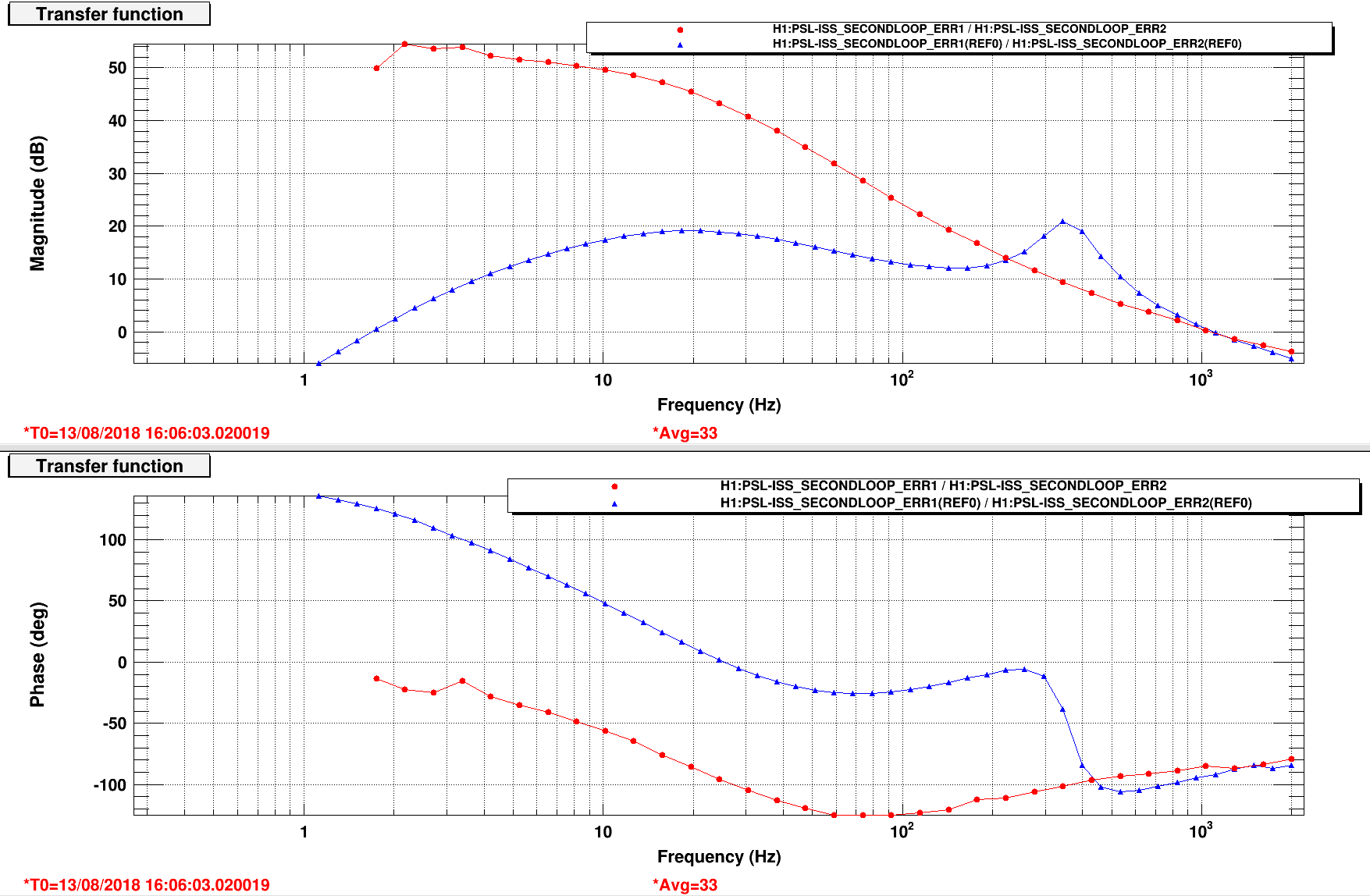
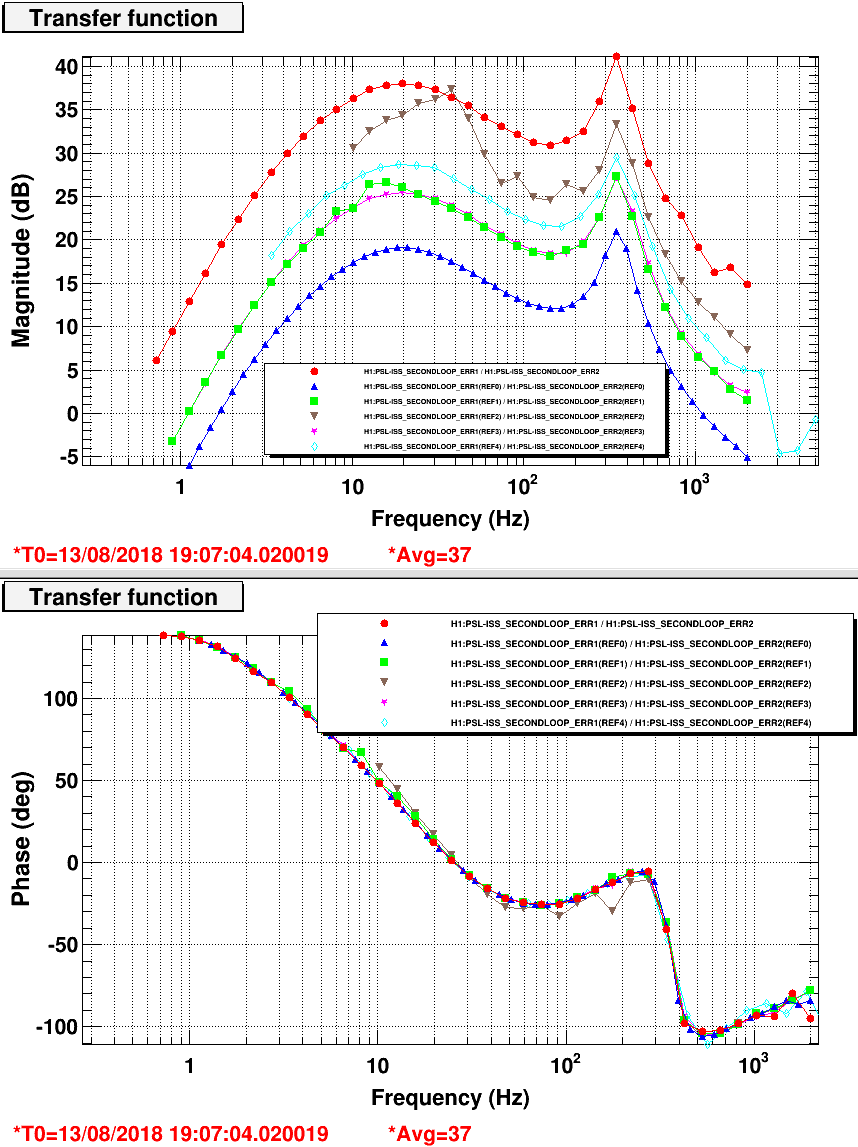
[Keita, Gabriele]
Summary
The ISS second loop is working fine, we could operate it at 36 W input power, with a bandwidth of about 16 kHz, all three boosts on, with a open-loop gain of 41 dB at 1 kHz.
Details
Today we continued out work on the ISS second loop. At the beginning we could engage the second loop at 2 W input power, with a gain of 26 dB, and then increase the power to 5 W. However, from 5 W up, it was not possible to have a second loop unity gain frequency higher than about 1-2 kHz. If the gain was any higher, some intermittent oscillation were visible in the time series and spectrum of the ISS signals.
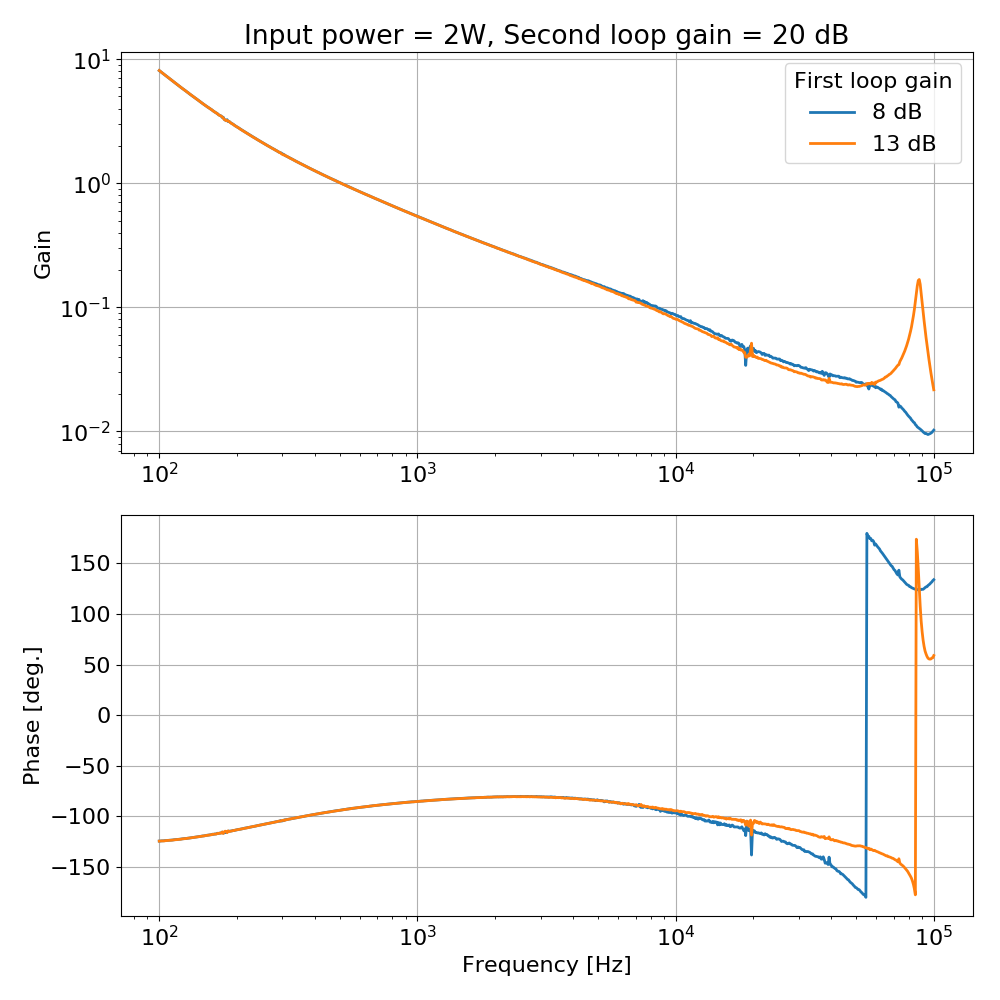
We decided to go to the floor and measure the second loop open-loop transfer function with the analog input. There was a large peak at about 82 kHz, giving us less than 5 dB of gain margin. This explained why we could not increase the ISS second loop gain, and why we failed increasing smoothly the power. We traced the problem to a gain peaking in the ISS first loop: by reducing the first loop common gain from 13 dB to 8 dB, the peak was gone and we were able to smoothly increase the ISS second loop gain.
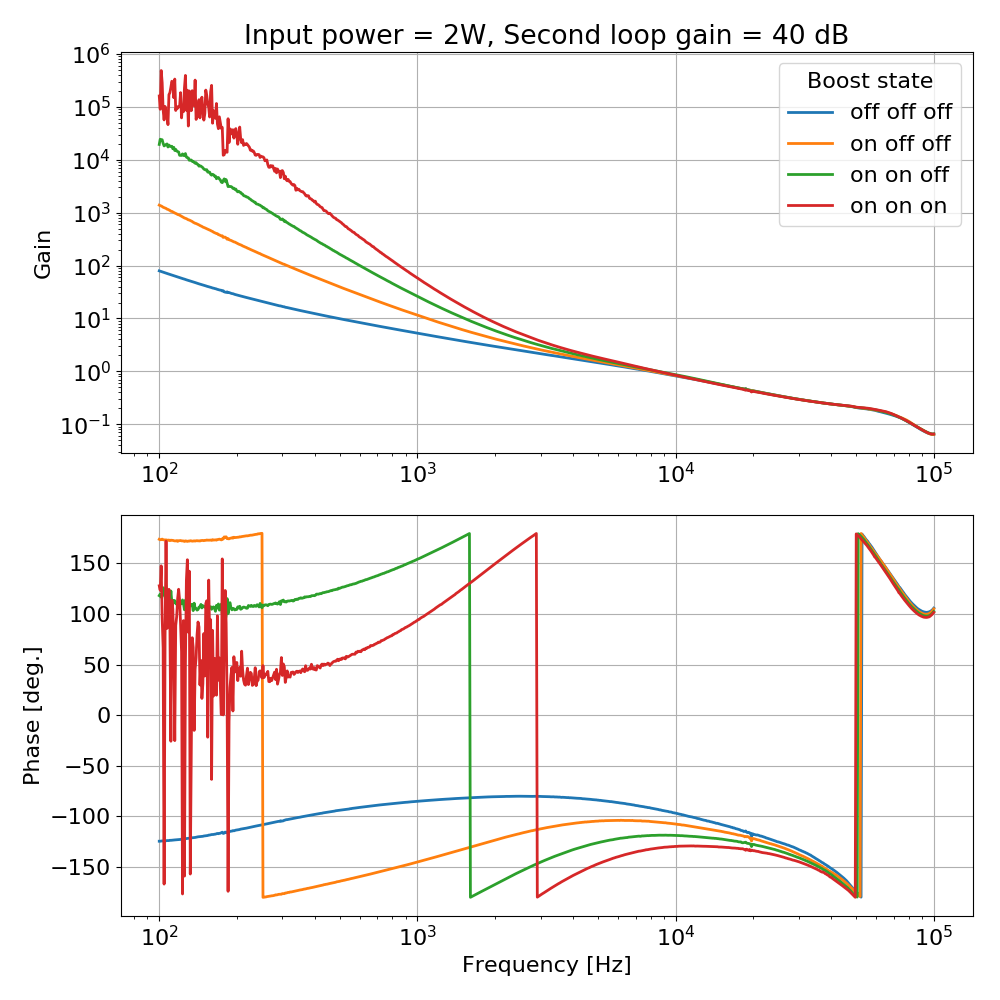
With an input power of 36W (the maximum we could get) we set the ISS second loop gain to 20dB, obtaining a unity gain frequency of about 16 kHz. We then disabled the AC coupling loop (by holding the output and disabling the input) and could engage all three boosts. The ISS second loop open-loop gain at 1 kHz was 41 dB. There is no visible transient when engaging or disengaging the boosts. NOTE: this measurement was taken with an input power of 2 W and increasing the ISS second loop gain to 40 dB to make the boosts stable.
Plots
The first plot attached below shows the open loop transfer function of the ISS second loop with the AC coupling on (blue) and off (red), without any boosts. You can't engage boosts with the AC coupling on.
The second plot shows the in-loop (red and green) and out-of-loop (blue) error signals without boosts (green) and with boosts (red).
The third plot shows some measured OLTF with AC coupling on: BLUE = 2 W gain 26dB, GREEN = 4 W gain 26 dB, BROWN = 8 W gain 36 dB, pink = 8 W gain 20 dB, CYAN = 16 W gain 17 dB, RED = 36 W gain 20 dB
The fourth plot shows the effect of the ISS first loop gain: there is gain peaking at ~80kHz when the first loop gain is 13 dB, no peaking when the gain is 8 dB.
The fifth plot shows the engagement of the boosts. NOTE: this measurement was taken with an input power of 2 W and increasing the ISS second loop gain to 40 dB to make the boosts stable.
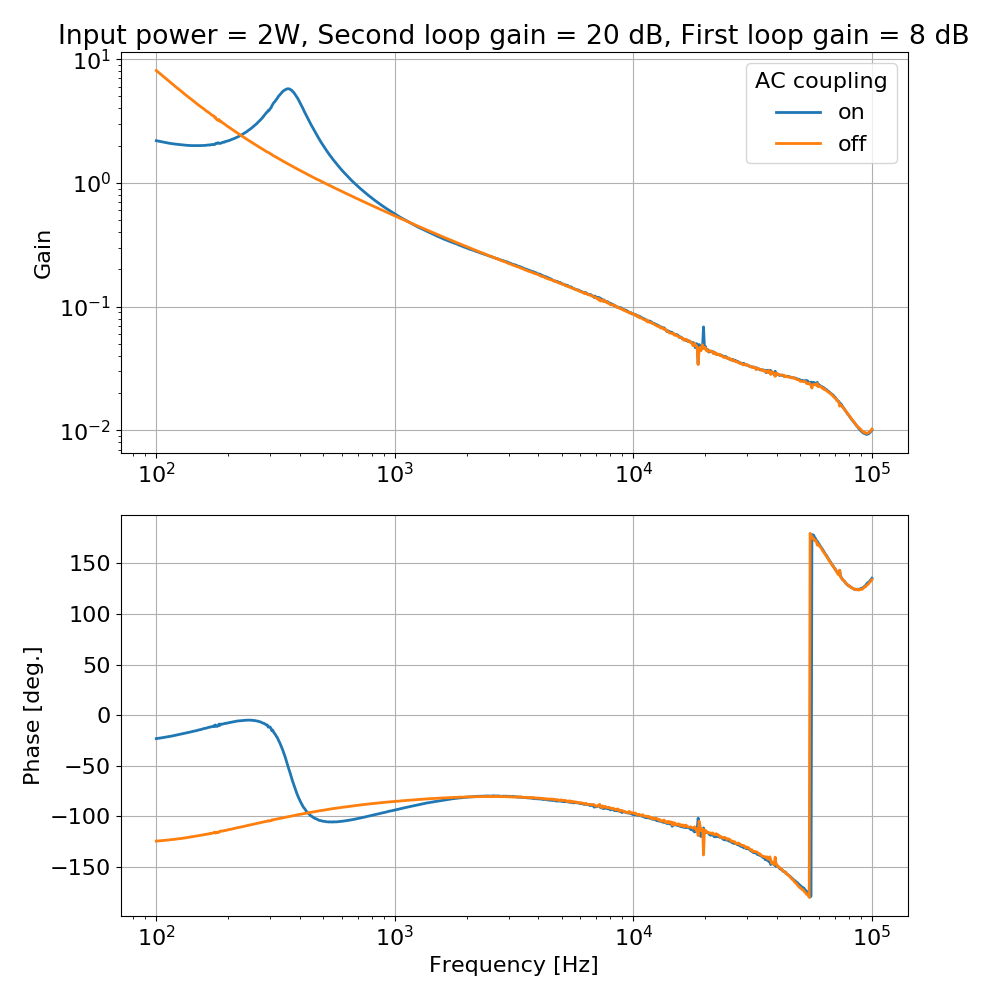
The sixth plot shows the effect of switching on and off the AC coupling loop.