Summary
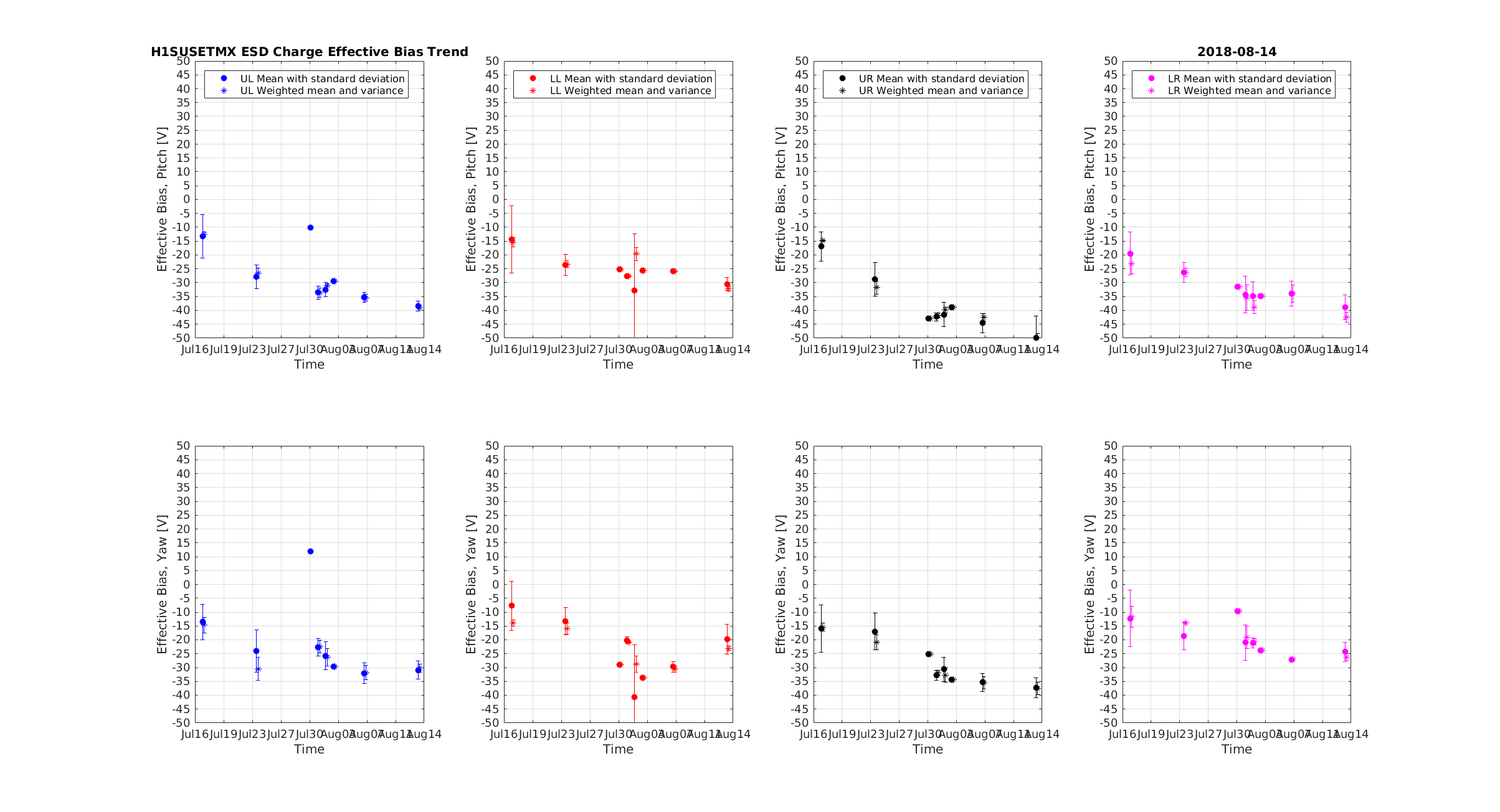
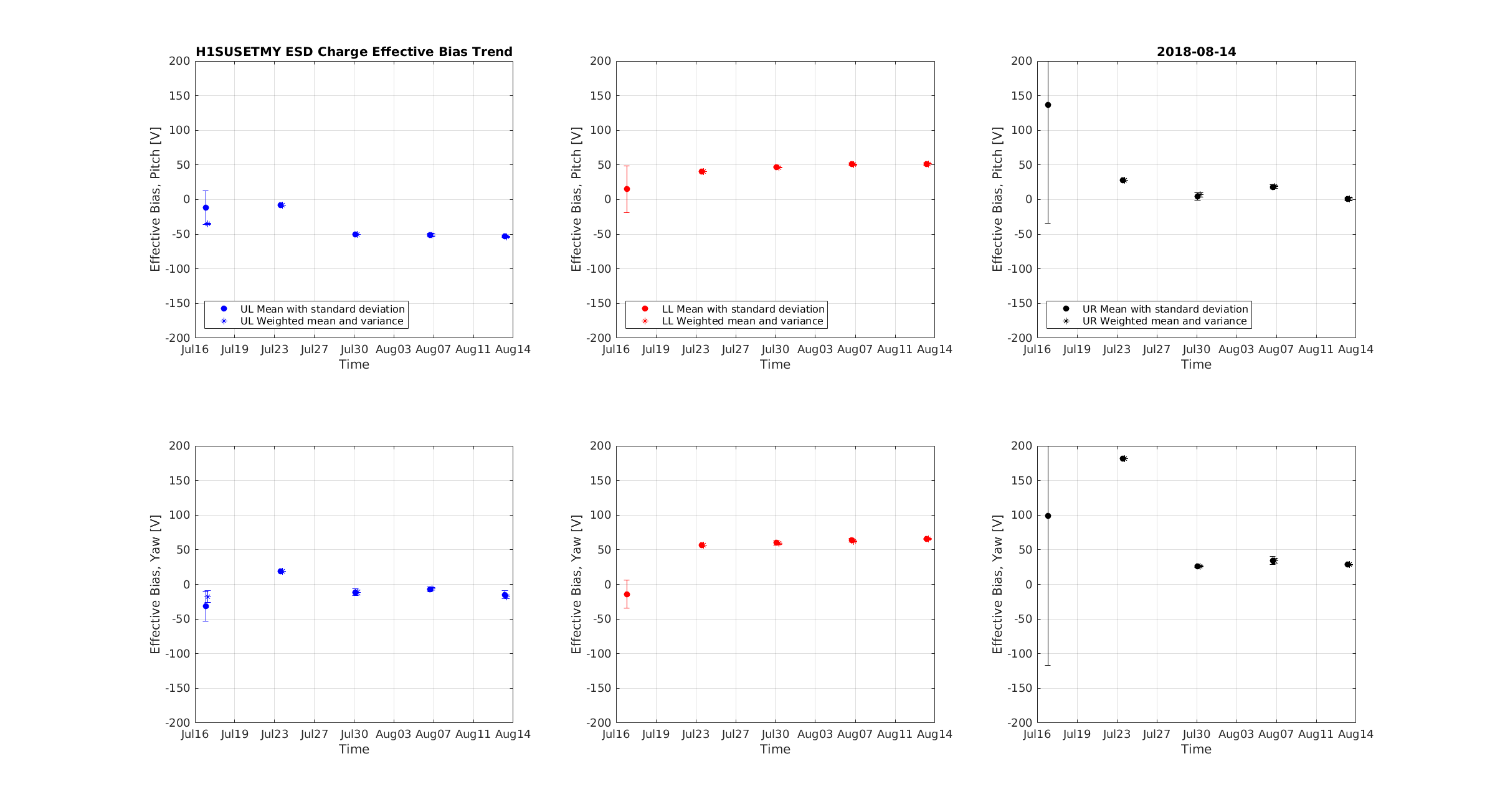
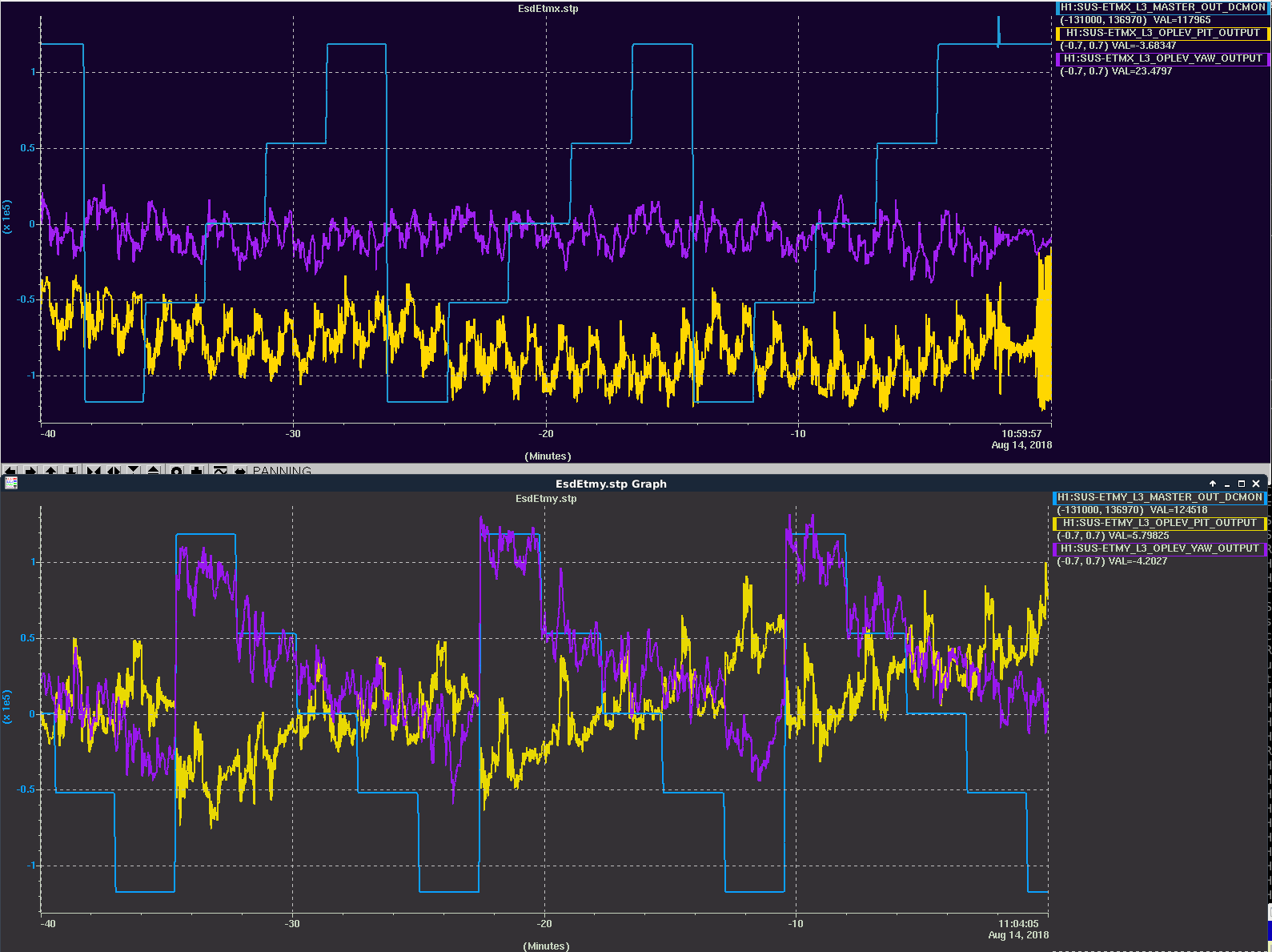
Today we ran the usual Tuesday-maintenance charge measurements. The effective bias trend of ETMX over the last ~month suggests a normal slow accumulation of charge, possibly consistent with space charge polarisation, induced by exposure to the large fields from the ESD bias. The ETMY effective bias trend is harder to interpret, some quadrants are possibly trending away from zero, others seem constant. I do not think at this stage that switching the sign of the bias voltage will help us with ETMY. I also had a look at the time series as we step the bias voltage from -400 V to 400 V: changing the bias is visible in the optical lever signal. This seems to indicate some asymmetric charge distribution on the test mass.
Details
The first attached plot shows the usual long trend of the effective bias for ETMX. I would tentatively suggest that the effective bias is trending away from zero, though more data would make this more convincing. My four-parameter measurement is consistent with this. All parameters except Beta-Beta2 are the same within reasonable uncertainty, and Beta-Beta2 has apparently increased slightly, also increasing the effective bias (now 37 V in pitch and 32 V in yaw).
The second plot shows the long trend of effective bias for ETMY. Only the lower left quadrant trends away from zero in a way reminiscent of space charge polarisation, the other two working quadrants seem stable. We have had the ETMY bias on at +400 V since July 19.
The third attachment is a screenshot of a striptool as we step through the bias voltages, for ETMX and ETMY. At each bias voltage, each quadrant is driven, which causes the higher frequency periodicity in the optical lever signal. The interesting feature is bias voltage showing up in the optical lever signal, which is significant in ETMY, and more noticeable in pitch. Any symmetric charge distribution, eg that caused by space charge polarisation, would not cause this, so this must be caused by some other source of charge (eg bump stop contact). I'm surprised that this doesn't show up as a large effective bias voltage in the usual measurements. Also, in the ETMY pitch optical lever signal there is a periodic offset, which occurs when the lower left quadrant is driven.
When compatible with other commissioning activities I would like to drive the ETMY bias and work out the beta+beta2 parameter from this, a back-of-the-envelope calculation based on the coupling to the op lev shown here suggests it's three orders of magnitude larger than ETMX.