Edgard, Hang, Jeff K., Brian.
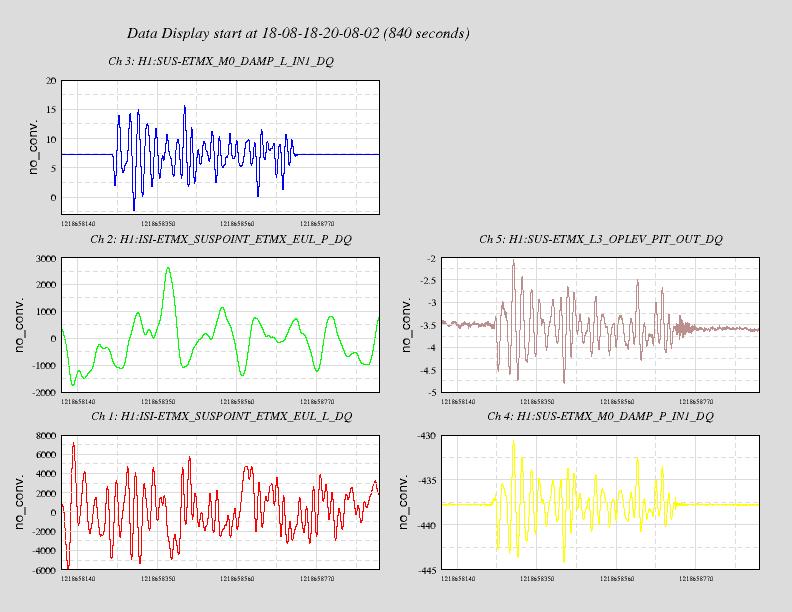
I briefly gave a second chance to the ISIFF using length and pitch simultaneously, in a way similar to LHO:42875.
The test was performed in ETMX, which has the RX/RY loops on. We observed no instability (see attachment 1, bottom left). This seems to suggest that the instability reported in LHO:42875 was indeed a result of the OSEM backreaction+ tilt horizontal coupling as we were suspecting.
The second attachment shows the power spectrum for L3P with and without the L-P simultaneous Feedforward. Two things to note:
- The performance above 0.15 Hz is amazing, especially at the QUAD resonances. I almost don't believe these measurements, we'll investigate more into this later.
- There is a lot of pitch motion being injected below 0.1Hz. This was completely expected, since I did not try to tune the bandpass carefully and only eyeballed the constant factors from the transfer function measurements.
__________________________________________________________________________
For the record, the values of the scalar FF I decided to eyeball the measurements described in LHO:43512 close to DC. Together with a recent M0 transfer function measurement found at:
/ligo/svncommon/SusSVN/sus/trunk/QUAD/H1/ETMX/ETMX/SAGM0/Results/2018-06-01_1602_H1SUSETMX_M0_DTTTF.mat
The estimate was made by using the DC levels of the TFs as described in (T1800301), by finding k= M0_L_2_M0_L/ST2_L_2_M0L; and l=M0_L_2_M0_P/ST2_P_2_M0P. I took care of calibrating into the right units too (cts/nm).