We tried to see how well we could model the DHARD OLTFs, and it seemed that my knowledge on the suspension model was not sufficient to give satisfactory results...
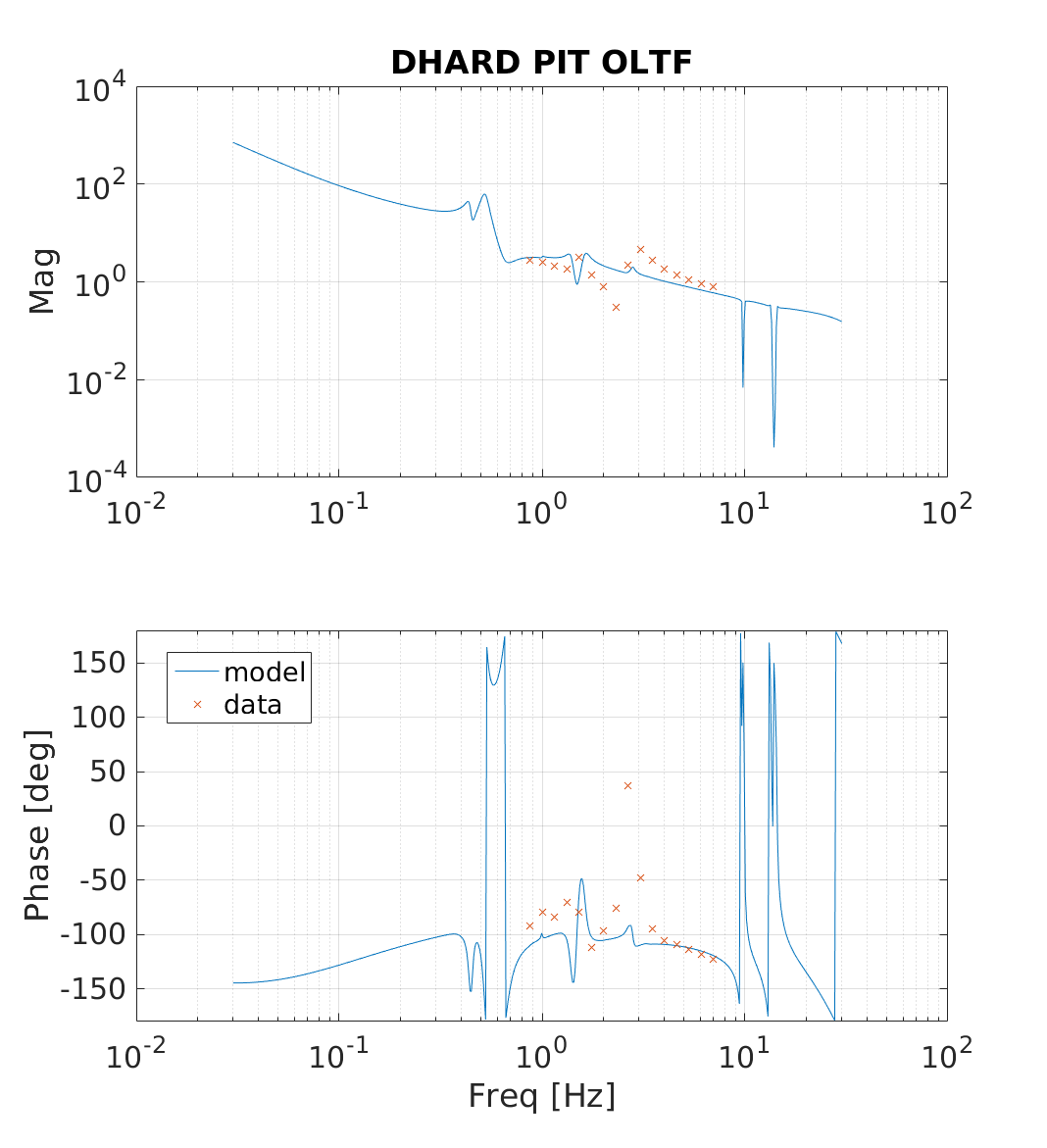
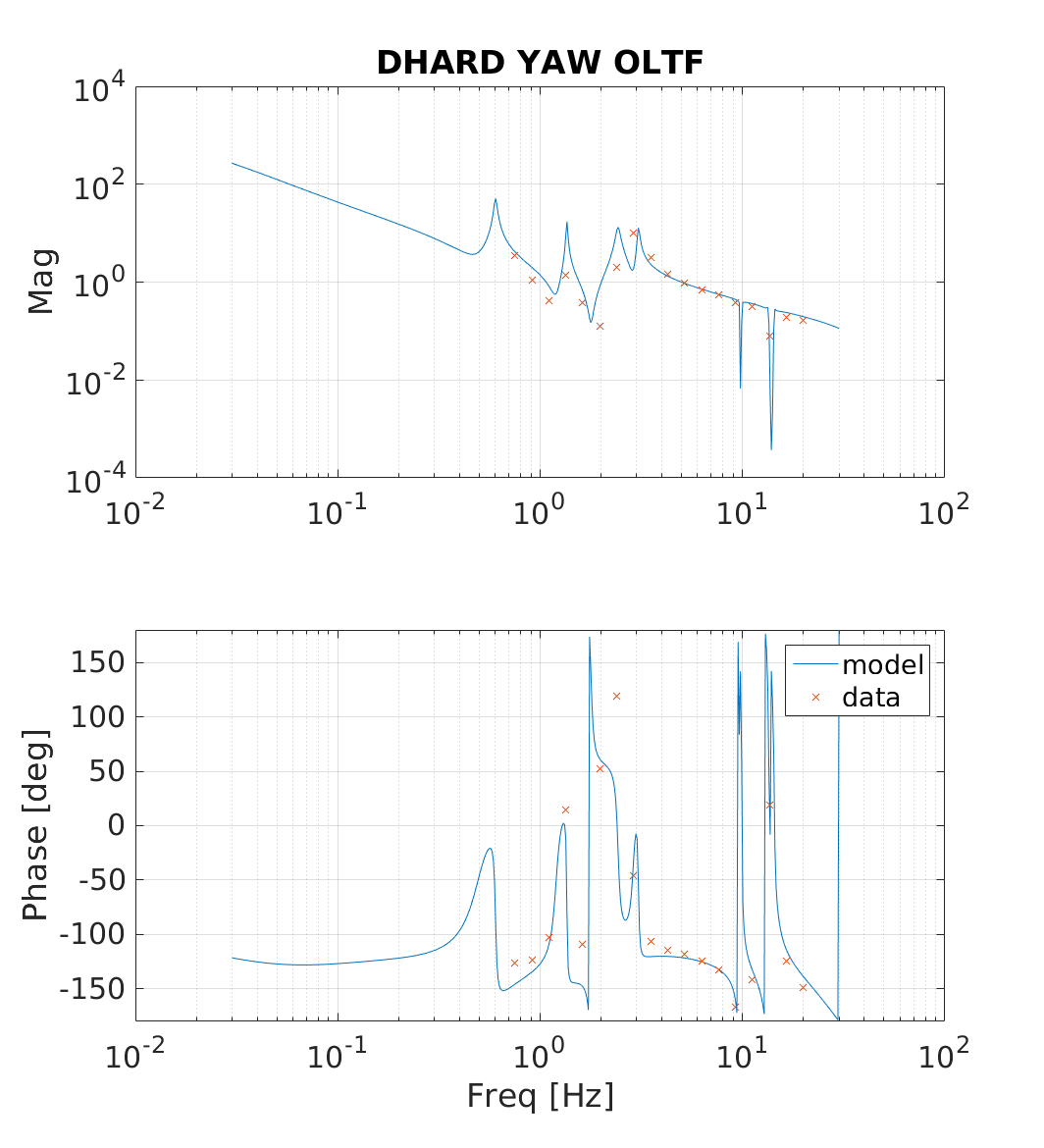
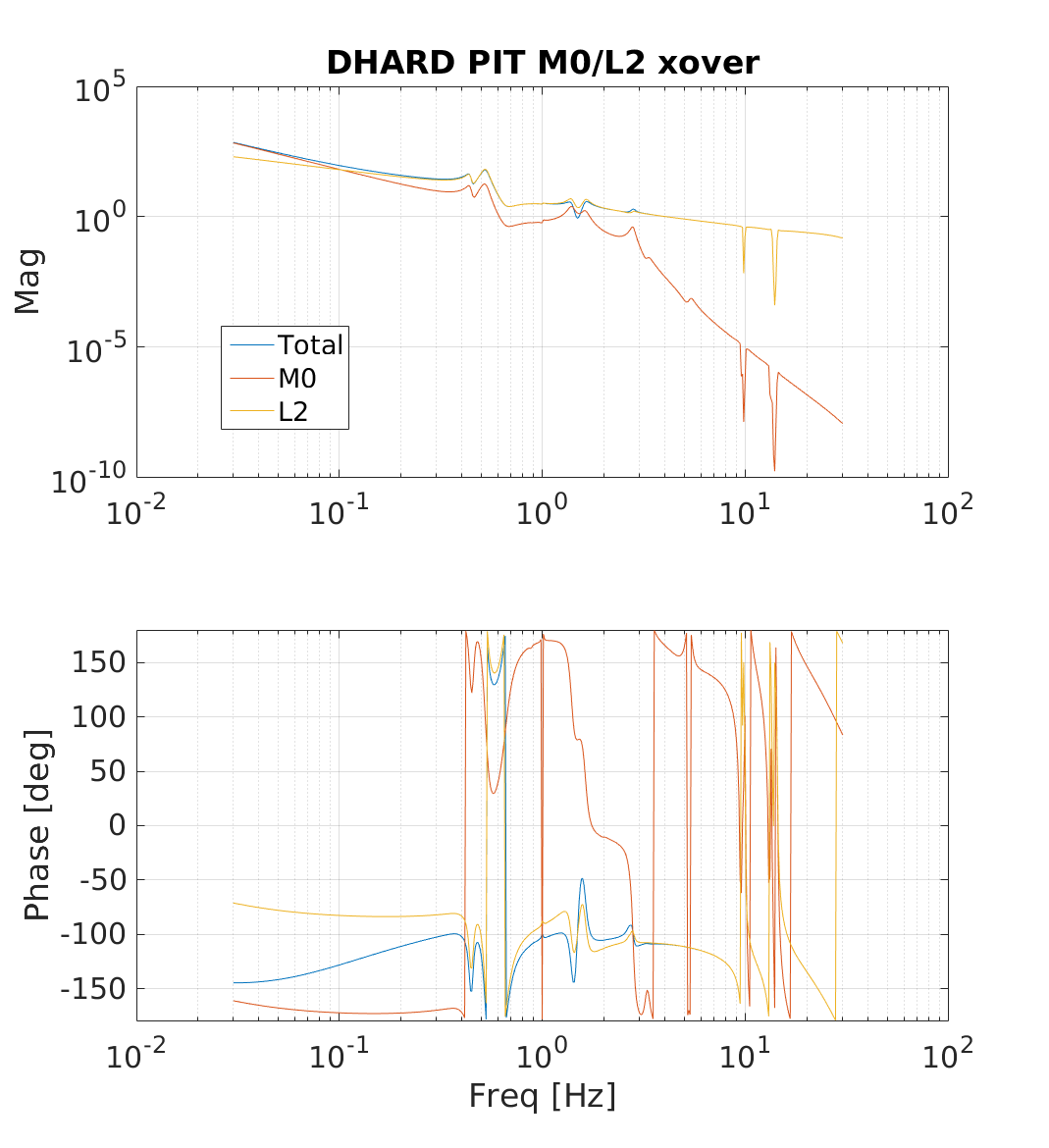
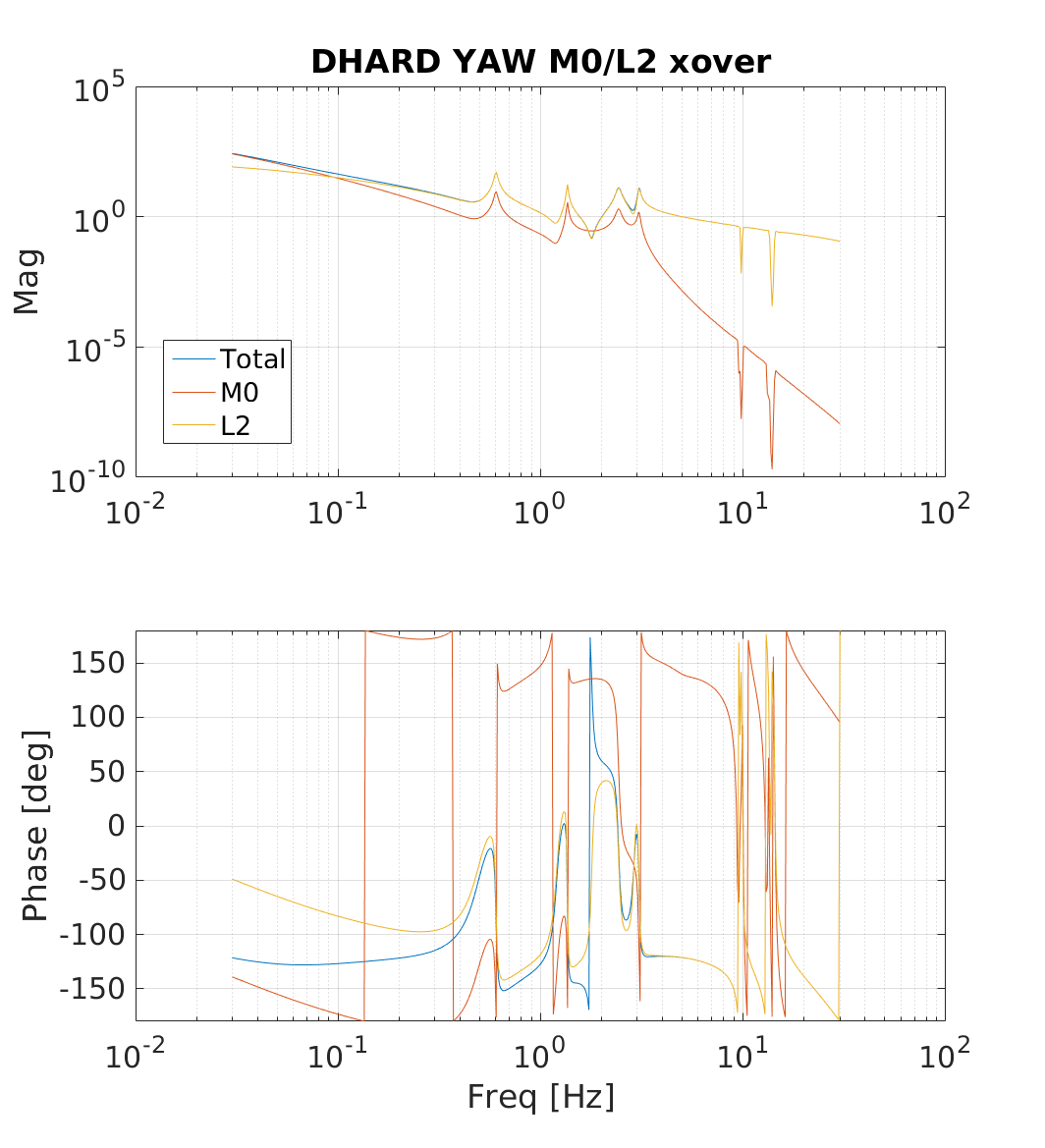
In the first two plots we show the modeled OLTFs for PIT and YAW in blue traces. As a reference, we also show the measurement data in the orange crosses. The measurements can be found at /ligo/svncommon/IscSVN/iscmodeling/trunk/ALIGOH1/ASC_loops/Measurements/DHARD/DAHRD_P_OLG_SS.xml and DHARD_Y_OLG_SS.xml. For PIT I took the REF4 curve and YAW I took the REF3 curve. The third and forth plot showed the modeled M0/L2 crossover.
For the SUS model I directly ran the generate_QUAD_Model_Production function in the SusSVN with default damping filters. The digital suspension filters (LOCK_P or LOCK_Y) we used were L2: FM2, FM3, L1: FM5, M0: FM3, FM4, FM5, FM7 for PIT, and FM3, FM4, FM5 for YAW. The Nm/ct actuator strength were 1.28e-6 [Nm/ct] for M0, and 6.32e-10 [Nm/ct] for L2, based on T1100378. We don't have a good calibration of the optical gains at this point so we just scale the model to have UGF at ~ 4 Hz. It did not seem the model could match very well to the measured data in the 1-3 Hz band (second and third sus resonances).
Moreover, for PIT, the SUS model predicted the main P2P sus resonance was at 0.525 Hz. Yet this cannot be true because if so our current control filter (with a pair of zeros at 0.65 Hz to invert the sus resonance) could not be stable. Also in the ISIFF measurements the main P2P resonance seemed to be at ~ 0.57 Hz.
If we want to optimize the DHARD loops in the future, we might need to have some good broad-band excitations to measure the OLTF, resolving at least the first and second sus resonances.