Sheila, Georgia
I ran the old optical lever effective bias measurements on ETMX and ETMY, as well as my four-parameter measurement on ETMX, and the bias drive to optical lever coupling (from which beta+beta_2 pitch and yaw can be calculated) on ETMY.
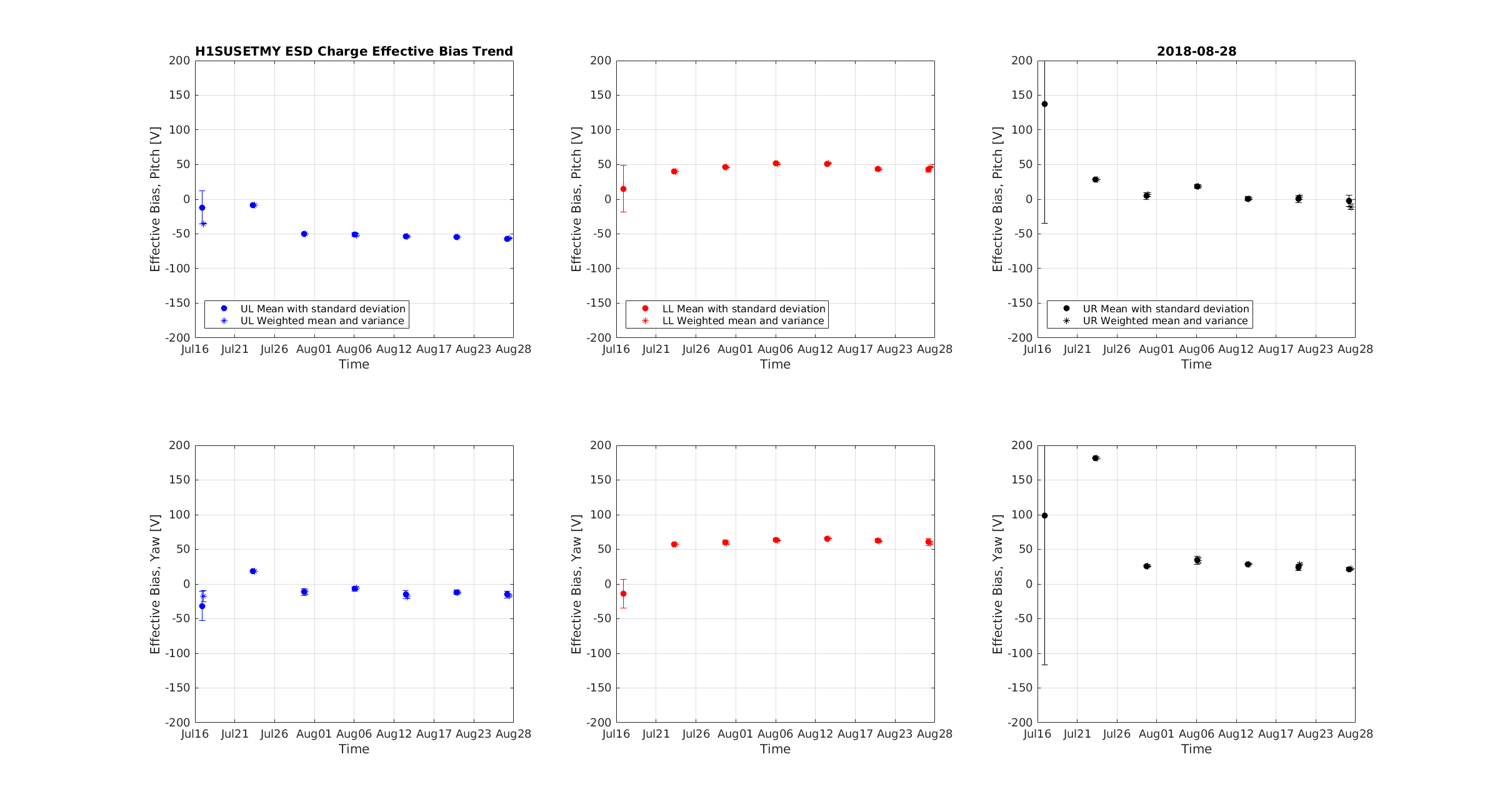
Trends of the 3 main measurements attached. First plot is ETMY V_eff for the 3 working quadrants, which is quite boring and stable (yay!), but with a large magnitude compared to ETMX.
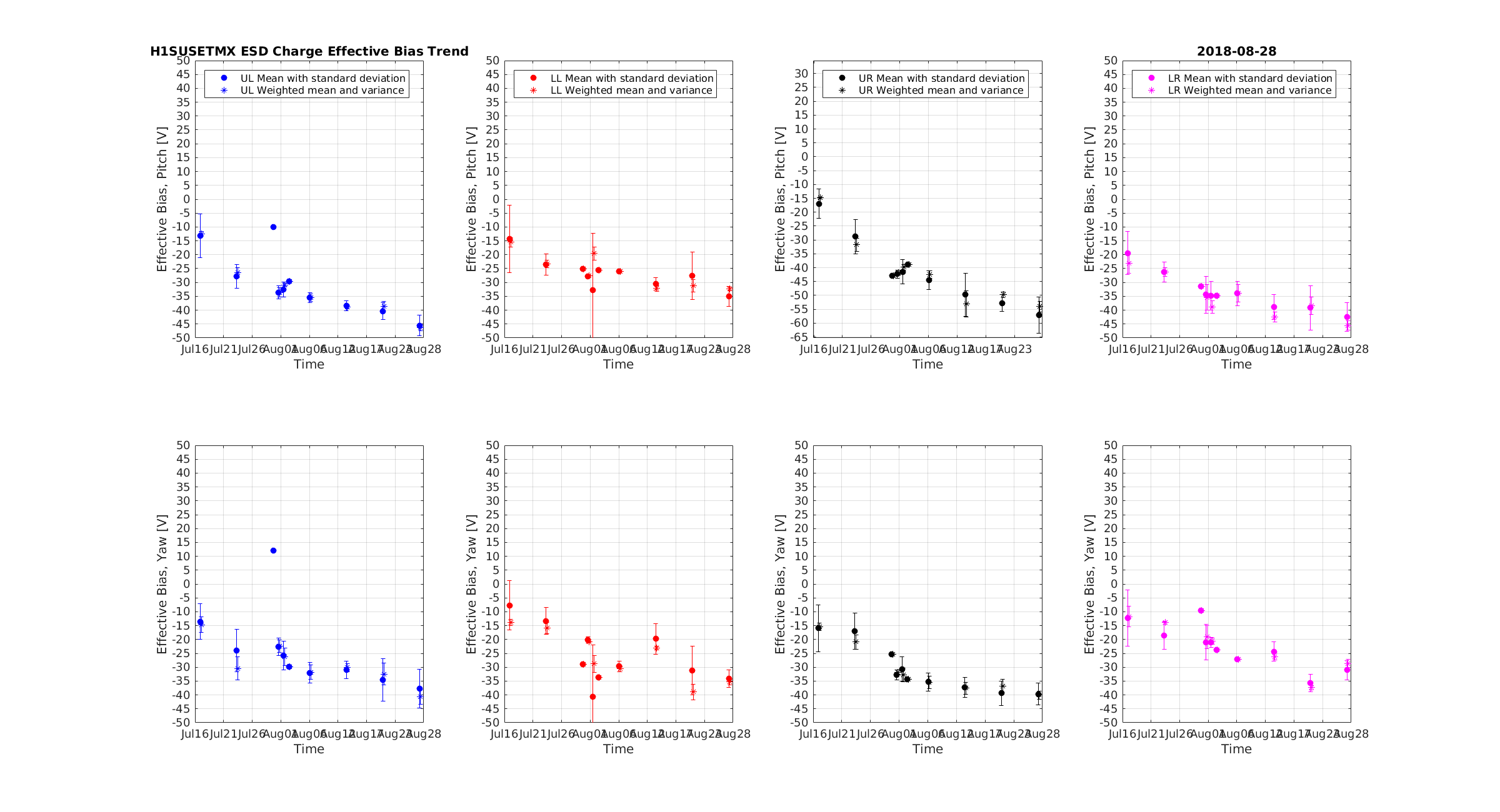
Second plot is ETMX V_eff for all four quadrants pitch and yaw. General trend is away from zero bias voltage, reminiscent of space charge polarisation. Charge due to space charge polarisation building up on ETMX has been mitigated by switching the sign of the ESD bias, causing the slope of the V_eff trend to change signs.
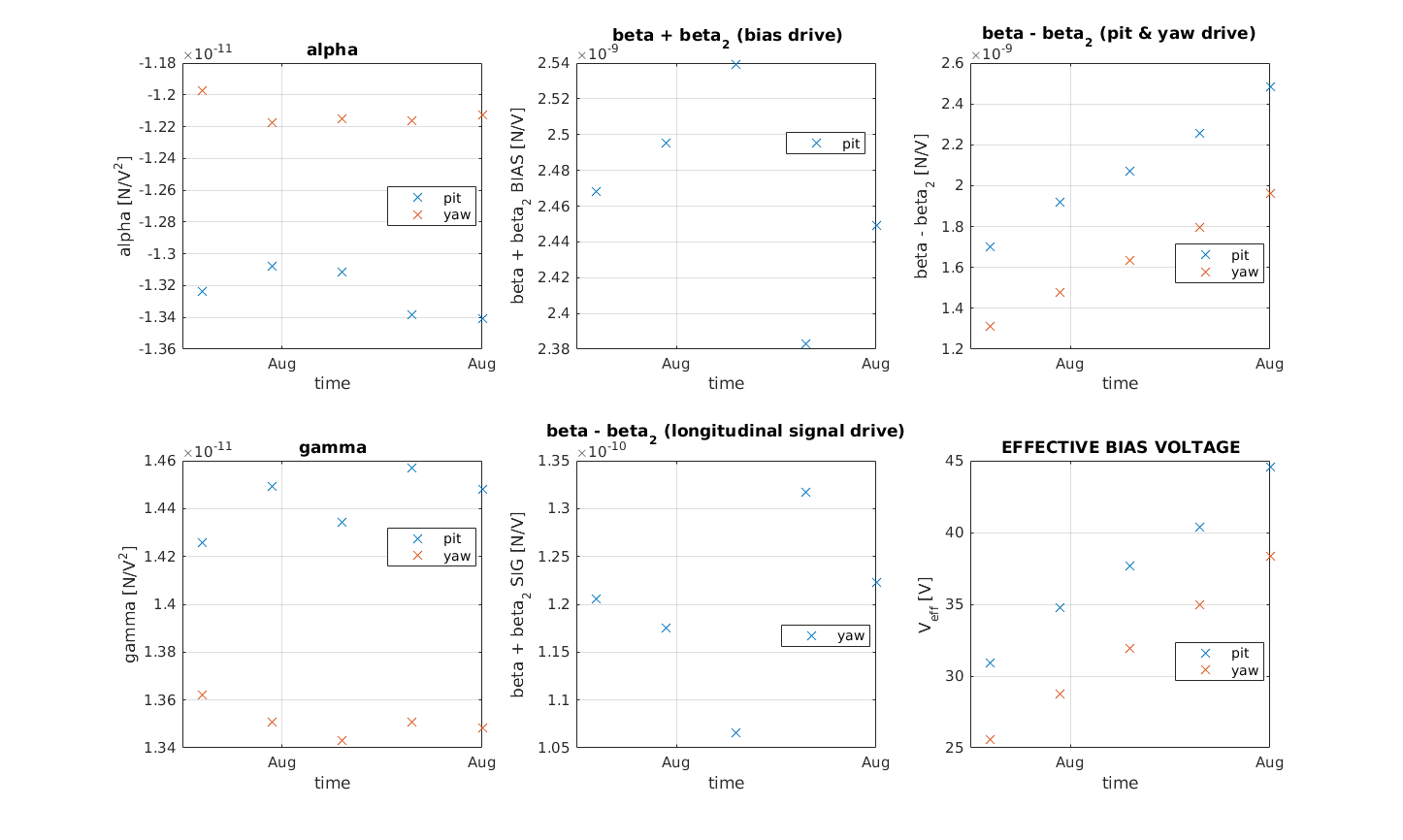
Third plot is the 4-parameter measurement, there are a few things we can take from these plots:
1. The difference in the size of alpha measured for pitch and yaw we think can be explained by the ESD layout, and the additional path around the barrel of the optic taken by the lower quadrant electrodes. When driving pitch the upper and lower electrodes are driven in common, but while driving yaw they are driven differentially. The potential difference between the upper electrode and the part of the lower electrode next to it on the barrel of the test mass could reduce the actuation strength in pitch.
2. The Beta - Beta_2 pitch and yaw, and V_eff measurements sensitive to space charge polarisation and are consistent with the old quadrant-by-quadrant Veff measurements. I probably have messed up some signs and am not too worried about the discrepancy there as the magnitude of the effective bias voltage is consistent.
3. The Beta + Beta_2 (bias) and Beta - Beta_2 (longitudinal) are longitudinal measurements and should not be sensitive to space charge polarisation. If the localised charge on the test mass is low, these drives should not couple to pitch and yaw on the optical lever. The centre top plot suggests that there is some source of charge on the same order of magnitude as that due to the space charge polarisation, coupling to pitch when the bias is driven and to yaw with the signal is driven, I'm not sure why these would be different between longitudinal signal drive and bias drive.
4. The Beta + Beta_2 (bias) is much larger than the Beta - Beta_2 (longitudinal), suggesting greater coupling to the bias electrode. Note that this is what we would expect if charge was localised around a bump stop, as the bias electrode passes closer to the bump stop.
Finally, analysing the op lev data while driving the ETMY bias gives:
Beta + Beta2 (p) = 4.4e-09
Beta + Beta2 (y) = 3.2e-08
This is consistent with last week, and consistently larger than ETMX.