peter.king@LIGO.ORG - posted 07:11, Thursday 30 August 2018 - last comment - 10:39, Thursday 30 August 2018(43743)
ISS behaviour
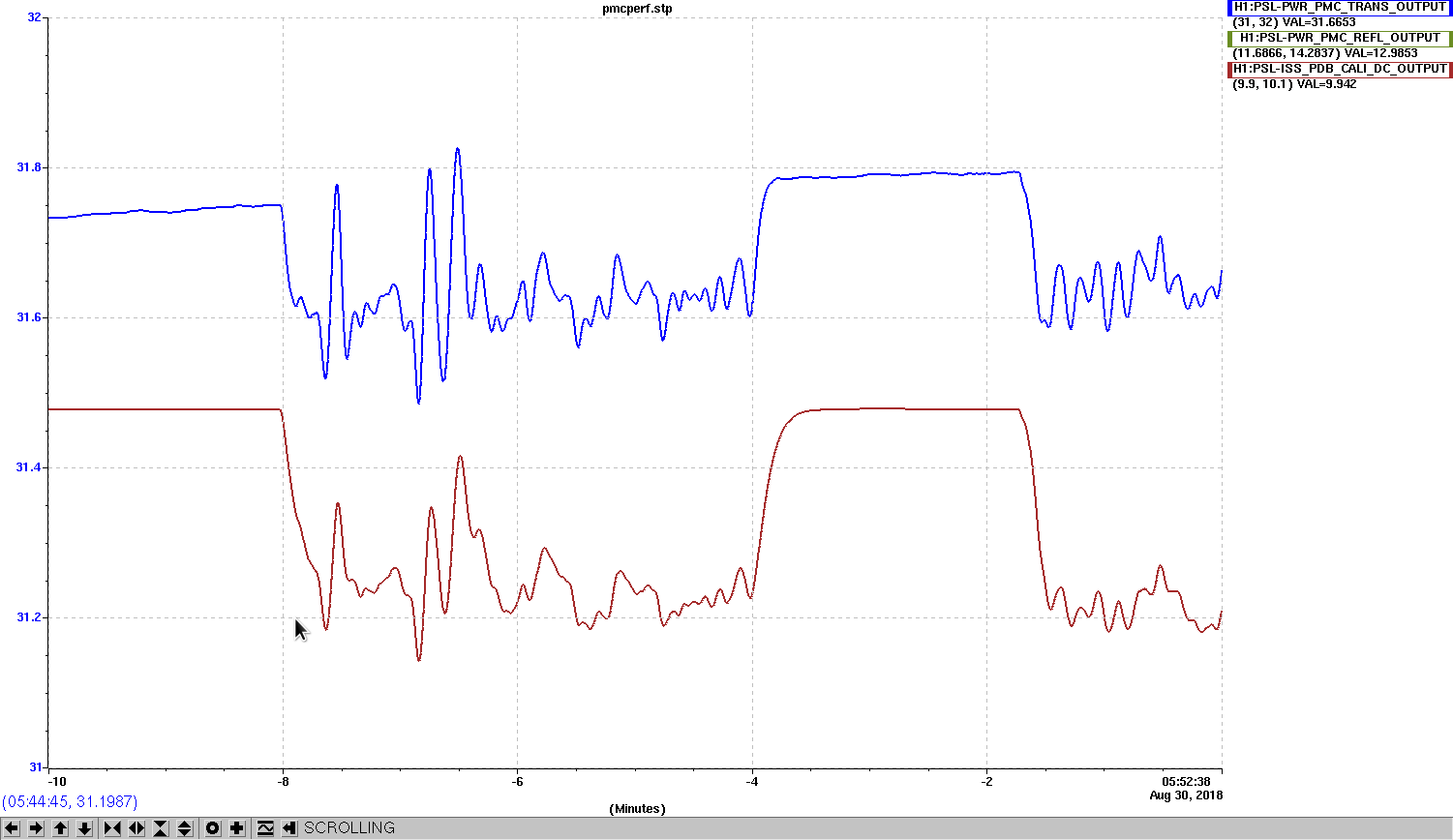
The attached plot shows the pre-modecleaner transmission and the out-of-loop photodiode (PDB) of the first loop ISS.
That flat periods are when the second loop output switch is off.  The first wiggle period is with the second loop
output switch on and the second loop 10 Hz pole engaged.  The second wiggle period is with the same but with the
10 Hz pole off.  These were taken with the second loop gain slider at 20 dB.

    At gains less than 20 dB, the first loop ISS pretty much rails straight away from which it seems to require
human intervention to bring it back.

    The symptoms of when the first loop rails, is that in the diffracted power plot on the MEDM screen the minimum
diffracted power is close to 0%.  Or there is a large separation between the minimum and maximum plots.  Typically the
diffracted power displayed in the numeric field is ~3.3%, and the AOM voltage displayed is 0.233 V.  This would suggest
that the control signal to the AOM driver is either oscillating faster than EPICS can monitor or that the AOM driver
input is saturated.  To remedy this, slide the REFSIGNAL slider all the way left, which then results in the AOM voltage
coming away from the 0.233 V.  The diffracted power will probably read something >= 11%.  Then lower the REFSIGNAL to
something like -1.90.  The diffracted power displayed should start coming down to something between 4 and 5%.  Then
slowly decrease REFSIGNAL to something like -2.  Ideally the REFSIGNAL should be adjusted so that the out-of-loop DC
voltage displays 10 V.

    At this point, it is not obvious to me if the saturation problem lies with the servo card or the AOM driver.
Images attached to this report
Comments related to this report
The AOM driver modulation input is set by the sum of an offset voltage (the OFFSET slider on the MEDM screen) and the
output of the first loop ISS servo card.  If the servo card output exceeds the offset voltage - for whatever reason -
the AOM driver no longer produces any RF.  This results in no light being diffracted until the modulation is reduced
or the OFFSET is increased.  The downside to increasing the OFFSET to avoid this situation altogether is that more
laser power is diffracted and "thrown away" making less available for the pre-modecleaner.

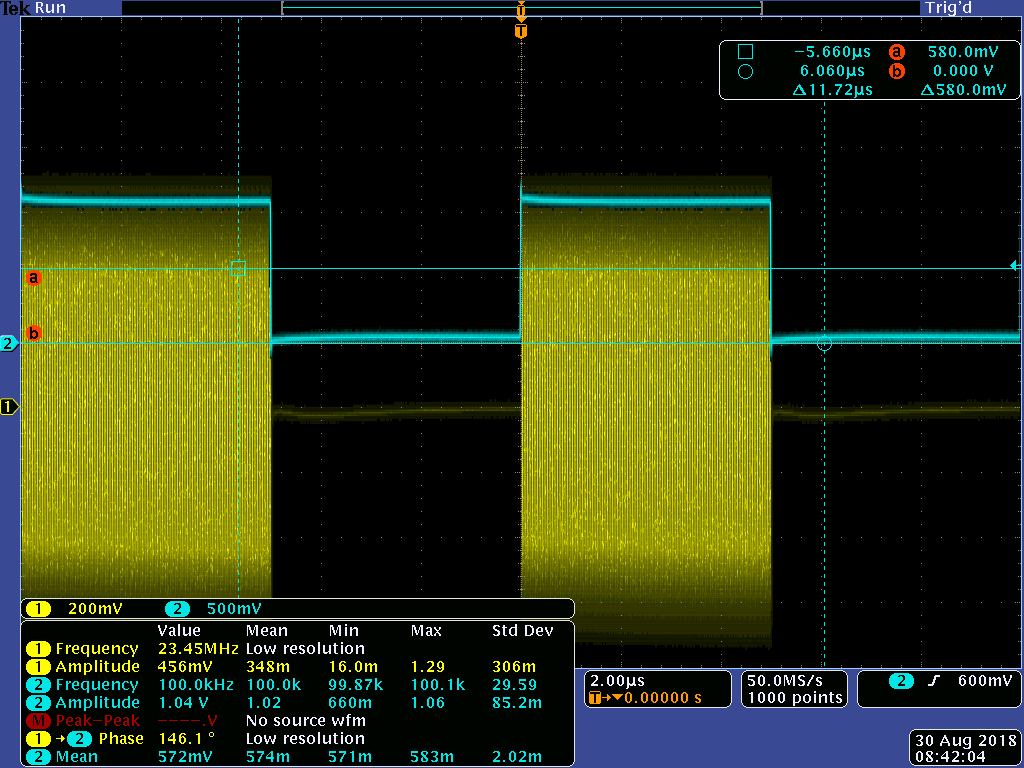
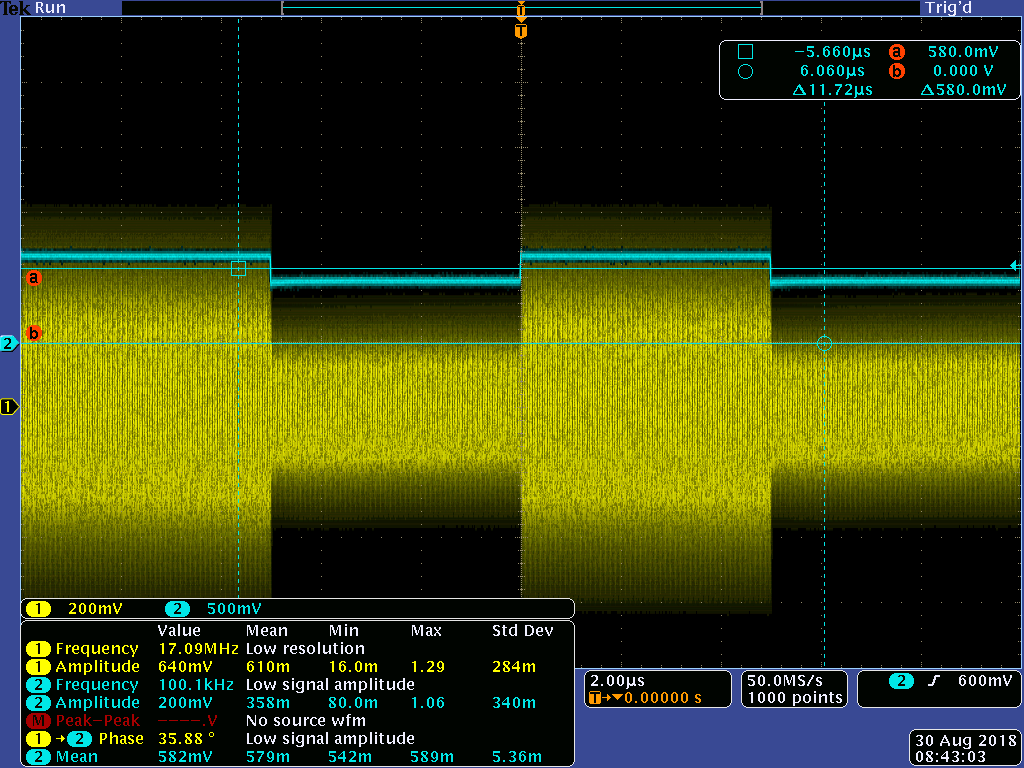
    tek00000.png shows the output of the AOM driver when the peak-to-peak modulation voltage (the blue trace) exceeds
the offset voltage.  tek00001.png shows the output at some other value of the modulation voltage.
Images attached to this comment