In brief
Here are my thoughts:
- it is not possible to close the CHARD YAW loop with any bandwidth larger than ~ 1 Hz
- the only way to increase the bandwidth is to understand the origin of the non-minimum-phase zero (see below and 43822) and fix it
- my guess is a large yaw to length coupling in some suspension (either coil unbalance or beam centering issue) that couples yaw to length and length back to yaw (through the longitudinal lock). I'm hopeful that JeffK's balancing of ITMX will help
On a side comment, it seems that DHARD YAW has a larger bandwidth, although the plant transfer function appears to be very similar. However we don't have a very high resolution DHARD measurement, so maybe the phase rotation is not as severe and we are just marginally stable there.
Why
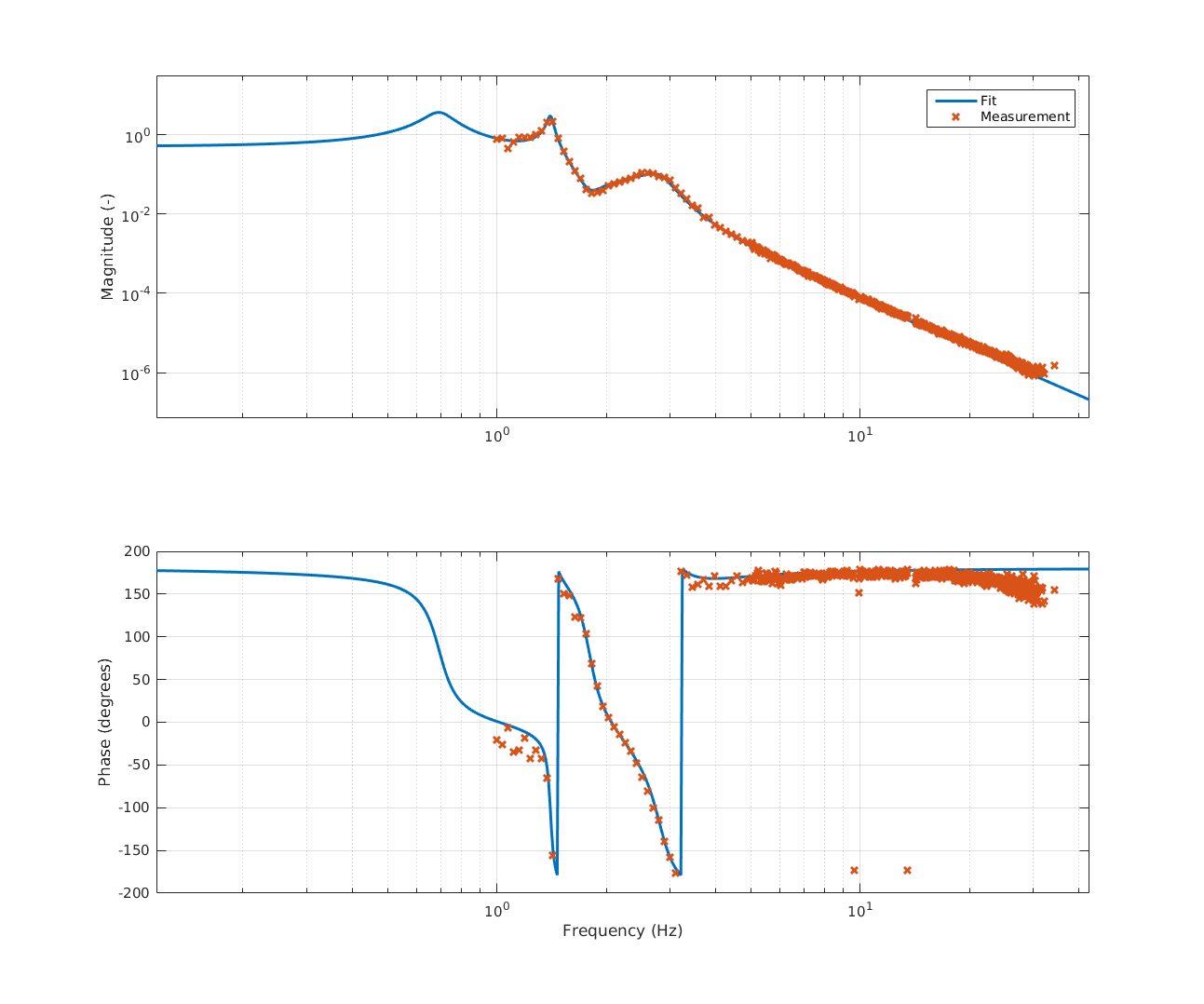
The measured open loop transfer function shows, as already noted in many places, a large phase rotation at about 1.5 Hz (see 43787, 43790, 43797, 43822). I put together all the measurements we have collected so far of the CHARD YAW open loop gain, factored out the control filter, and fit the plant transfer function.
In MATLAB ZPK format:
>> b.z{1}/2/pi =

      -1.4069 +      2.829i

      -1.4069 -      2.829i

      0.12077 +     1.7943i

      0.12077 -     1.7943i

>> b.p{1}/2/pi =

    -0.060244 +    0.69109i

    -0.060244 -    0.69109i

    -0.024256 +     1.4047i

    -0.024256 -     1.4047i

     -0.71192 +     2.3138i

     -0.71192 -     2.3138i

     -0.24979 +     2.7982i

     -0.24979 -     2.7982i

>> b.k=  -1077.5
The additional phase rotation is described by the non-minimum-phase (right-half-plane) zero at about 1.8 Hz.
When there is such a right-half-plane zero, it is not possible (maybe it's possible, but definitely not easy), to increase the loop bandwidth above the frequency of the zero. Indeed, let G be the open loop transfer function, which has a pair of zeros in the right half plane. The closed loop transfer function is as usual 1/(1+G). If we had to have a bandwidth larger than 1.8 Hz, then we must have | G(1.8Hz) | >> 1, so that the closed-loop transfer function becomes simply 1/G. But then the right-half-plane zero in the OLTF becomes a right-half-plane pole in the closed-loop TF: the loop becomes unstable!
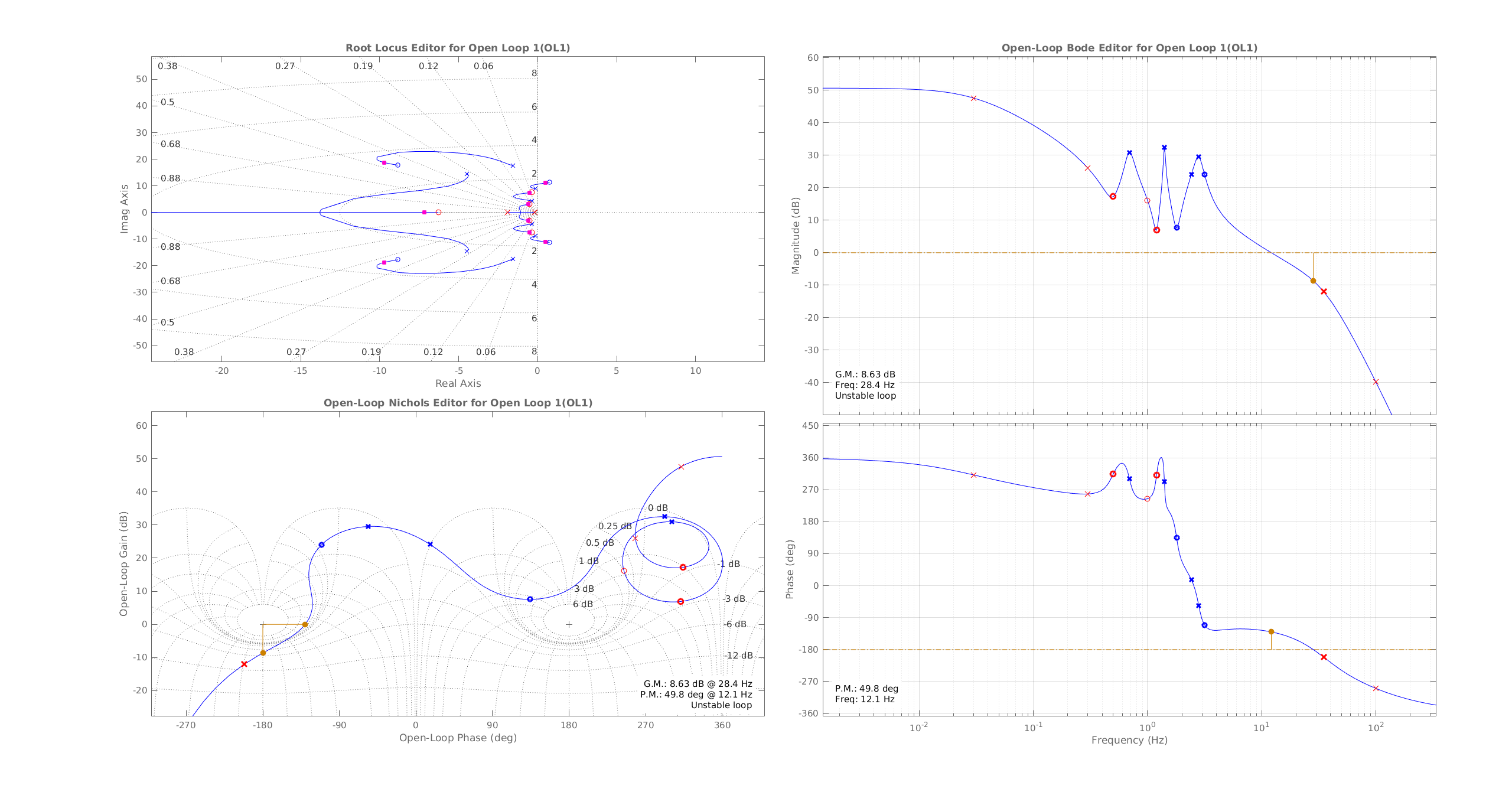
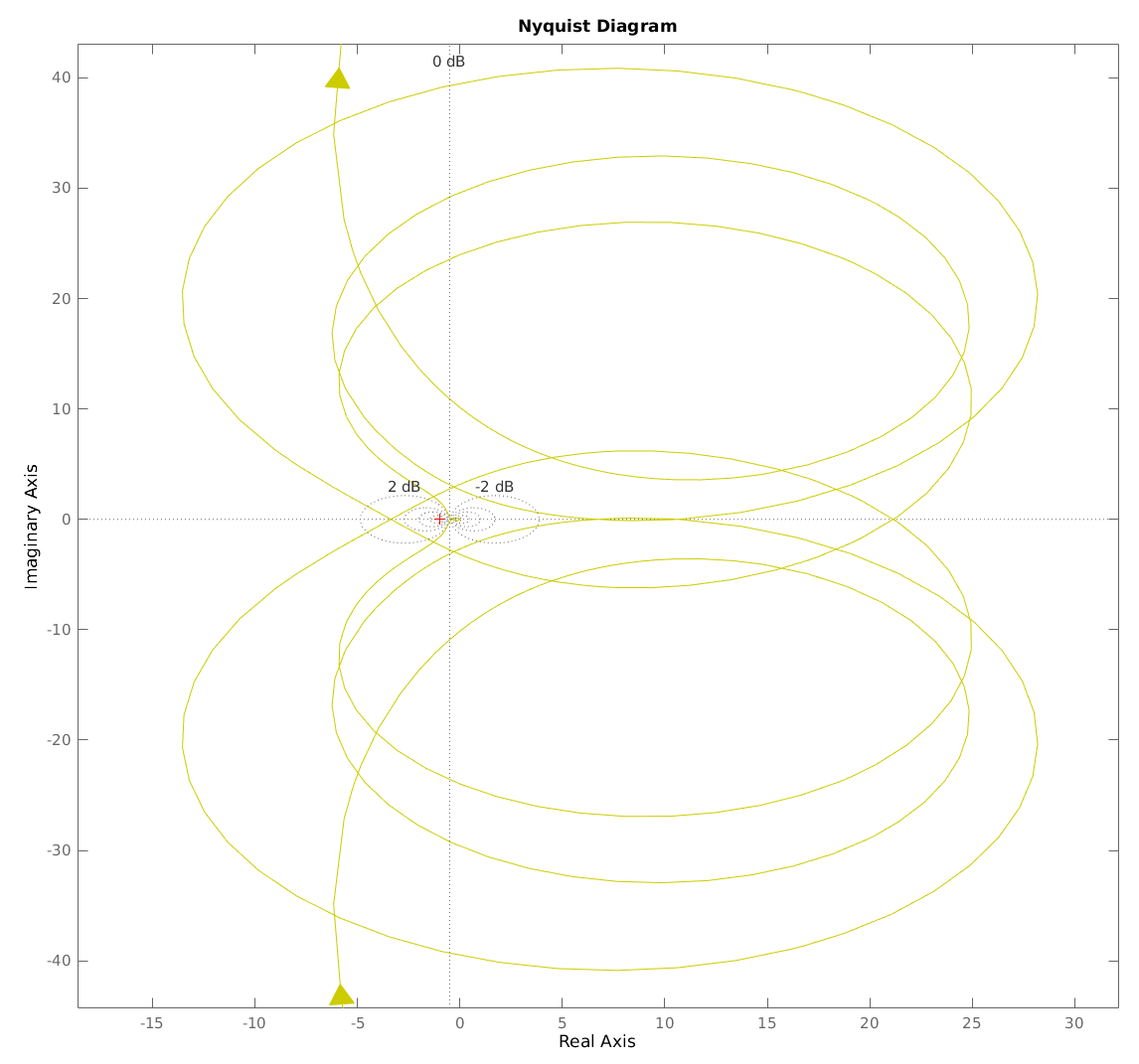
One can plug in the fitted transfer function into MATLAB sisotool and plot all sorts of root locus and Nichols charts, as shown in the attached plots below. The fact that the phase rotates by about 360 degrees in such a short frequency span (between ~1 and ~2 Hz), makes the loop unstable.