kara.merfeld@LIGO.ORG - posted 14:40, Friday 07 September 2018 (43875)
PSL dust and overpressure
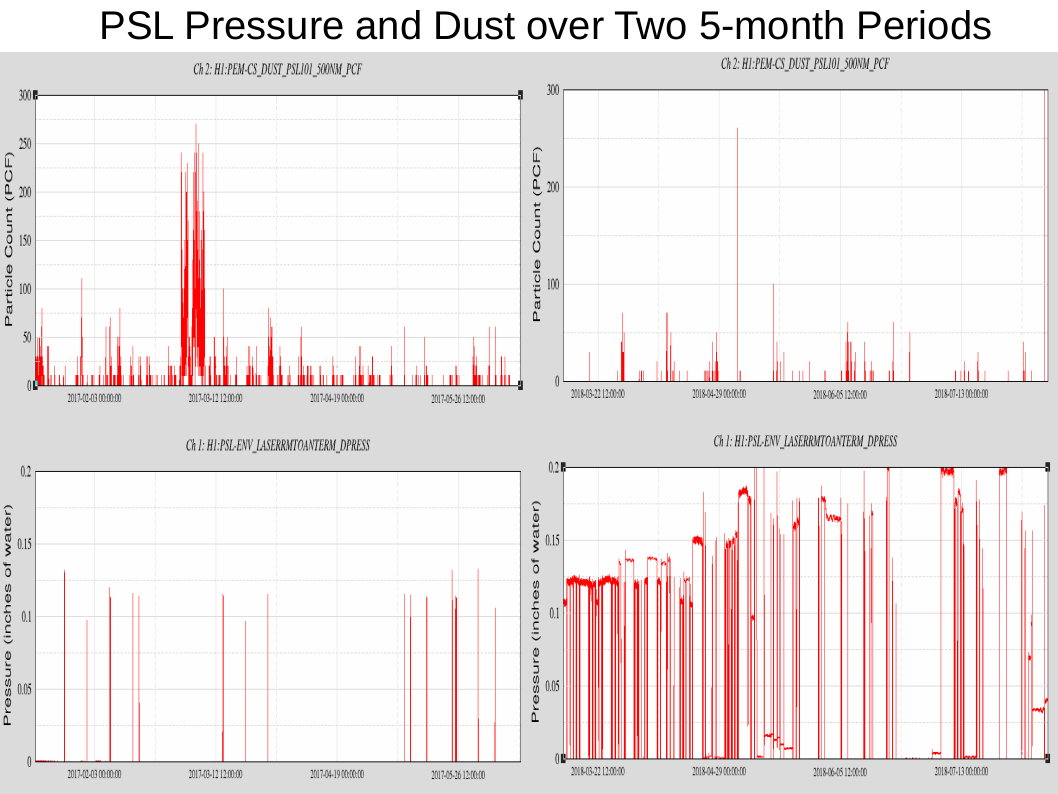
The PSL was rarely over-pressured during O2, which had a negative effect on the amount of dust in the PSL.  We should probably set an alarm on low PSL overpressure.

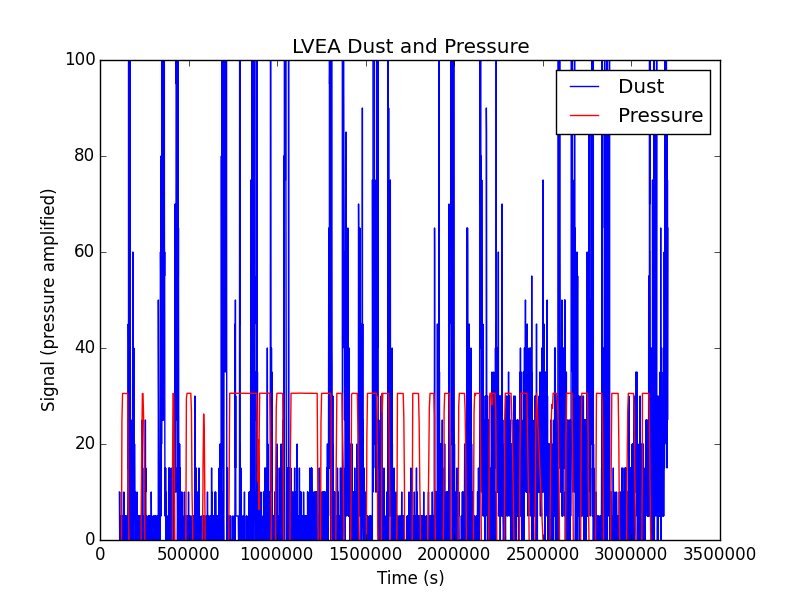
Figure 1 compares the particle count in the PSL during a 5-month span of time in O2, and in recent months.  It is very clear that there is much less dust in the PSL when it is over-pressured.  The average particle count over a 36-day interval in July and August 2018 (using only times when the PSL was void of people) was 0.165, an entire order of magnitude lower than it was in O2.  So the consistent overpressure is helping.  We broke this down more specifically into high-pressure (greater than .1 inches of water) and low-pressure (less than .1 inches of water) averages, which were 0.01 and 0.21 particles/ cubic foot, respectively, with standard deviations 0.32 and 2.89.  A similar correlation holds between the dust in the LVEA and the pressure in the LVEA, as shown in Figure 2.

It should be noted that the average particle counts published in ALOG #43253 are not correct.  The average particle count in the PSL over O2 was 3.63 particles larger than 500nm in diameter per cubic foot.  During the most significant dust event in O2, taking place between March 2nd and March 5th, 2017, the average PSL particle count rose up to 71.88 particles per cubic foot.  Both of these numbers are still below 100 particles per cubic foot, the clean room's standard.
Images attached to this report