[Sheila, Hang, Gabriele]
In brief, the L1 LOCK gain in ITMX was 10 instead of 1 (as it used to be during O2). Therefore the reallocation of pitch and yaw to M0 was ten times stronger, and it modified the suspension angular response as seen by the ASC at the lower stages. This created a crossover at about 1 Hz that produced the right-half-plane zero we measured in CHARD and DHARD. This wrong gain was there only in ITMX. We reverted it to 1 as it was during O2. The gain was changed from 1 to 10 on Saturday June 2nd 2018 at about 21:55 UTC. Nothing relevant written anywhere in the elog.
The plot below shows the yaw to yaw response of ITMX, measured with the optical lever, in a few different configurations.
- Blue: M0 reallocation on, as it has been for the past 3 months (ten times stronger than it should be). This transfer function deviates from the expectation (and from other suspensions) below a few Hz. You can also note the large phase rotation at about 1.8 Hz, which corresponds to the non-minimum-phase zero
- Green: M0 reallocation off, this is the expected response of the suspension, and there is no weird phase rotation
- Red: M0 reallocation, turning the L1 lock gain back to 1 from 10. Note that we are not using L1, but this is a pass-through gain
- Brown: M0 reallocation plus a 0.6 Hz Chebyshev low pass filter, that Hang designed to reduce the impact of the reallocation. The design is based on the suspension model, which seems to match reasonably well the measurement (at least qualitatively)
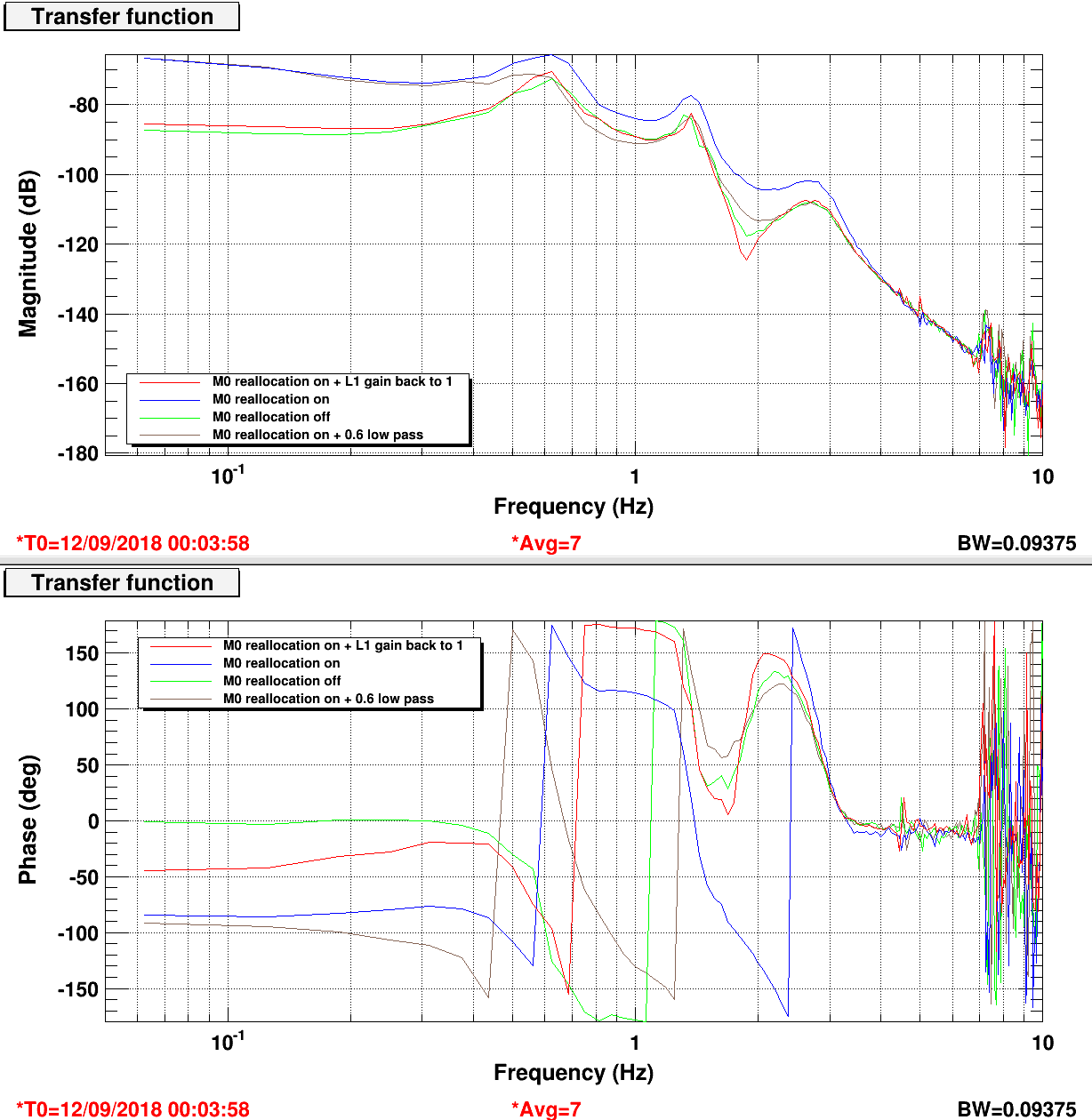
The expectation is that this will fix the DHARD/CHARD plants (43844)
We implemented the low pass filters in all test mass M0 stages, since it gives us some more phase and gain margin at about 1.8 Hz, where there is still a zero.
The story of how we found this problem is long and convoluted. A brief summary below:
- we noticed that there was a large coupling of yaw actuation to pitch motion for the two ITMs, much larger than the ETMs
- we wanted to measure and fit it, so we repeated optical lever measurements of all angular transfer functions of all four test masses
- we noticed that the ITMX pitch to pitch was clearly different from the others, and we traced the difference w.r.t. ITMY to the fact that M0 was on for ITMX and off for ITMY
- we then took a ITMX measurement with M0 reallocation off, and found that ITMX was now behaving
- Hang added the low pass filter in the M0 path, and we found that the yaw transfer function was much better
- We finally found the wrong gain looking at the conlog
As part of this story, Jenne Hang and I checked the calibration of the test mass oplevs using the baffle PDs.
ITMY pit oplev is about 4% larger than what I got from the baffle PD, yaw is 3.5% lower, ETMY pit oplev is 13% high and yaw is 2% high. Jenne did a similar check for the Y arm optics, and I think that she also found that the optical lever calibrations are OK. (for locations of baffle PDs see D1200657)
The check that there wasn't a cross coupling between pitch and yaw on the ITM optical levers, Jenne and Hang steered the green beams to PD2 +PD4 on the ETM baffles, and in both cases the optical lever response in yaw was about 2% of the pitch response.
It would be great if someone could follow up on the ITM pitch to yaw cross coupling during some down time (without the confusion about top mass offloading).
For the yaw to pitch coupling, we already have good measurements of all test mass actuation responses. We only have to repeat the ITMX measurements since they were taken with the wrong M0 offloading. This will take about (10+10)*100 s = 2000 s of interferometer offline.
I will post more details with the measurements tomorrow, and hopefully there will be time to repeat the ITMX measurement.
Commenting on Sheila's log about oplevs checks:
To check the calibration:
- See alog 43816 for the method. In summary, we expect the baffle photodiodes PD1 and PD4 on the ITMs to be 37.2 urad different in pitch, and 37.4 urad in yaw.
- Looking at a time when the baffle PD dither align script was run, you can see what the oplevs report for the pitch and yaw positions at the time that the beam is centered on either PD1 or PD4, and check that the delta between them matches the 37urad expectation.
To check that true pitch motion is reported by the oplev as pitch-only, and not a combination of pitch and yaw:
- (For ITM, ensure that ETM is misaligned to avoid confusion of reflected beams)
- Put sliders such that the green beam from the end station is centered on baffle PD 4 (ex. H1:AOS-ETMX_BAFFLEPD_4_POWER when checking on the ITM). The appropriate location should have been found with the baffleAlign script. Make note of the oplev reported values.
- Move pitch slider such that you see light on PD2 (ex. H1:AOS-ETMX_BAFFLEPD_2_POWER when checking on the ITM). Adjust both pitch and yaw sliders such that you are centered on baffle PD. Make note of oplev reported values.
- For ITMX yesterday, the difference in pitch reported oplev values was 47.2 urad. The difference in yaw reported was 0.4 urad. So, for what should be a true pitch motion (PD2 is directly above PD4), the ITM thinks that it saw mostly pitch motion, and a small amount of yaw (about 1% as much yaw as pitch).