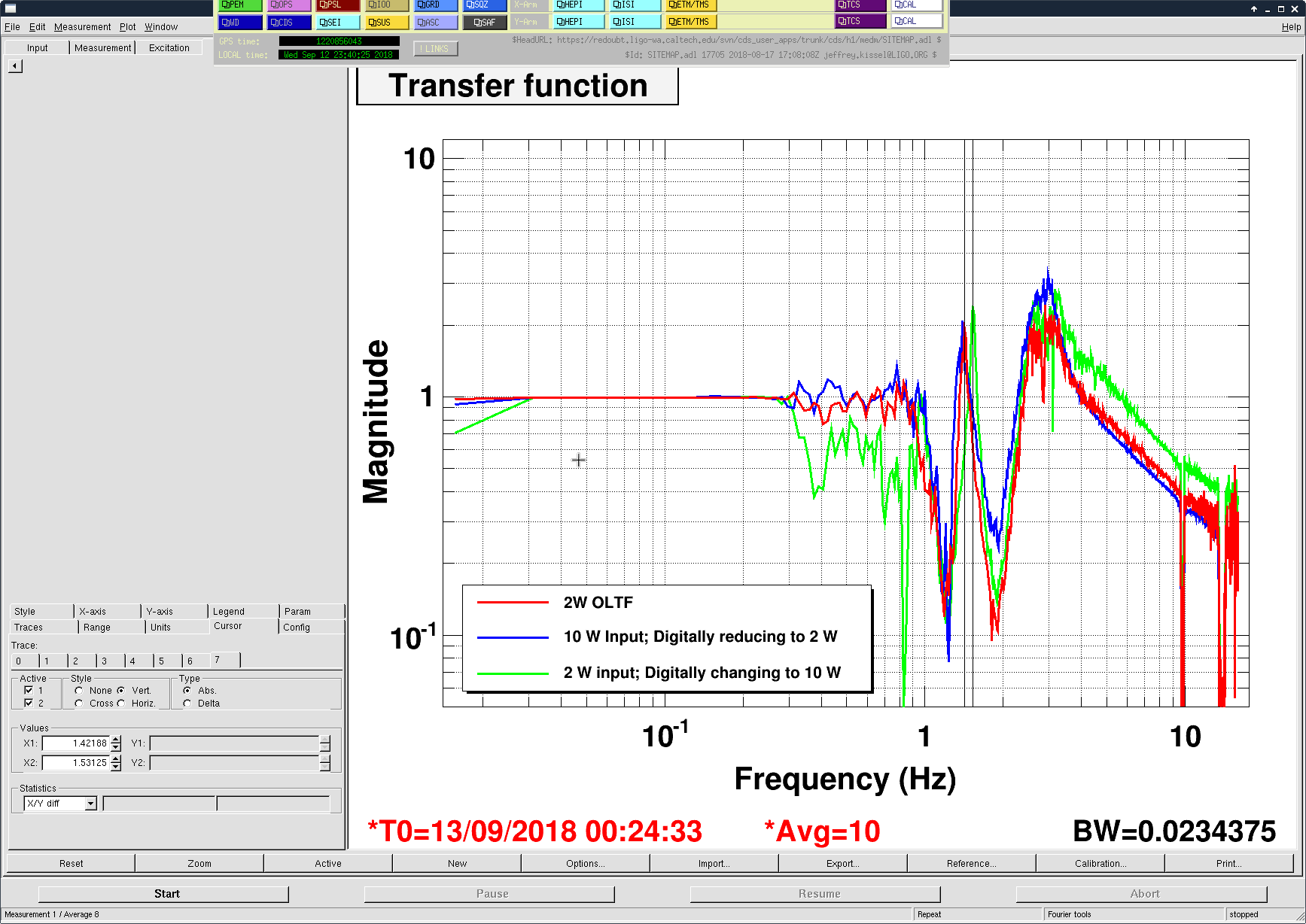
We were able to modify the ARM ASC plant by digitally adding the Sidles-Sigg torque.
Specifically, at 2 W input power, we are able to digitally modify the plant to look like a 10 W one, and at 10 W, we can reduce the plant back to the 2 W one. This further means that we should be able to remove the power-dependent part of the ctrl filter, and designing a single ctrl filter should be sufficient.
Please see the first attached plot.
Here the red trace was the DHARD YAW OLTF measured at 2 W input power without digital compensation.
The blue trace was the DHARD YAW OLTF at 2 W input power but with a digital Sidles-Sigg torque added so that it looked like a 10 W plant. Note that the sus resonance was shifted digitally from 1.4 Hz to 1.5 Hz. (We increased the overall loop gain to make the UGF 6 Hz for this measurement.)
The green trace was the OLTF measured at 10 W input power with the digital compensation to reduce the plant back to the 2W one, as the resonance peak was shifted back to 1.4 Hz. (As we power up the optical response decreased a bit thus the UGF reduced to 4 Hz; yet this is only a dc factor and can be tuned easily. Also we do not need a perfect subtraction here. With 10% error we can already reduce the 50 W plant to a 5 W one which we can control without modifying filters. The DC gain also provides us a measurement of the )
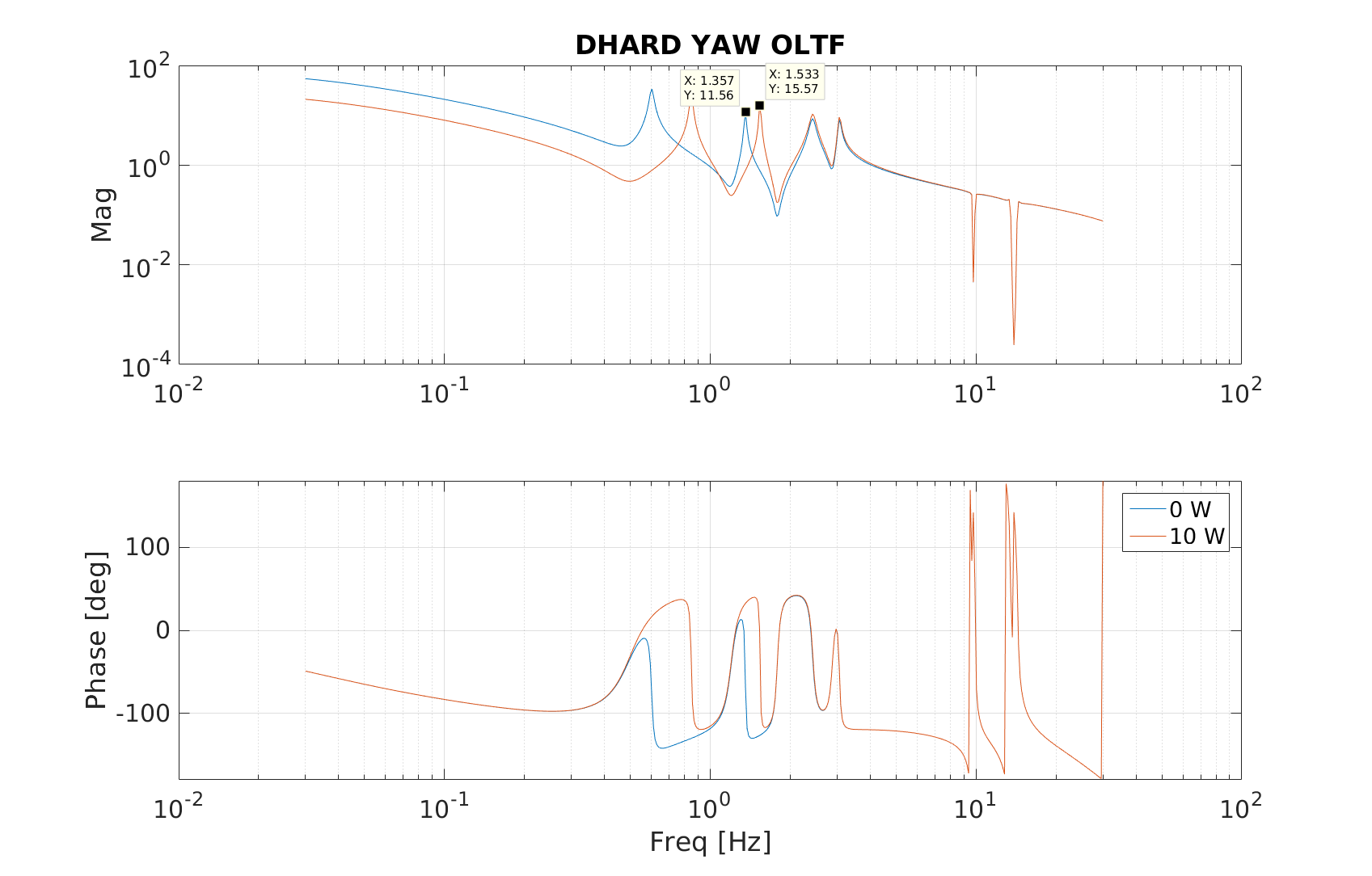
As a reference, in the second plot we also show the matlab modeled DHARD YAW OLTF. My sus model was just the default one so the resonance frequencies did not match the real LHO quads exactly, but the point is that from 0 W to 10 W (50 kW per arm circulating power), we should expect the secondary suspension resonance at 1.4 Hz to be shifted to 1.5 Hz, as illustrated in the measurements.
==================================================================================================================
Details:
We currently do not have the path dedicated for this digital compensation. Thus we borrow the DC 5 filter bank for this compensation. The same error signal for DHARD Y ctrl was sent here and the output goes to the same output matrix as DHARD Y ctrl. The details of the filters was detailed in LHO:43849. We updated the optical response FM5 [rad/ct] by increasing it by a factor of 3. Changing the 2 W plant to 10 W we put a DC gain of +1. To compensate for the 10 W plant to make it back to 2 W we put a gain of -0.8 (due to lose in the optical gain as we increased power; again this is just a DC factor and tuning it to 10-20% accuracy should be much easier than designing different ctrl filters at different input powers).