Gabriele, Jenne, Sheila, Hang
We fixed the right-hand zero in CS_P OLTF (LHO:44216) by using a blended error signal for CSOFT, as illustrated in LHO:44237.
Specifically, we used a combination of TR QPDs that are insensitive to TMS drifts (LHO:44240) at low freq, and then blend in a different combination of TR QPDs that are insensitive to CHARD_P for the high freq input. The blending freq is set to 0.06 Hz for now.
The input matrix we use is now
| TR_X_A | TR_X_B | TR_Y_A | TR_Y_B | |
| -0.619 | 0.313 | -0.271 | 0.133 | CSOFT_P_A (< 0.06 Hz) |
| -0.140 | 0.135 | 0. | 0.039 | CSOFT_P_B (> 0.06 Hz) |
The HF input is consistent with those measured in LHO:44237 with the error in the overall sign fixed. We set the overall scale by dithering CS at 13.2 Hz and match the two sets of signals' responses.
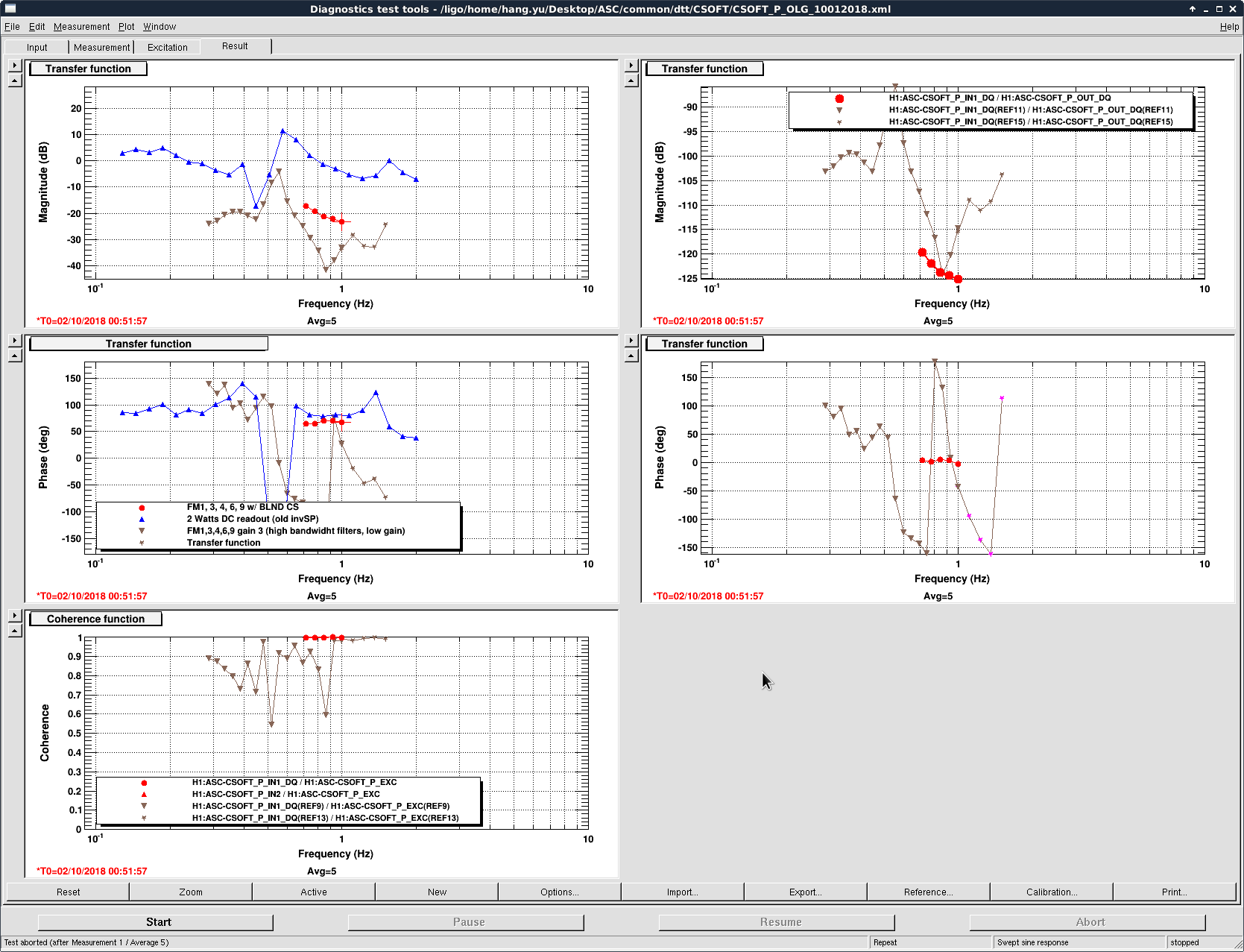
With this setup we measured the CSOFT OLTF as shown in the attached plot. The red trace was the measurement result for the new CS loop with blended error signal, and the blue was the O2 reference. The brown trace was the one showed the right-hand-zero at 0.85 Hz due to cross-coupling with CHARD, and presumably with DH/DS as well (as subtracting CH alone did not fix the problem; LHO:44246).
After the measurement, we further turned off the -20 dB filter (FM1 in CSOFT_P filter bank) so the current CSOFT loop should have a high BW of 0.8 Hz or so, matching the O2 reference.
In addition to switching off the -20db filter, we could also increase the gain from 3 to 30.