sheila.dwyer@LIGO.ORG - posted 02:20, Friday 05 October 2018 - last comment - 09:37, Friday 05 October 2018(44352)
Progress tonight, CHARD blends, ASC cut offs
Hang, Sheila, Georgia, Craig
We made progress on several things tonight.
- After blending CHARD Y we no longer have the mystery phase loss that we have been concerned about. (more details on CHARD blending below)
- We reverted changes to DRMI acquisition and our re-locking has been much quicker tonight than it had been. 44348
- Hang got the HARD yaw radiation pressure compensation working 44349 and we added this in the guardian in the CHARD_BLEND state.
- Craig has updated the calibration (44351)
- We stepped through the low noise ASC, and have a DARM spectrum that is mostly limited by ESD noise.
- We have had several locklosses that look like the ones we've been calling fast locklosses at 10W, but we have been able to relock quickly.
- We had one very interesting lockloss 44353 where the IMC stayed locked and the ref cavity was wiggling on the camera.
- Georgia worked on damping ETMX mode2, which was ringing up.
More details on CHARD blends:
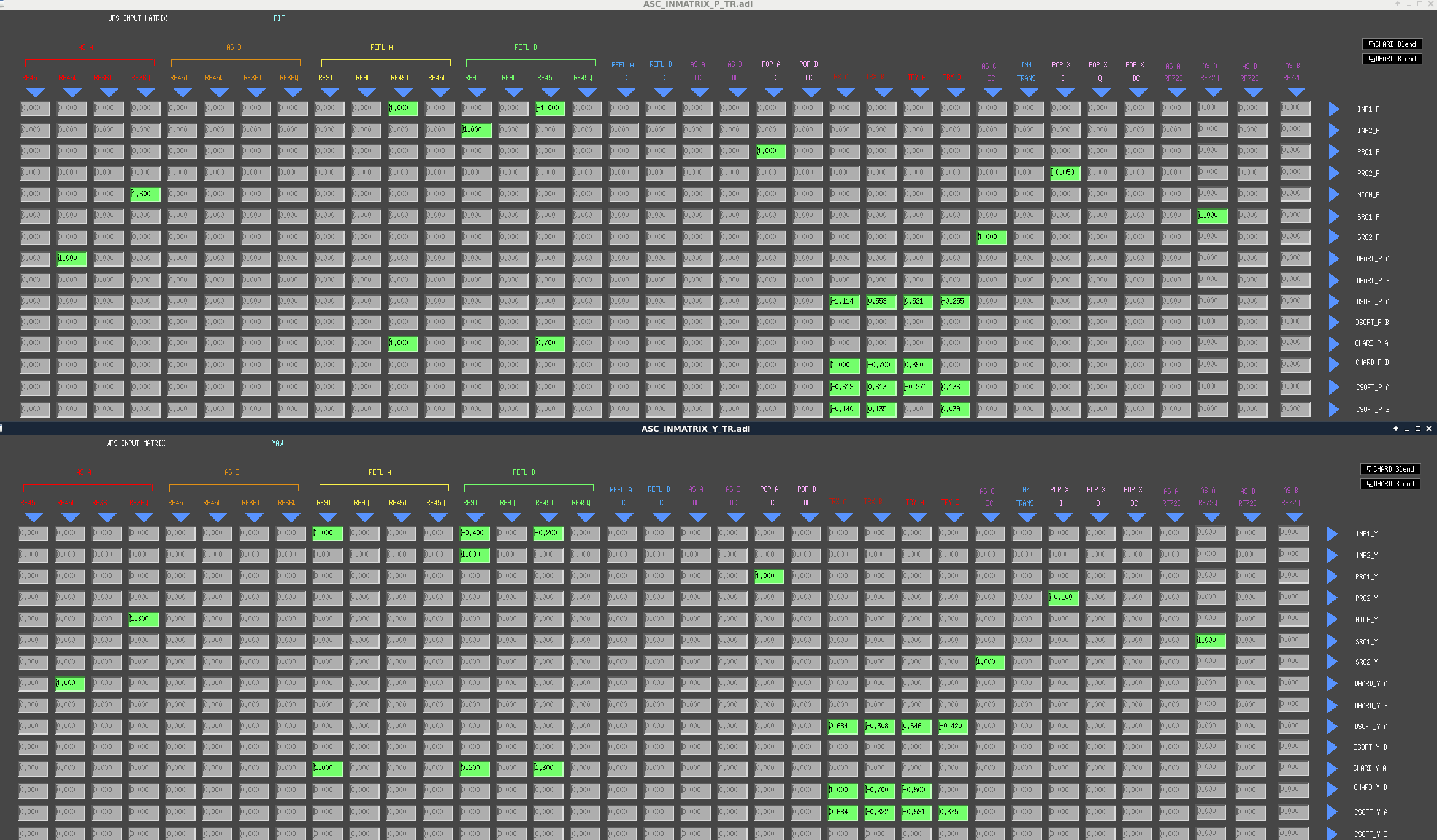
- 1st attachment shows the QPD combinations that Hang choose for the CHARD blends.
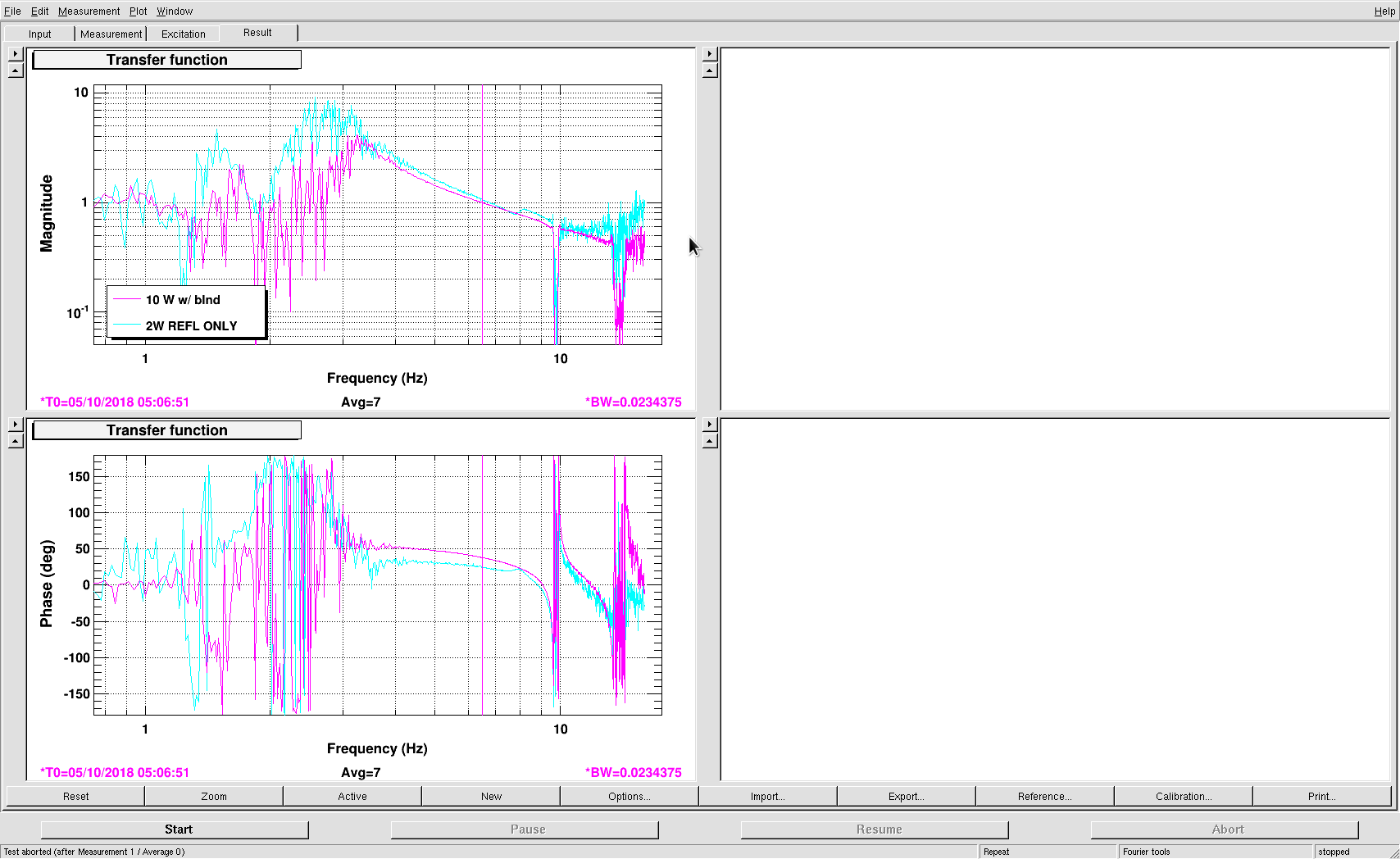
- 2 screenshot (and dtt template) CHARD Y OLG comparison with and without the blends on. The phase that has been missing (44341) is fixed with the blend on.
- We added a new state called CHARD_BLENDS in the guardian, since we weren't ready to test LOW_NOISE_ASC yet. (Caution to anyone who recombines this with LOW_NOISE_ASC, deleting guardian states breaks out lockloss tool)
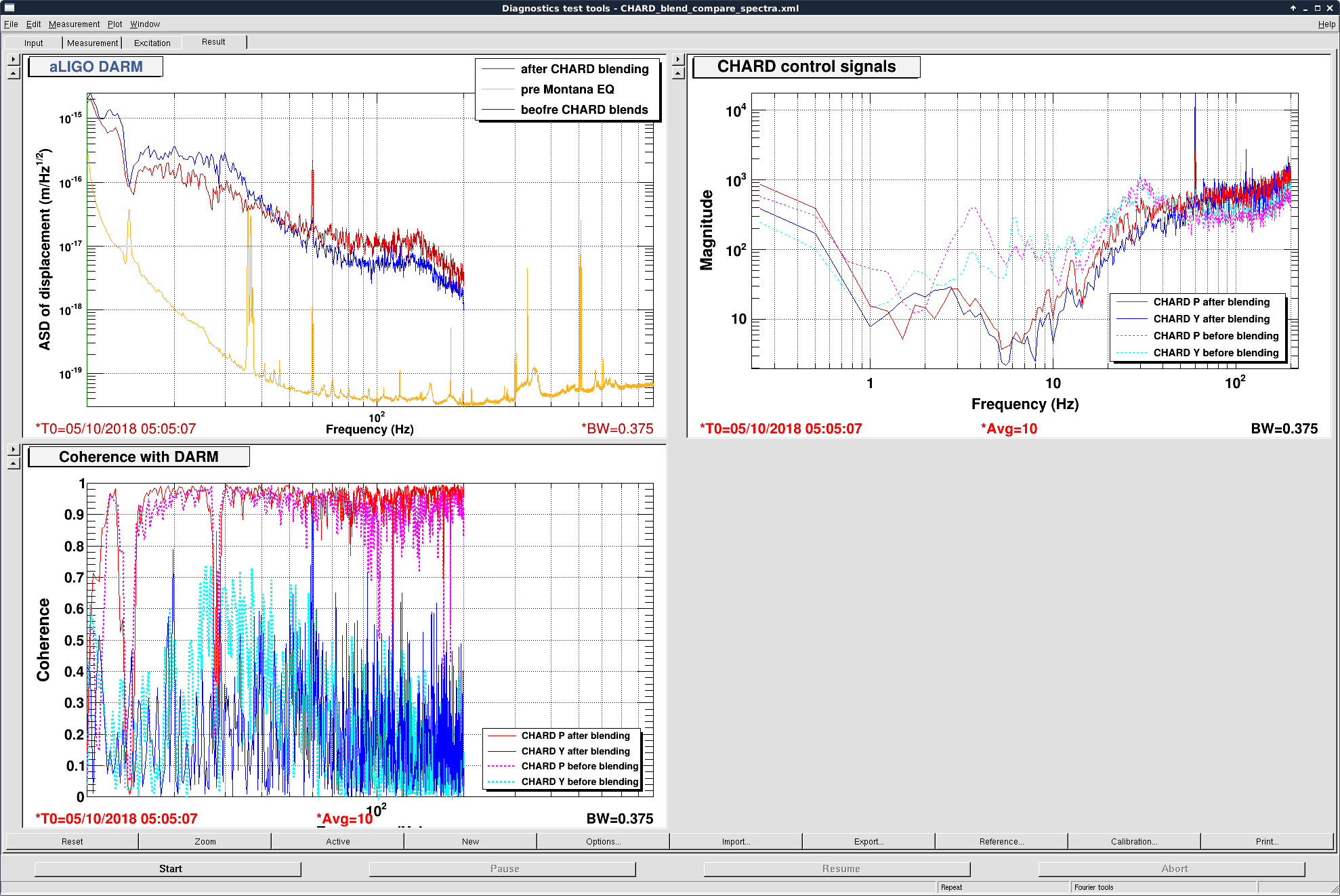
- 3rd screenshot: Before and after comparisons for the CHARD blends. We did this before doing the low noise ASC steps, so the ASC noise is huge in DARM. The yaw control signal is reduced more than the pitch one, it is about a factor of 10 lower at 10 Hz and about a factor fo 7 lower at 30 Hz. For pitch the blending isn't quite as beneficial but we are still getting a factor of 3 improvement at 30 Hz.
More details on LOW_NOISE_ASC:
- Georgia and I stepped through the low noise ASC state, and edited it in places to reflect what we did.
- We commented out the compensation filters for yaw, since we are using the radiation pressure compensation.
- We engaged the HARD P compensation filters and reduced the DSOFT gains in the same way that they were written in the gaurdian.
- There are gain reductions for all the hard loops in this state, we edited this based on measurements by Gabriele, Jenne and Hang 44341 We reduced the CHARD Y gain by a factor of 2, P by a factor of 3, and DHARD P by a factor of 2. We didn't reduce DHARD Y, but it probably needs to be done.
- For both HARD yaw loops we are using cut offs which are less aggressive than what the guardian called for. For and DHARD Y we left out the ELP10 filter that the guardian would have engaged, for CHARD Y we left out the cutoff15Hz. It would probably be a good idea to measure the loops and check the gain settings before we engage the more aggressive cut offs. For the pitch loops we did engage the more aggressive cut offs used during O2, but we didn't measure the loops.
- We commented out the PRC1 cut offs because we have increased the gain in this loop and it isn't coherent with DARM (yet)
- We ran this state once and it is fine as it is now, the coherence with DARM of the hard loops is greatly reduced, CHARD Y still has some high coherence up to 35 Hz because we didn't engage the more aggressive cut off. The DARM noise is now probably limited mostly by ESD noise. (note the DARM calibration used in the last attachment is not right).
Images attached to this report

Non-image files attached to this report

Comments related to this report
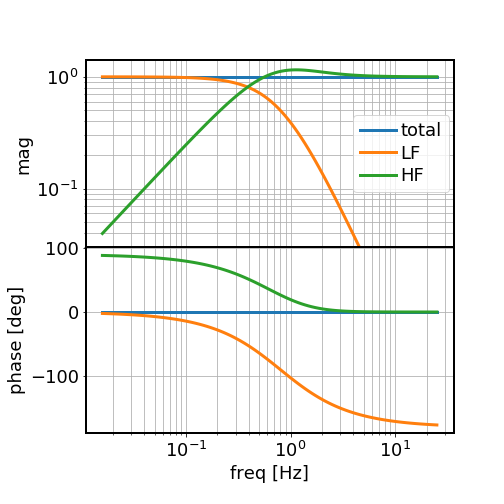
For the CHARD blending, we chose the blending freq to be 0.4 Hz (defined where the |LF| = |HF|), 5 times lower than what was used in O2. Please see the attached image for filter design
We hope that this lower-freq blend should reduce the coupling to CHARD ASC from both HAM1 and PRCL/MCL.
Images attached to this comment