Craig, Sheila, Georgia
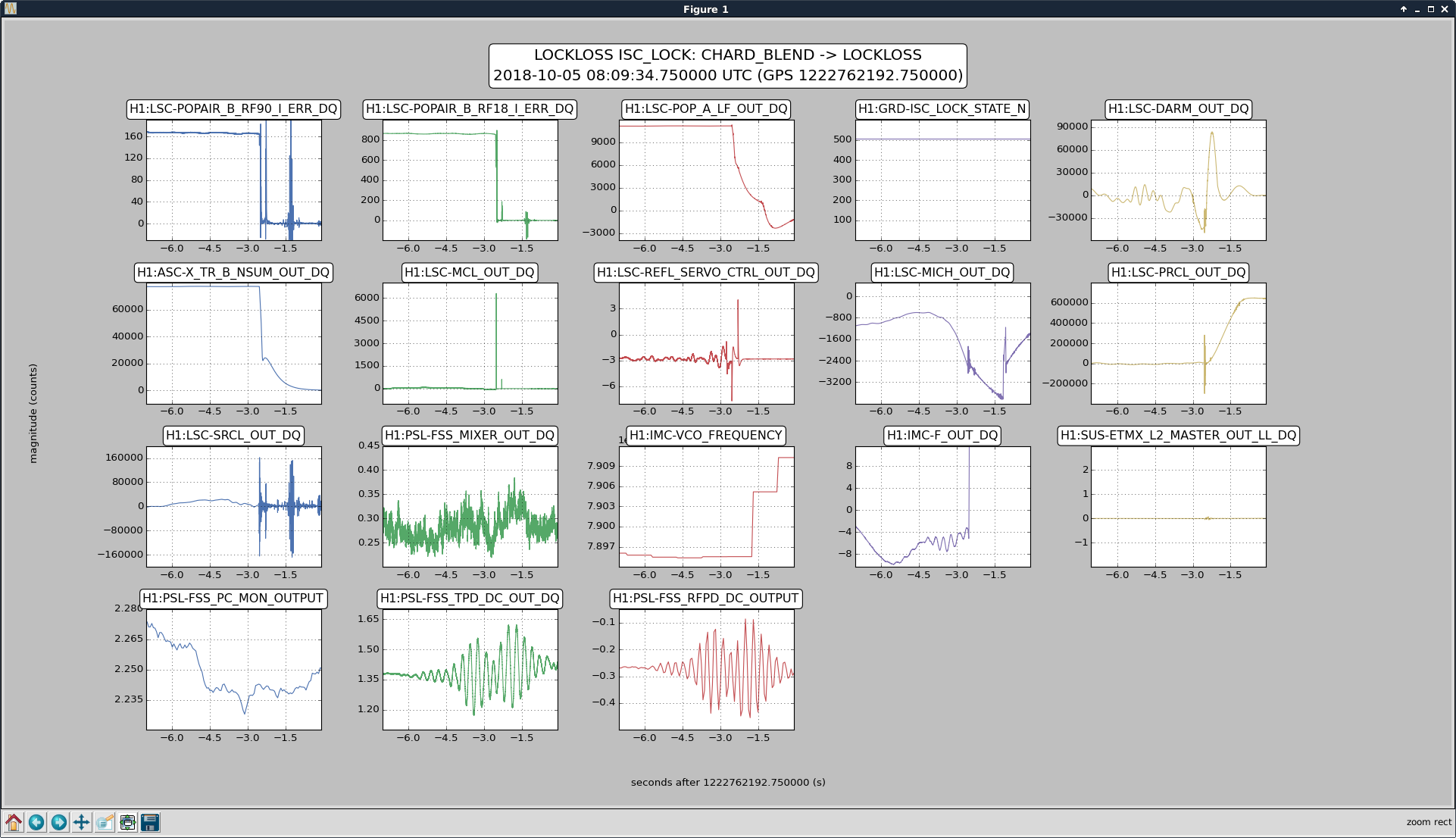
This evening we had a fast lockloss from 10W. The IMC did not lose lock however we saw on the beam on the reference cavity reflection and transmission cameras jiggling at something like 3Hz, as if the ref cav was swinging around.
We ran the lockloss tool and included some PSL channels; sure enough see a 3Hz oscillation in the ref cav transmission and reflection, starting 3 seconds before the lockloss. The oscillation is just visible in the IMC-F, but we don't see it in the mixer, vco, or eom monitors (see bottom two rows of plots in the attachment).
Maybe this is a clue for our past fast locklosses?
I looked into the source of the reference cavity motion and loss of lock and found that it was a huge site-wide but rare seismic and acoustic event. The interesting thing is that the arrival time at all stations is within about a second. This is consistent with teleseismic events, but unlike an earthquake, it has content up to 30 Hz (Figure), which should be highly attenuated for distant seismic signals. It is unlikely to be something nearby generated at the surface because the propagation delay is too small for surface waves of these frequencies. It would have to be generated right out in the middle of the arms at nearly the same distance from each of the buildings. It could be a small earthquake located nearly right under us.
It could also be acoustic, but it would have to originate far above us to be consistent with propagation delays. I think it is most likely under us because the seismic SNR is higher than the acoustic SNR. Also, the TF signature is not consistent with flying vehicles.
In any case, the DV plot in the figure shows that it is rare, nothing else as loud in the last month.
