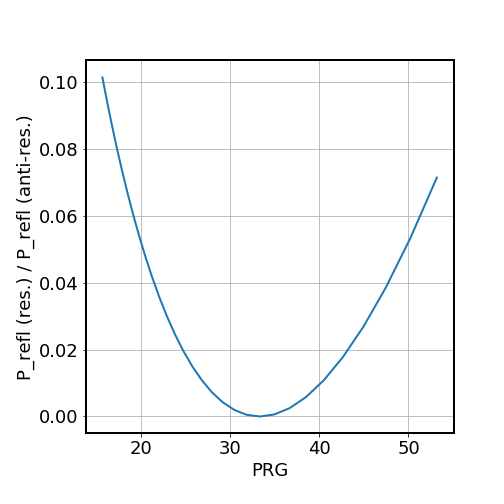
In the attached plot we show the refl pd power as a function of power recycling gain (PRG). Here the x-axis is the PRG, the y-axis is the refl PD power, normalized by the power when the carrier is anti-resonant in CARM & PRC. In generating the plot we vary the arm losses as a parameter to compute the PRG and refl power simultaneously.
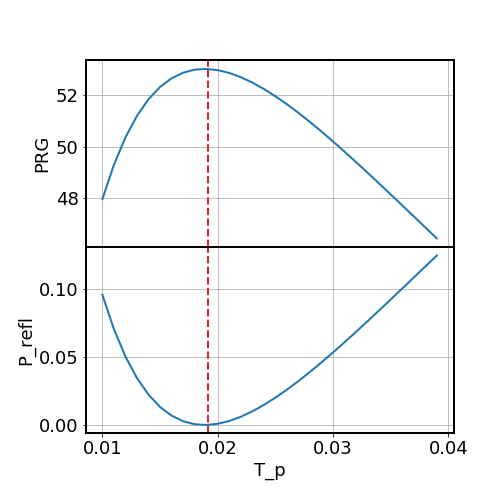
Daniel suggested that in the future we might consider changing the PRM transmissivity to optimize the power recycling gain (PRG), given that we have less losses in the arms.
In the attached figure we show the PRG and reflected power P_refl (normalized by the anti res value) as a function of the PRM transmissivity. In the calculation we have assumed a total loss in one arm is 67 ppm (55 ppm loss at the ITM, 8 ppm scattering loss at the ETM, and 4 ppm transmissivity of the ETM), which gives a PRG of 50 for the current PRM transmissivity of 0.03. The red-dashed line shows the theoretically expected optimal T_prm that maximizes the recycling gain, and can be calculated based on the simple relation (cf. eq. 2.18 of Evan Hall's thesis, assuming T_itm=0.014):
T_prm (optimal) = 4 eta_arm / T_itm = 1.91% * (eta_arm / 67 ppm),
where eta_arm is the total loss per arm. This leads to an optimal recycling gain of
PRG (optimal) = T_itm / (4 * eta_arm) = 52.2 * (67 ppm / eta_arm).