This is a late alog of work done yesterday afternoon with Gabriele.
Friday evening Daniel and I noticed that we have about 10 times more power on our REFL diodes than in O2 according to the readbacks, with 1mW on the in vac REFL LSC diode when we are locked at DC readout. Yesterday we tried to check that the amount of DC power roughly makes sense, which it does. Since this is one thing that is different than O2, we suspected it could be contributing to our fast lockloss problems.
-
The amount of power on the diodes:
-
There is a factor of 2 missing in the calibration for REFLAIR A, and an ND filter which attenuates the light by half. While we were sitting at DC readout with 2W of input power and a recycling gain of 48, I measured 0.54mW of light heading towards the REFL air A diode, before the ND 0.3 filter which is mounted on the diode face. That means that there should be 0.54*10^-0.3 = 0.27mW on the diode if the entire beam hits the diode and the ND filter is accurate. Our readback says that there is 0.145mW on the diode, so there is a factor of 2 missing. I also checked the centering of REFLAIR A, and noticed that we are overfilling the diode. I didn't check the calibration for REFLAIR B but there may also be a missing factor there.
-
The two LSC REFL air diodes should each have half as much power incident on them as the in vacuum diode does, if there were no ND filter on REFLAIR A. (see ISCT1 drawing and HAM1) This means that the measurement of 0.54mW heading towards REFLAIR A is consistent with the 1mW readback of REFL_A with 2W locked interferometer.
- The amount of light we get with the interferometer unlocked roughly makes sense. Anamaria suggesting checking that the powers make sense with the IFO unlocked, which they almost do. With PRM aligned, 2.1W of input power, and the interferometer misaligned our readbacks said that we had 2.3mW on REFLAIR A (which really means 8.6mW heading toward the diode based on the measurement above) 5.08mW on REFLAIR B (I didn't check this calibration), and 15.5mW on REFL. According to the HAM1 drawing, we dump 90% of the refl light using M14 and 50% of the remaining light using M17 before splitting between AIR/in vac and LSC/ASC. Including 80% efficiency through the IMC and input Faraday, we should expect to get 2.1W*0.8*0.1*0.5*0.25=21mW on LSC in vac, and about 10mW on both REFL AIR diodes. I haven't included any losses in the REFL Faraday path since I don't know what they are.
-
In O2 we had 1.8mW on LSC refl with 30W input and a PR gain of 29.5. Now with 2W of input power and a recycling gain of 48, we have 1 mW on the refl diode according to it's readback, which means we have ten times more power on the diode with the improved recycling gain for the same input power. Hang did a quick calculation for the increase in carrier power that we expect based on the improved recycling gain, 44370, and it seems plausible that we could have a factor of 10 more carrier light for the same input power with our improved recycling gain.
-
We are now powering up with nearly twice as much 9MHz modulation depth as we used in O2. (The 9MHz modulation depth was only slightly reduced by the EOM swap 41435 (for 45 see 41889 )) In O2 we reduced the 9MHz modulation depth by 6dB before powering up, I believe that the morning crew tried to do this in the last half of this week but it unlocked the interferometer.
- As we power up the power on the REFL diode is increasing roughly linearly, so we can expect that if we power up to 50W and maintain our recycling gain we will have about 25mW on the REFL diode.
-
As a quick test yesterday afternoon Gabriele and I switched the CARM control from REFL to REFLAIR, since it has a fourth of the amount of light that in vac REFL has.
- I phased REFLAIR 9 using an excitation into the common mode board well above the ugf to move most of the signal into I. The delay line in on "Int" mode which means that the front panel switches and not beckhoff control the delay. We are now using 3ns of delay on REFL air. (the 1 and 2 ns switches are flipped up)
- The cable to the common mode summing junction was connected to the Q output of the REFLAIR 9 demod, so I switched it to the I output. I did not switch the cable which go to the whitening board, they are connected so that the cable with the yellow tape that says A is connected to I and the one that says B is connected to Q.
- For in vac Refl, the switch on the front panel is set to Ext, which means that the delay is beckhoff controlled. The cable that goes to the summing junction is connected to I, as it was when we phased REFL on monday night. (44272 and comments) The cables that go to the whitening chassis seem swapped however, the cable labeled A goes to Q while the cable labeled B goes to I.
- Using a swept sine excitation I measured that the gain of refl air is 23dB lower than the gain of refl, and there is a phase of 0 degrees between I mon of the two demods.
- We switched the control of CARM over to REFLAIR after the ANALOG CARM step by reducing the gain in the REFL path by 6dB then ramping on the REFLAIR path. The attached script can be used to do this.
- We also edited the adjust_CARM gain function in ISC_library and added a parameter to lscparams to indicate that we are on reflair and ramp down the appropriate gain slider as we power up.
- We tried switching to reflair and powering up a couple of times, and tried once to power up on in vac refl. Each time we lost lock due to something very fast that happened within minutes of reaching 11W input power.
Ideas for things to try next:
- Look at the spectrum of the RF monitor on REFL (and pop) and see if there are any frequencies that are large enough to potentially saturate the diode.
- Try to debug the modulation depth reduction step so that we can try reducing 9MHz before powering up.
- It seems that this problem with fast locklosses has been gradually getting worse over the last month, it is happening at lower powers and more frequently, yesterday was the worst that I have seen it.

We definitely need to fix the fast locklosses, but I think that the 45MHz is important to look at as well.
We have never reduced the 9MHz before power-up. It is the 45MHz that we reduced by 3dB before power-up. In O2, the 9MHz was reduced by 6dB after we've transitioned to the low noise ESD at high power. So, we should look at both the 9 and the 45, just in case it's the 45 causing weird saturations and weird behavior in the REFL diodes, even though it's the 9 that we use for CARM control.
It's this 45MHz reduction state that I tried last week, and it failed and caused a lockloss, although I have not yet determined why.
Reflected power on lock is around 6.5% of unlocked power.
9MHz sideband power on input light is 1.8% (Γ~0.191); most of it will show up in reflection.
45MHz sideband power on input light is 3.3% (Γ~0.251); around half will show up in reflection.
So, the reflected sideband power is around 3.5%.
Sheila, Hang
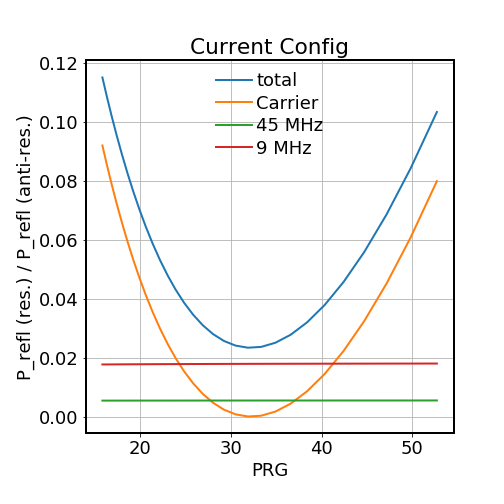
In our previous calculation LHO:44370 we only kept tracking the carrier field. As Daniel pointed out, the sidebands also contributed a significant amount of power in the REFL port. Thus we updated our calculation to include the RF sidebands.
In the first figure we show the locked / unlocked refl power as a function of PRG for the current configuration, and the second plot for the O2 configuration (9 MHz mod depth is about a factor of 2 lower than current setup).
It seems that the measured result is consistent with the theoretical model prediction. For now P_refl (resonance) / P_refl (off) = 6.5% corresponds to a PRG of ~ 46.5, consistent with our measured PRG of 48.
For O2 w/ PRG of ~ 30 and 6 dB lower 9 MHz mod depth, we should expect P_refl (resonance) / P_refl(off) ~ 1%, also consistent with the measured value.
Also for the 45 MHz, we found that about 20 % of the power is reflected and 80 % transmitted, thus its contribution to the REFL port is more like 0.5%.
The code for doing the calculation is available at /ligo/home/hang.yu/Desktop/pyComm/refl_vs_trans.ipynb

I discovered that I had a typo in the reduce modulation depth states, which are a remnant from when I cleaned up all of the guardian code a few months ago. Instead of setting some TRAMP values to 30 seconds in preparation for increasing digital PD gains to compensate for lowering the modulation depth, I was setting the PD GAIN values to 30 (they should be order 1, not 30).
This is now fixed in both the 45 MHz and 9 MHz states, and loaded.