Continuing the activity described in 44366, I measured the response of REFL WFS in yaw to CHARD, INP1, PRC1 and PRC2. Here's the sensing matrix, measured with a line at 8.5 Hz (CHARD ampl. 1.0, INP1 ampl. 1e6, PRC1 ampl. 0.01, PRC2 ampl. 0.3). The units are REFL_WFS units / ASC filter bank output. Therefore a direct comparison of the different degrees of freedom is difficult, since the actuator response is different in all cases (I can't see the excitation in the OPLEV signals, so I don't have a calibrated motion sensor).
| CHARD | INP1 | PRC1 | PRC2 | |
|---|---|---|---|---|
| REFL_A_RF9 | -0.000529 | 0.0553 | 0.0228 | 0.202 |
| REFL_B_RF9 | -0.000591 | 0.0278 | 0.0511 | 0.246 |
| REFL_A_RF45 | -0.000441 | 0.0686 | 0.0123 | 0.248 |
| REFL_B_RF45 | -0.000484 | 0.0461 | 0.0160 | 0.276 |
If we use this matrix and the ASC yaw input matrix currently in use for CHARD and INP1, we get the following response
| CHARD | INP1 | PRC1 | PRC2 | |
|---|---|---|---|---|
| CHARD err | -1.2764e-03 | 1.2079e-01 | 5.3820e-02 | 6.1000e-01 |
| INP1 err | -1.9580e-04 | 3.4960e-02 | -8.4000e-04 | 4.8400e-02 |
| REFL_A_RF9 | REFL_B_RF9 | REFL_A_RF45 | REFL_B_RF45 | |
|---|---|---|---|---|
| CHARD | 11.38 | -4.048 | -11.011 | 5.170 |
| INP1 | -0.178 | 0.138 | 1.495 | -1.336 |
This is quite different from the sensing matrix currently in use. I plugged those numbers into the CHARD_Y_B row of th input matrix, and measured the response to a CHARD sweep. If the new combination and the old one were equally sensitive, one would expect that CHARD_Y_B_IN1 / CHARD_Y_IN2 = CHARD_Y_IN1 / CHARD_Y_IN2 and that CHARD_Y_B_IN1 / CHARD_Y_IN1 = 1. This is not the case... Actually the new combination shows even less phase margin than the old combination. So the CHARD_Y sensing mystery deepens.
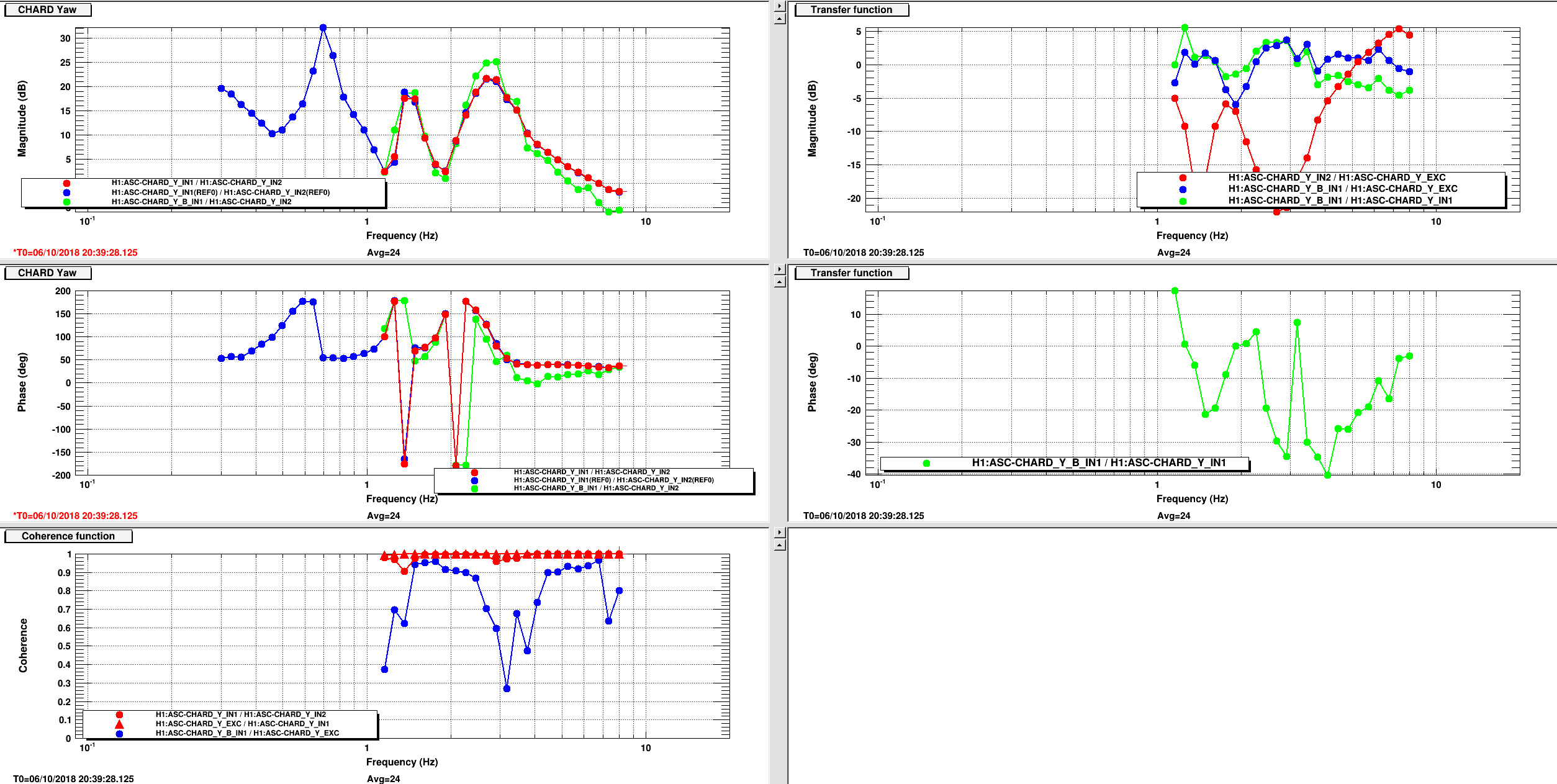
I left the IFO locked in DC_READOUT, with a CHARD_Y sweep sine going, measuring the coupling to all other yaw loops.