- Came in, IFO still locked from overnight. Hooray!
- Started to get ready to tune SRCL FF measurement templates (from Sheila's CSWG log 11217 of June2017).
- Lownoise_ESD_ETMX state seems to have been stuck just before the last counter. It had not removed the IX element from the LSC output matrix (which the state should do), and it was actively setting the ITMX_L3_LOCK gain to 0, so I couldn't start any FF measurements (IY was able to excite).
- I had tried running a measurement before realizing that IX wasn't sending signal out, so was only pushing on IY. But, I was using an excitation amplitude 1000x smaller than in Sheila's template, so it should have been fine. This was off for a few minutes while I looked at the guardian situation for IX before I lost lock.
- Lost lock, not sure why. No measurements running, nor had any been running for several min.
- New lock (no init align). Going to 15W.
- Rad Press compensation still set for 10W, but should be okay. Just won't look all the way like a 2W plant.
- Meas SRCL FF path
- Gain = 1 in SRCLFF1. Input off, FMs 3, 6, 7 left on (AC coupling and violin stopbands), all other FMs off.
- Gabriele tried with gain -1 in FF path, no real effect. Trying again with gain +1 caused some pitch mode to ring up. Even after turning off SRCL FF, pitch kept oscillating, lost lock.
- New lock, 20W.
- Gabriele disabled the Xarm green WFS again. They were okay earlier today (if the arm was very close to perfectly aligned), but now they're being bad again.
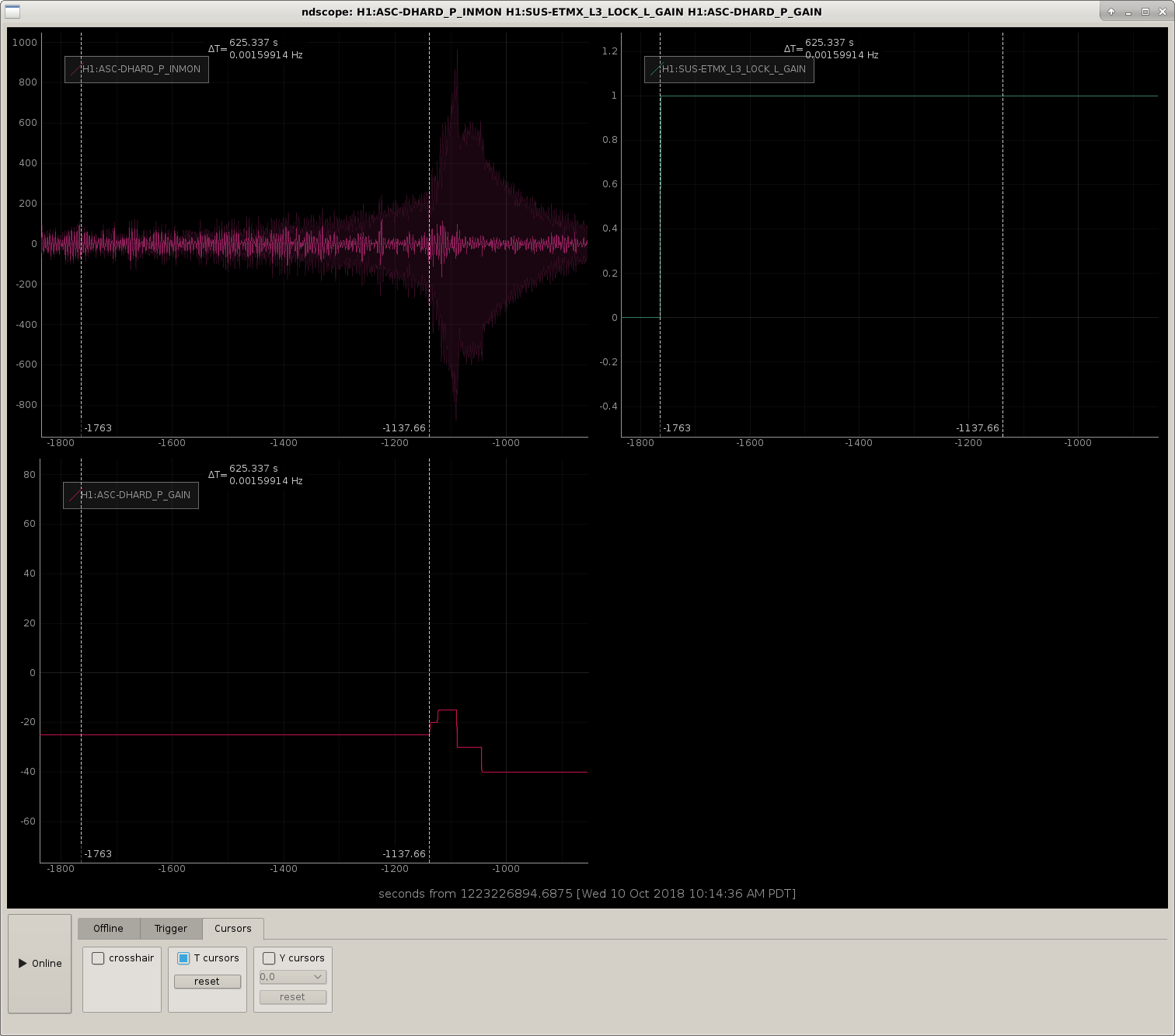
- DHARD_P started oscillating around 1Hz after ~5 min at lownoise ESD. Gain down = bad. Gain up = better. Using -40 rather than nominal -25. Seems to be ringing down. Trying to measure DHARD_P OLG, aborting DTT measurement killed the lock. DaveB looking into why excitations using filtered noise don't seem to be ramping down. (alog 44465 for details and screenshots, FRS 11367)
- Attached ndscope figure (DHARD_P_osc.png) shows this oscillation. First time cursor is set to the time when we started ramping back to lownoise ESD ETMX, and you can see that about 300 seconds we see an oscillation building. The second time cursor is set to the time when I decreased the DHARD gain, and you can see that the oscillation gets much worse. When I increase the gain, the oscillation goes away.
- New lock, 22W.
- Trying to measure DHARD_P, lost lock during a measurement, so must have been me, but I wasn't expecting a factor of 3 increase in my excitation to kill the lock. Ooops. (I'm already a factor of 10 lower excitation amplitude than we had been using at 10W with lownoise ASC but not lownoise SUS, this was going to a factor of 3 below the old excitation amplitude in the template). DHARD_P gain had been set to -40.
- New lock, 22W. Guardian INCREASE_POWER state now goes all the way to 20W.
- DHARD_P gain in LOWNOISE_ASC now set to -40 rather than the -25 that was okay for 10W.
- Human error lockloss.
- New lock, 22W
- Not sure what transitions were happening at the time, but at some point DHARD_P got some kind of kick, started to oscillate, but then calmed back down on its own.
I forgot which lock, but I measured MICH ctrl to DARM err for MICH FF. I didn't (yet) get a chance to measure the FFpoint to DARM, but other than somewhat different AC coupling filters, this should be the same as for SRCL, since they're both just pushing on the differential ITMs. FF measurement xml files are attached. The FF_point_2_DARM is measured using the SRCLFF1, with that version of AC coupling. Undoing this AC coupling and applying the MICHFF AC coupling should allow for the fitting of the MICHFF as well.
Lock lengths so far today:
- 8000 sec @ 10W with lownoise ESD (left from last night). Lockloss: unknown
- 6190 sec @ 15W, 5790 of those sec with lownoise ESD. Lockloss: human error
- 3200 sec @ 19.5W, 1320 of those sec with lownoise ESD. Lockloss: human error
- 1220 sec @ 21.75W with lownoise ESD. Lockloss: human error
- 640 sec @ 21.75W with lownoise ESD. Lockloss: human error
We do want to calibrate the IFO, but we should also carve out some time to just let the IFO sit untouched to see how long we can really stay at 20W on the lownoise ESD ETMX, perhaps during the site weekly meeting this afternoon.