Craig, Sheila
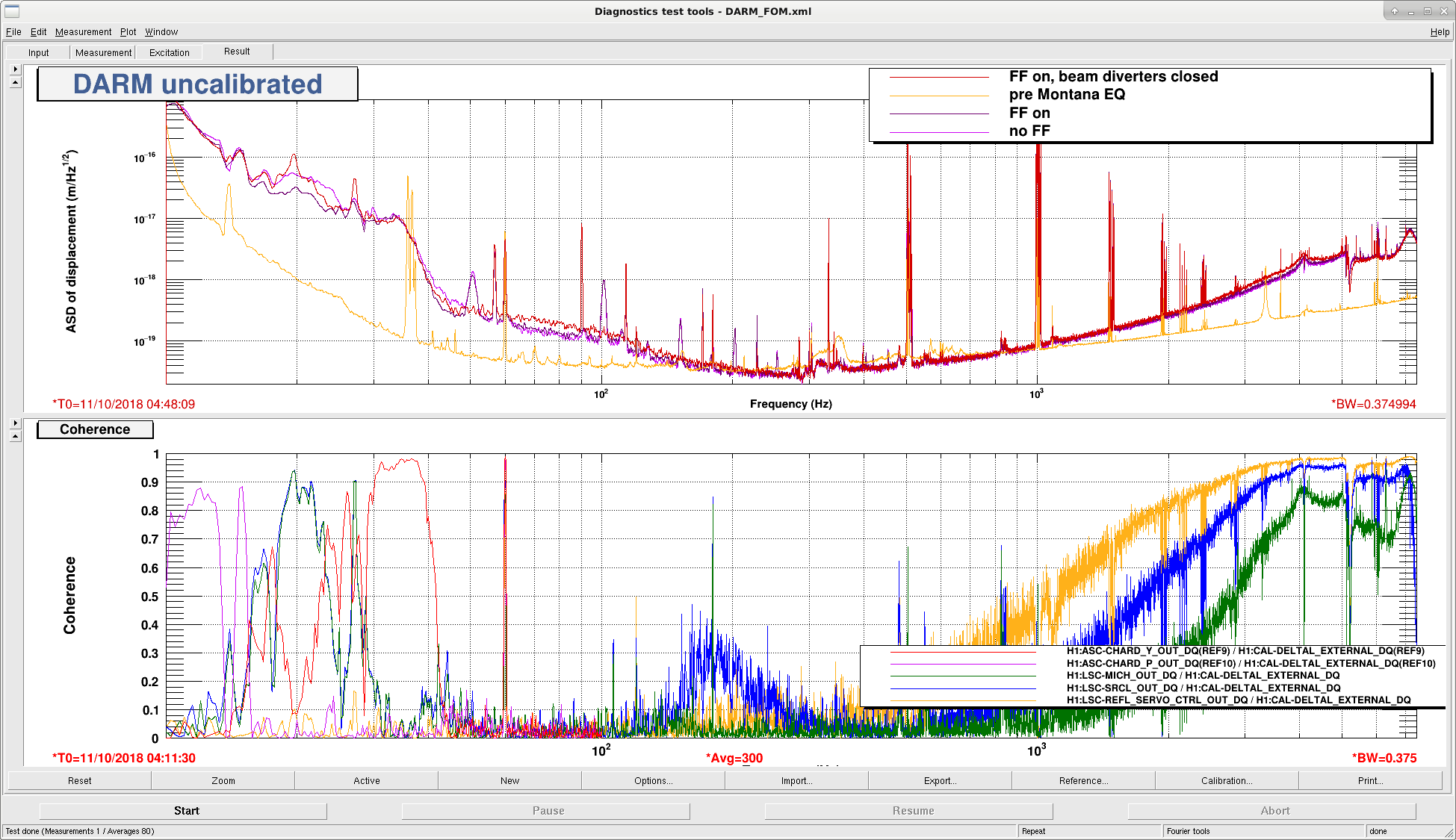
We engaged the MICH and SRCL FF with the filters that Jenne and Gabriele loaded 44470. There is some remaining coherence with MICH and SRCL, so our FF could be tuned. There is a lot of noise due to CHARD up to 40 Hz. We also have frequency noise above 1 kHz, we haven't boosted the CARM loop yet. (see attachment)
The peaks we've seen the last 2 nights at 50Hz and harmonics went away when we closed the REFL and AS beam diverters.
The calibration isn't done yet, but Craig did a spot check with PCAL at 90 Hz and it seems like the calibration there is not off by much. We still have a lot of broadband noise from 45-150 Hz, we will wait until this is calibrated to make a comparison with the noise which appeared after the Montana EQ.
The BRUCO scan that Gabriele ran had coherence with REFL 9 Q (which was plugged into I last night but is now fixed so that digital I is really I and digital Q is really Q) around 100 Hz. This coherence is eliminated along with the peaks at by closing the beam diverters.
We are leaving the interferometer alone to get at least 25 minutes of data with no one doing anything starting at 4:50 UTC Oct 11.
Lockloss at 1223271902 in state CLOSE_BEAM_DIVERTERS, the guardian did not take us to DOWN straightaway, I had to manual there.
Lockloss likely ASC, oscillation at 0.5 Hz in POP 18 and 90.
I tried to set up an LSC sensing matrix measurement while locked at 21.7 W, but was unable to excite anything using awggui or DTT.
DTT reports there are no available channels for excitations, and awggui will not connect to any EXC channels.
awgSetChannel: failed awgnewchannel_1(chntype = 1, arg1 = 0, arg2 = 0, awg_clnt[31][0] = 0) H1:SUS-BS_M3_LOCK_L_EXC
BruCo scan of the time starting at 4:50 UTC Oct 11 (1223268618 + 600s):
https://ldas-jobs.ligo.caltech.edu/~gabriele.vajente/bruco_1223268618/
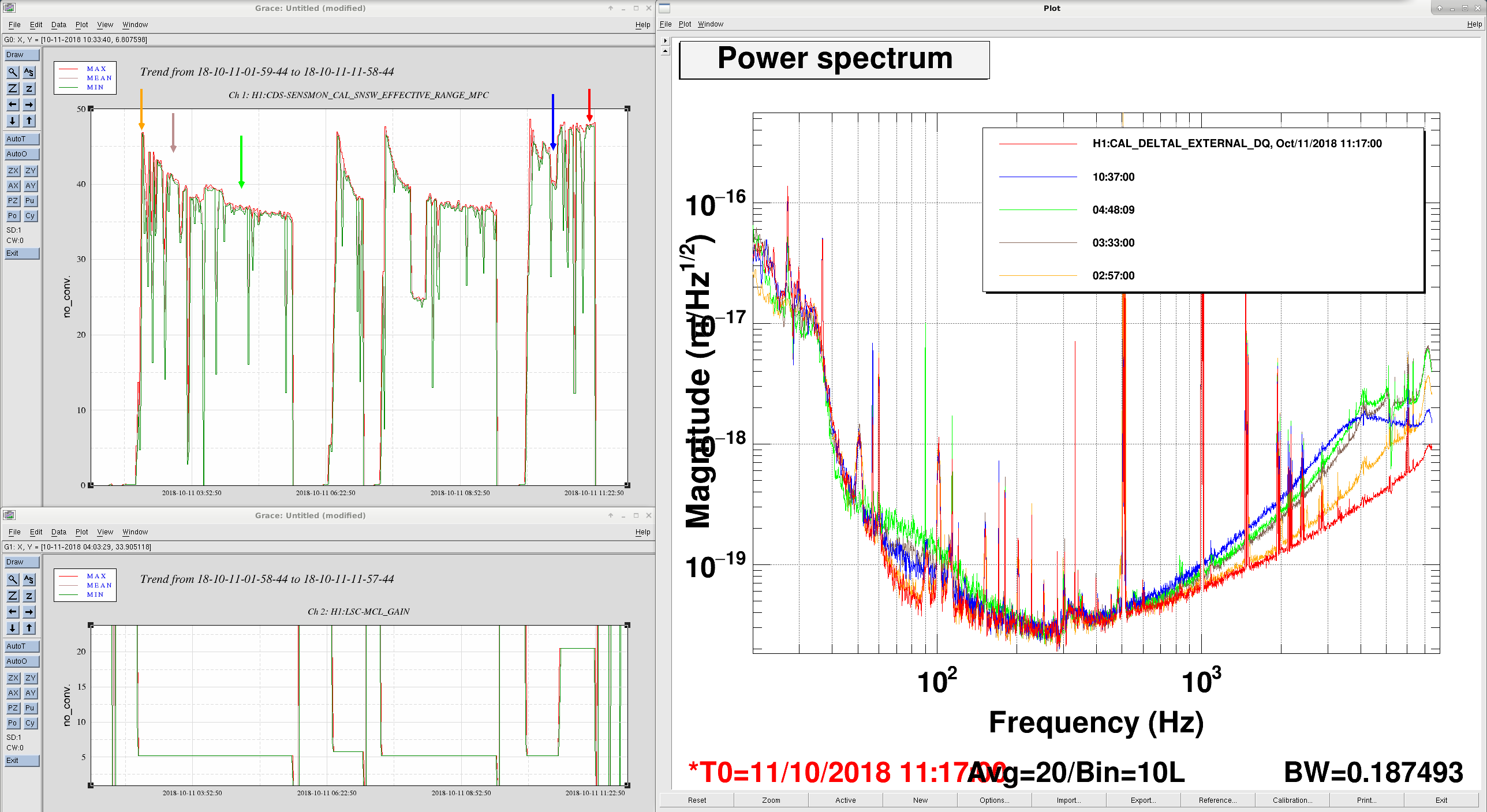
Recently the noise at 100Hz is consistently smaller than the plot Sheila posted (top, green trace is now, red is the same as Sheila's plot).
One question was if this difference is somehow bogus due to unintended calibration model/parameter change. Calibration was changed at some point but was reverted back on the same day. I looked at uncalibrated OMC DCPD SUM (bottom) and the same difference is there, so this cannot be the calibration difference.

Seems like broad noise is somehow related to CM gain. (Sheila, Craig, Keita)
In the attached, the color of the traces on the right corresponds to the color of arrows on the left top. Green is the same time as Sheila's plot.
It turns out that H1 BNS range used to nose dive right after going high power but it stopped doing that after Oct/11/2018 10:40:00 UTC or so, that's right after the blue. And that's where the broadband noise got much better (red).
No activities at that time other than Craig's changing gains in CM path (44480), e.g. in the left bottom you can see that Craig changed MCL gain from 5 to 20.5.
From high kHz bump, it seems like the frequency noise coupling and/or frequency noise itself are changing slowly at the same time as the broad band noise at about 100Hz (compare orange, brown, green and blue).
It's not clear to me if this is somehow coming from the residual frequency noise at 100Hz (gain-limited or what?). Need more investigations e.g. reducing CM gain, noise budget, and maybe injections.