Some general thoughts
We used to do the angle to length decoupling of the test masses by adding lines on pitch and yaw of each test mass and demodulate DARM_IN1 at those lines to get centering signals. We then move the A2L coefficients to a few values, compute the average signals, and fit a line to the values to estimate the zero crossing. This approach has two problems:
- the lines are added to each test mass at different frequencies, but those frequencies are not notches in the ASC HARD loops. Since CHARD and DHARD have non negligible gain at the line frequency, and high coupling to DARM, the line is actually sent to all test masses and therefore we measure a combined effect on DARM
- the actual zero of the "centering" signal depends on the phase at which we demodulate the lines
The method I implemented in the last couple of days (and described in 44532 and 44542) does not suffer from this two problems: since I am using only one line at a time, I can notch it in CHARD and DHARD loops, solving (1); I directly measure the coupling from the angular drive to DARM and the coupling from the A2L path to DARM, and use the ratio: the phase of the ratio is always very close to 0 or 180 degrees, thus solving (2).
Servoing the A2L coefficients
Today I tried yet another way to tune the A2L. I added lines between 20 and 34 Hz, spaced by 2 Hz, on yaw and pitch of all test masses (no notches). I then used FFTs in python to compute the transfer function of each line to DARM_IN1. I checked that the value obtained in this way responds to me changing the A2L values. Then I build a python servo loop that adjusts the A2L gains to zero the real part of the transfer function.
The servos work, and they managed to drive the real part of the A2L transfer functions to zero. However, as shown below, the imaginary parts are not zero. Moreover, the residual coherence between CHARD and DARM is not as low as I could get yesterday with the single test mass, single shot, measurement. This is another example of the issue (2) highlighted above.
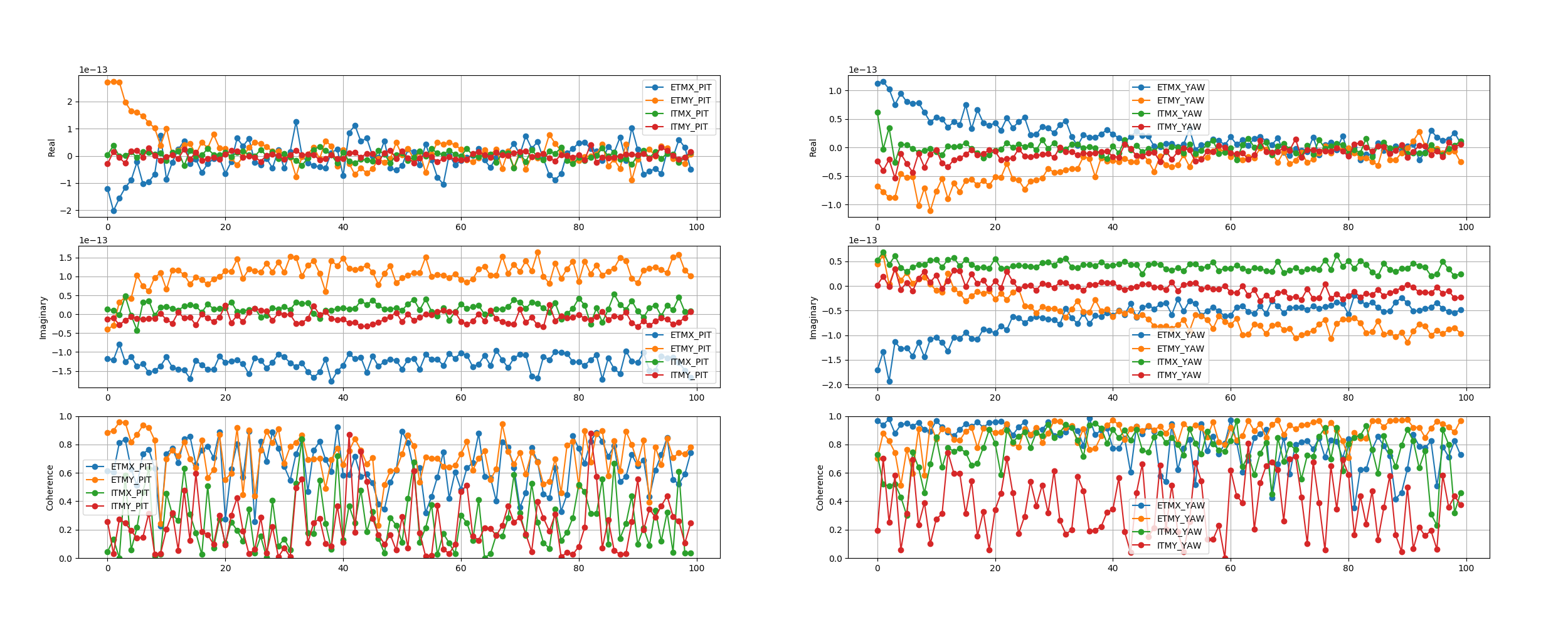

This method works, but suffers from the same problems as the standard method.
Hang, Sheila
Thanks Gabriele, you make a good point about needing notches for the A2L.
The A2L script Hang wrote several years ago rotates the demod phase in the script to maximize the signal, so the result is independent of the demod phase set in the front end.