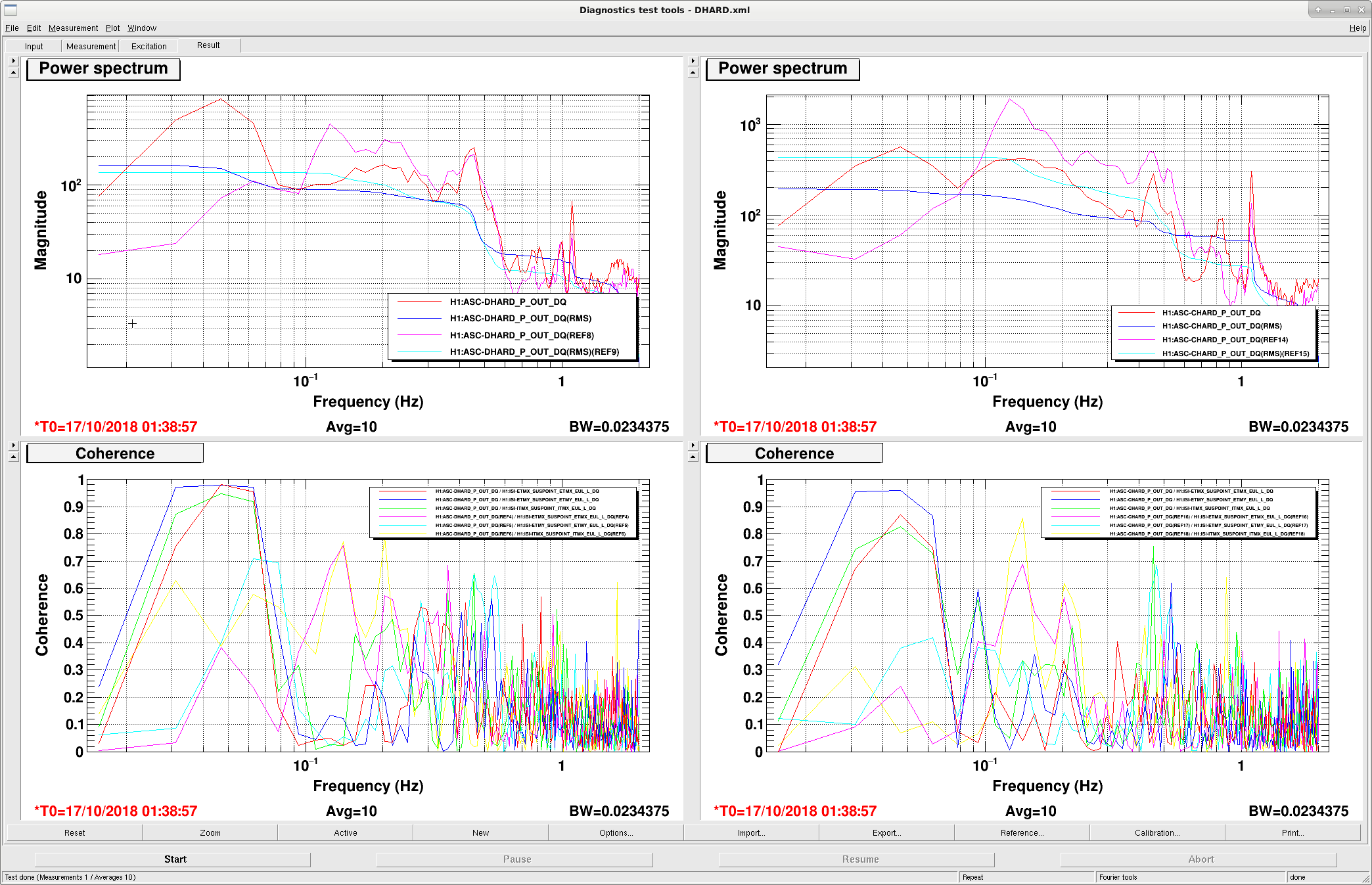
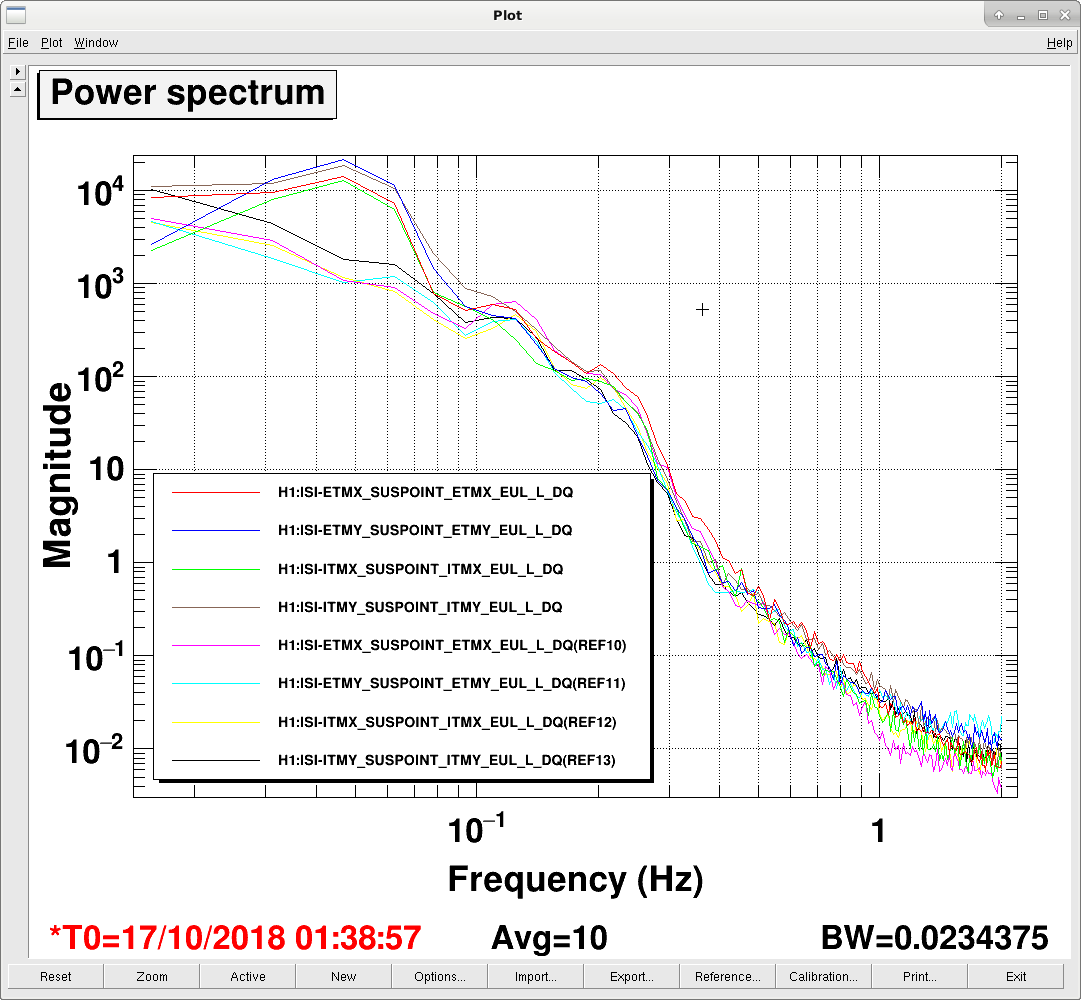
As the microseismic motion is rising back to its mean value, we tested again the performance of the ISIFF (currently L2P only; the ITMs have their filters updated in LHO:44406; the ETMs are still using their original filters). The microseismic motion was around 0.1-0.2 um/s in the 0.1-0.3 Hz band during the test. Please see the attached image for the results.
In the first plot we show the comparison for DHARD/CHARD ctrl output with and without ISIFF. The ref traces (pink/cyan/yellow) were without ISIFF and the red/blue/green ones with the ISIFF.
For DHARD we saw a factor of 2-3 reduction in the ctrl output in the 0.1-0.3 Hz microseismic band by turning on the ISIFF. The total rms got slightly worse, but it was because an earthquake happened during the ISIFF on measurement, causing the ground motion to be ~ 10 times larger around 0.05 Hz = 50 mHz, as shown in the second attached plot.
For CHARD the improvement was more significant. The peak at 0.12 Hz was reduced by a factor of 5, and the motion at 0.3 Hz by a factor of 3. A broadband reduction was seen from 0.1-0.7 Hz. Even an earthquake happened when we did the ISIFF on measurement, the overall ctrl rms was still reduced by a factor of 2.2 as we turned on the ISIFF.
Since CHARD has the largest noise contribution to DARM, reducing its motion should allow us reducing the required UGF for the CHARD loop a bit. Due to the constrains from radiation pressure torque we might not be able to reduce it below 2 Hz. However it is possible to push it down to maybe 2.5 Hz or so.