It should now be possible to engage the ISS second loop by requesting the state ISS_ON of the IMC guardian. This state engages an AC coupled ISS loop.
The you can request the state ISS_DC_COUPLED. This state for now just switches off the digital AC coupling. It used to have the engagement of two boosts: for now I left them out, since we need to be at high power to ensure that the ISS second loop has enough gain to be stable with the boosts.
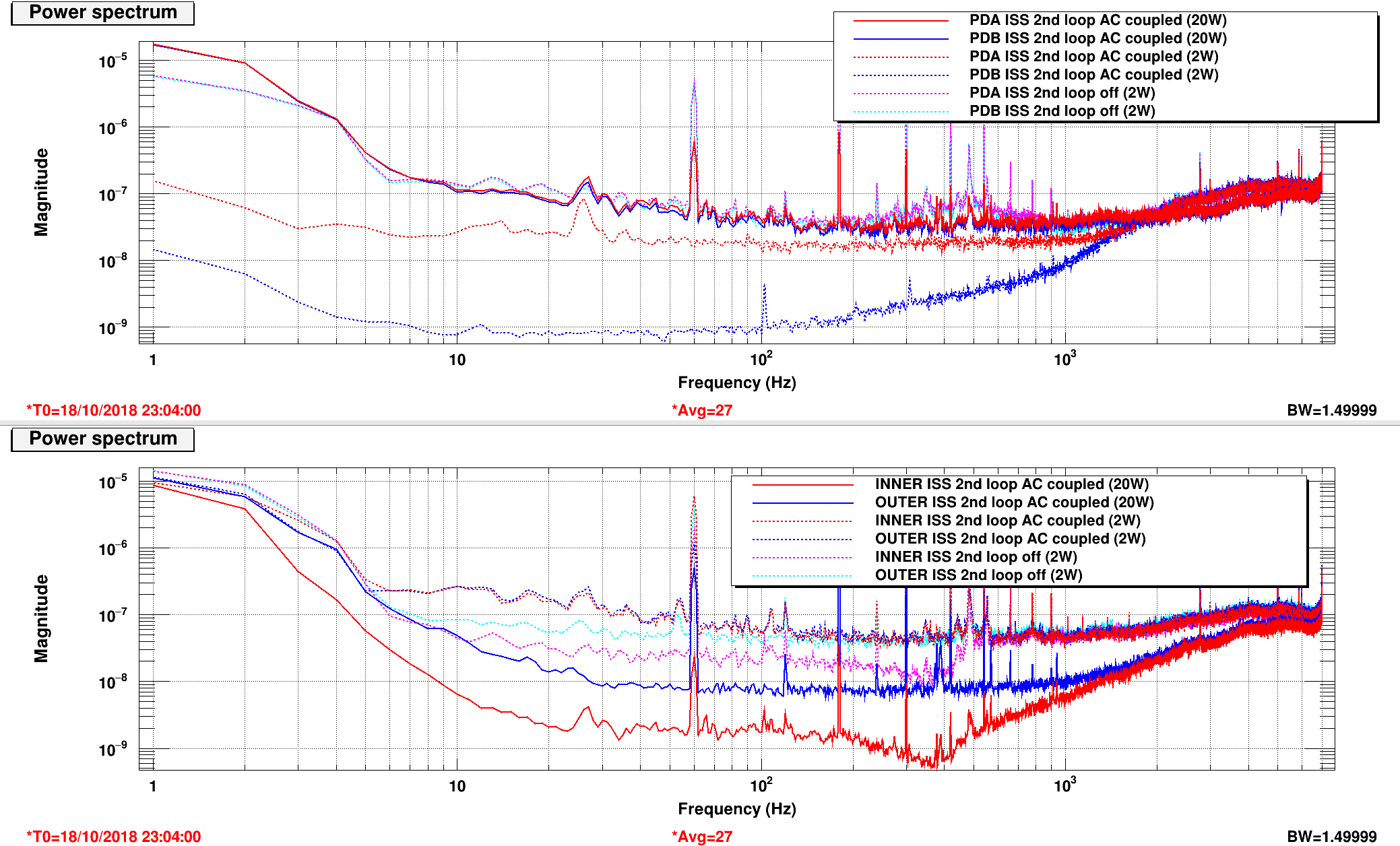
I tested the switching on and off at 2 W. The third plot shows both the first loop (PDA and PDB) and second loop (INNER and OUTER) signals in the three different configurations: ISS 2nd loop off, ISS 2nd loop AC coupled, ISS 2nd loop DC coupled (no boosts)
To be tested at high power (including the boosts)
Some details
- The AC coupling integrator was in a wrong configuration, basically completely off. The right configuration is shown in the first attachment
- Adjusted the diffracted power reference servo offset (second figure)
- Adjusted the reference servo filter banks and gain so that the two servos are working: one is active when the ISS second loop of off and should maintain the board output close to zero; the other is active when the ISS second loop is on, and keeps the refracted power close to the set offset (which is H1:PSL-ISS_SECONDLOOP_REFERENCE_DIFFRACTION_CAL_OFFSET)


[Daniel, Gabriele]
Changed the gains of AC coupling "prediction" path to adjust for new power levels:
H1:PSL-ISS_SECONDLOOP_PD_CAL_GAIN = 1.0 (was 1.2)
H1:PSL-ISS_PD_NORM : FM2 changed to gain(0.079) was gain(0.113)
Now the output of H1:PSL-ISS_PD_NORM is close to one.
Second loop successfully engaged in full IFO lock, up to 20 W.
We tried the DC coupling at 2 W (no boosts) and it did not work (refracted power running away), to be investigated.
After today's maintenance and restart of the ISS model, the second loop is no more working at powers above ~10 W. It's fine to engage the second loop at 2 W, and to increase the power to 10 W. Above that, the loop drives the diffracted power very high.
It's not clear if the problem is to be traced to some configuration parameter in the ISS model, or to the fact that the diffracted power is now larger (2.4% instead of 1.4%).
More dedicated time is needed to investigate the problem.