We tried to do some DARM noise budgeting based on its coherence with the auxiliary degree of freedoms. The data we use for this analysis are starting from GPS 1224301218 and for a duration of 1024 sec. The auxiliary loops we consider so far includes LSC MICH/SRCL/PRCL/MCL, ASC CH/CS/DH/DS P/Y, as well as the ones we used for jitter noise subtraction during O2 (PSL-DIAG_BULLSEYE_PIT/YAW & IMC-WFS_A/B_DC_PIT/YAW). We only focused on the freq range from 10-100 Hz as this should be the band where the auxiliary DOFs' coupling being most significant.
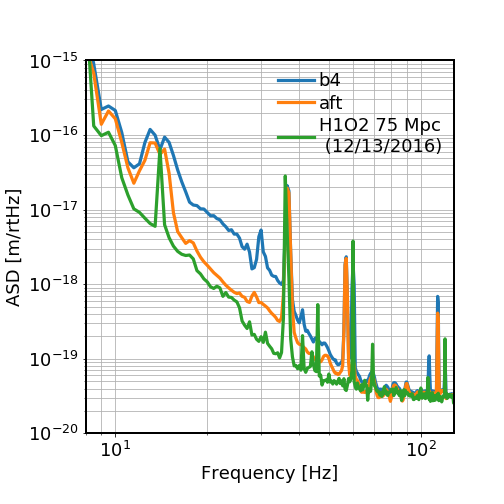
In the first attached plot, the blue trace is the raw DARM output, the orange trace is the one after we removed all the linear coherence with the aux loops we considered (computed based on the f-domain MISO coherence; the subtraction is also done in the f-domain, i.e., the subtraction is assumed to be ideal), and the green trace is an O2 H1 reference before the Montana earthquake. There exists some calibration uncertainties and we simply scaled the current and O2 DARM to match at 100 Hz. Nonetheless, it suggests that we have some excess noise below 60 Hz compared to the O2 ref, and those noise cannot be solved by tuning LSC FF nor A2L.
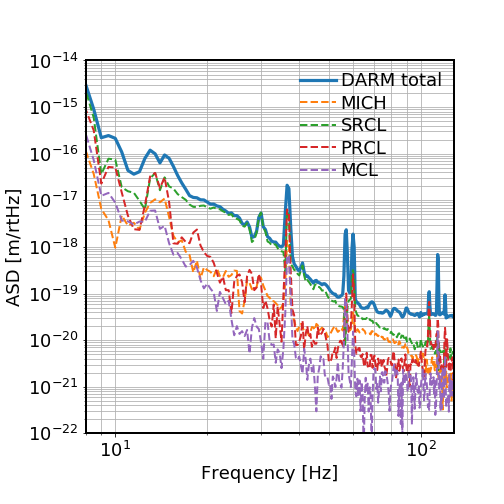
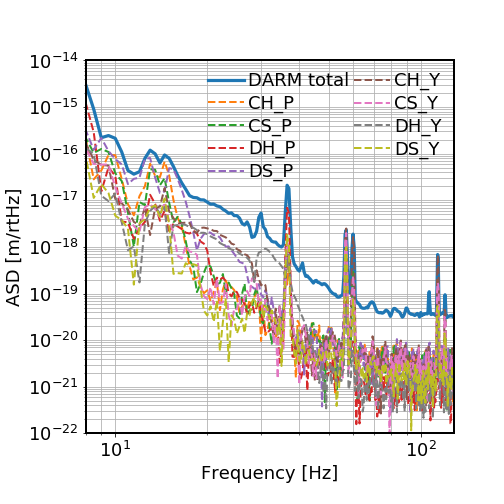
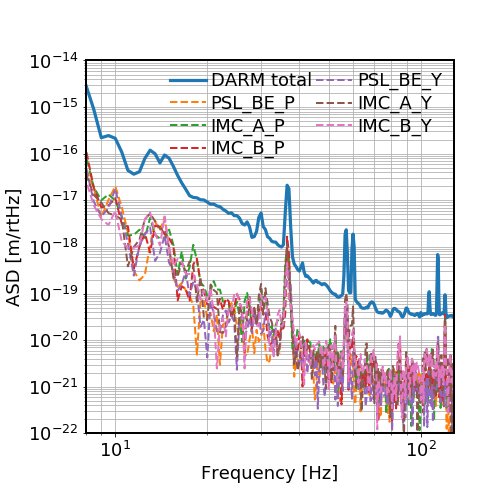
In the second plot we show the noise projections from the LSC auxiliary loops, in the third plot the projection based on the ASC loops, and the last plot the projection based on the jitter channels.
For the LSC, coupling right now is dominated by SRCL (and its slope is much sharper than 1/f^2 as I would naively expect due to DARM detuning...).
For the ASC, we have large DS_P coupling because we are trying to suppress the 0.5 Hz oscillation. However, as we have SRC ASC controlled it seems unnecessary to have such a high BW DS_P loop. The noise above 20 Hz is then dominated by CH_Y and DH_Y. For DH_Y we have some margin and should be able to improve the LP relatively easily. For CH_Y, however, as we kept losing phase for that loop at ~ 3 Hz the optimization might be challenging... Need to think more carefully how to handle it.
For the jitter noise, we do not see significant couplings to DARM.
===============================================================
In principle the all the linear coherence can be subtracted out and should not contaminate DARM. Ideally the subtraction should happen online, but in the worst case we can still remove them from offline regressions (as we did for this study). Thus those noise should be the easy ones to tackle.
The subtraction residuals, if not explained by the coherence with aux dofs we haven't considered so far, are probably from nonlinear couplings and would be harder to remove. That would be the hard part of the commissioning work. From the current study, we do see excess noises in the <60 Hz region that cannot be explained by the linear couplings between the major LSC/ASC loops and DARM, and thus we might need to start thinking about the origins and solutions to those noises.
There is a small amount of coherence with the jitter channels above 200Hz, but it's pretty small relative to what we used to see. Interestingly, there are some sharp lines of coherence with the bullseye width channel above 800 Hz.
The IMC WFS and the bullseye are only saved to 2kHz, so we should re-look at these coherences online next time we're at NomLowNoise to check if there are any surprises at higher frequencies.
EDIT: Jason noticed today that the bullseye is not well aligned, so we should revisit the coherences with the bullseye after he aligns it (likely during next Tuesday's maintenance).
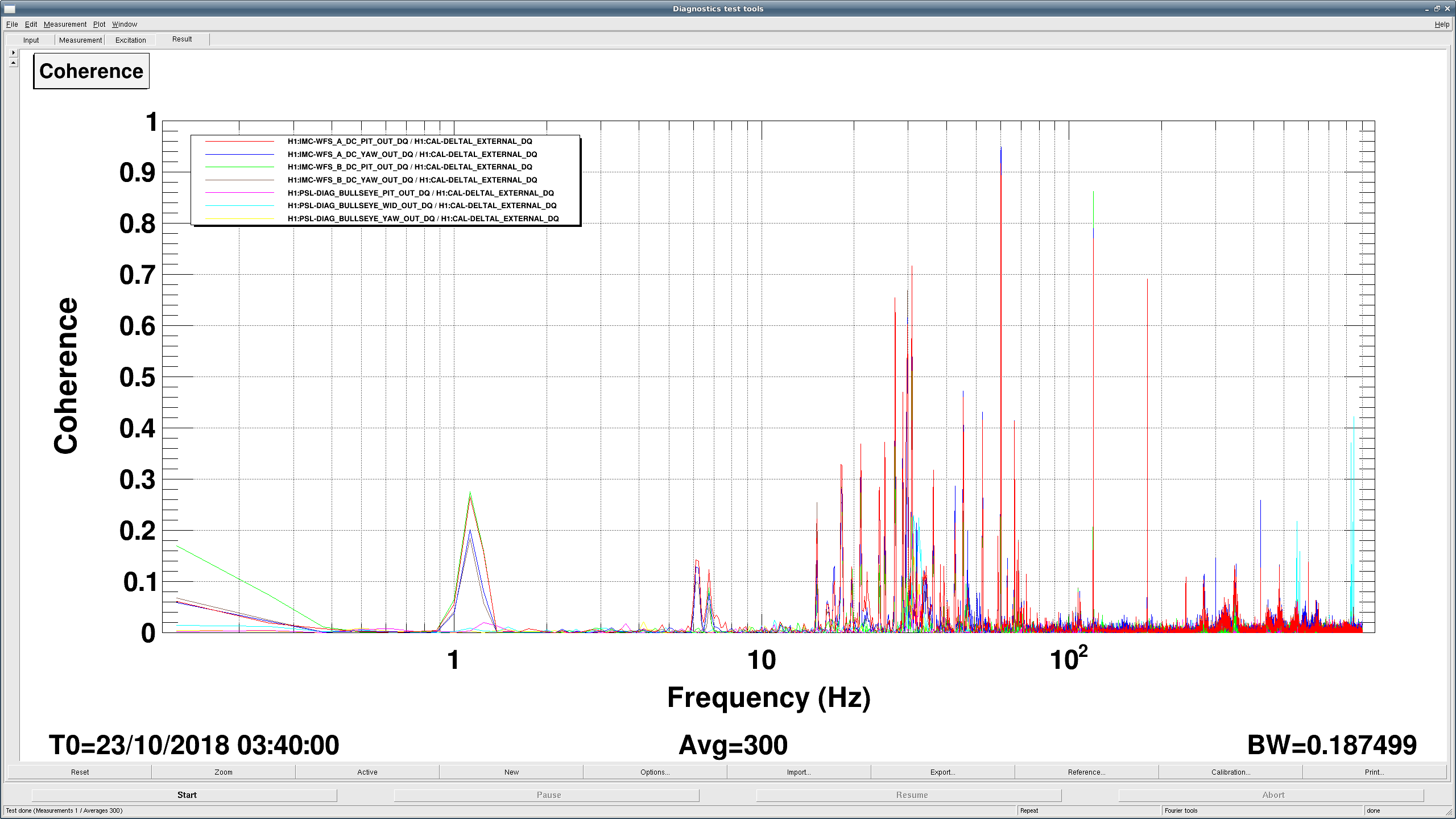
Attached is a higher frequency coherence between IMC_WFS and DARM up to 7 khz, doesn't look like interesting at higher frequencies than what Jenne had posted about earlier. The bullseye sensor is doesn't sample past 2khz so it's not included.
