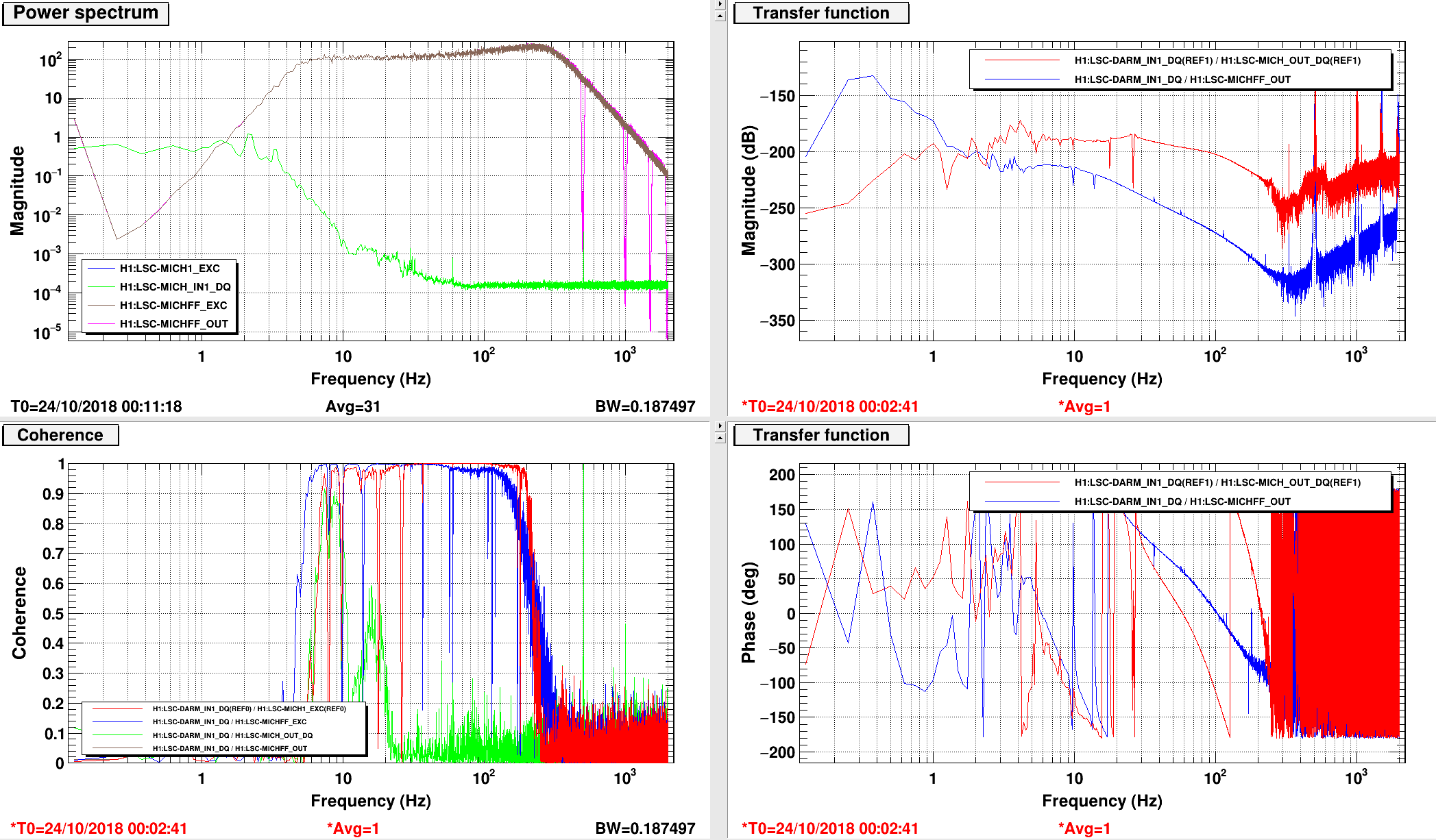
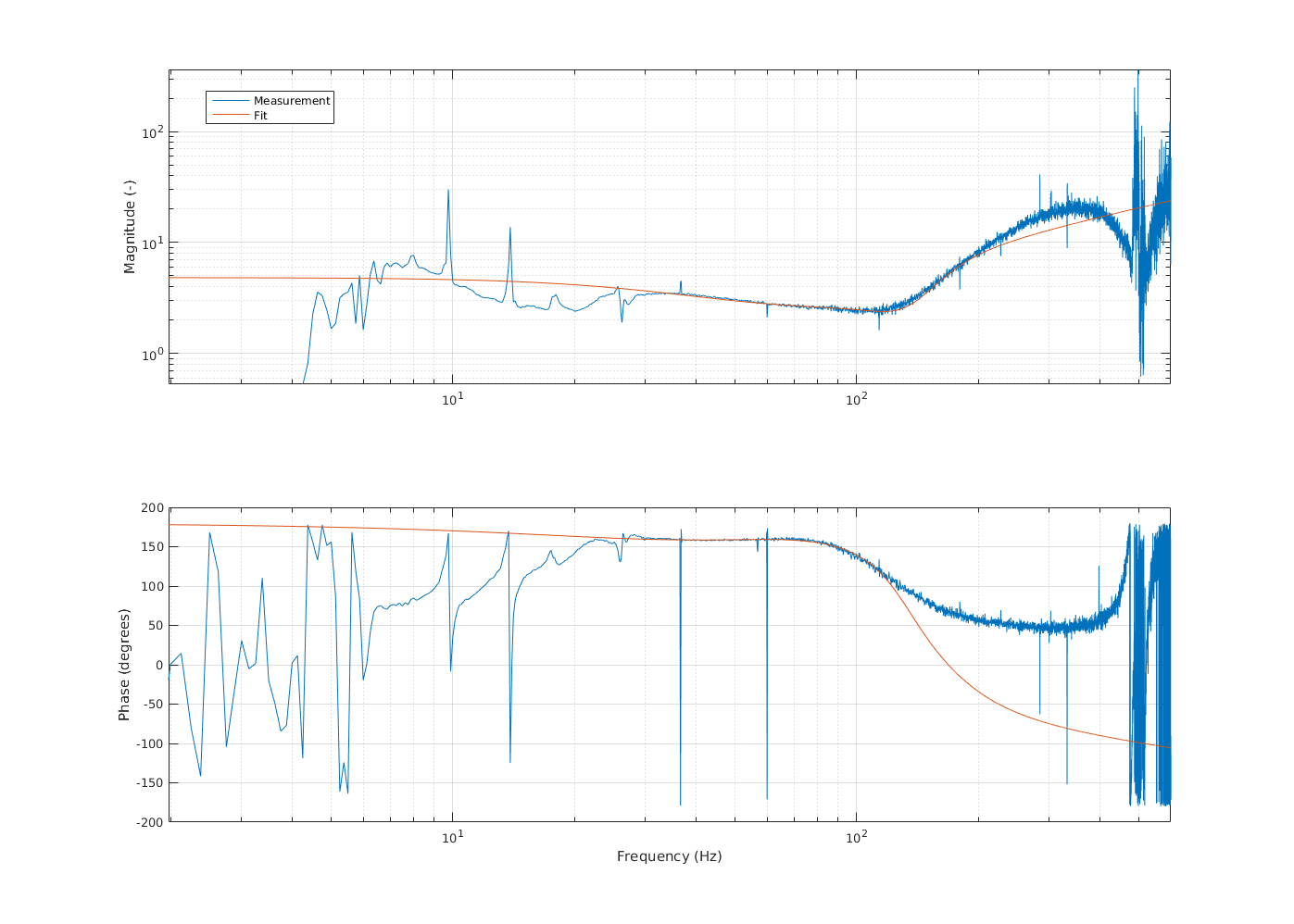
In breif, I measured, fitted and retuned the MICH and SRCL feedforward. The results are good, but the first SRCL FF filter I tries showed the same instability reported in 44740, probably due to the "large" gain below 10 Hz that's neede to have a good fit down to 10 Hz. So I restricted the fit above 30 Hz, and got a new filter, which should have good performance in the 30 to 100 Hz region. I haven't tested it yet, since the IFO unlocked.
Measurement templates are attached, since I don't have permissions to copy them in /opt/rtcds/userapps/release/lsc/h1
The plot below shows the DARM spectrum without any feedforward (red), with MICH only (blue) and woth MICH+SRCL (black).
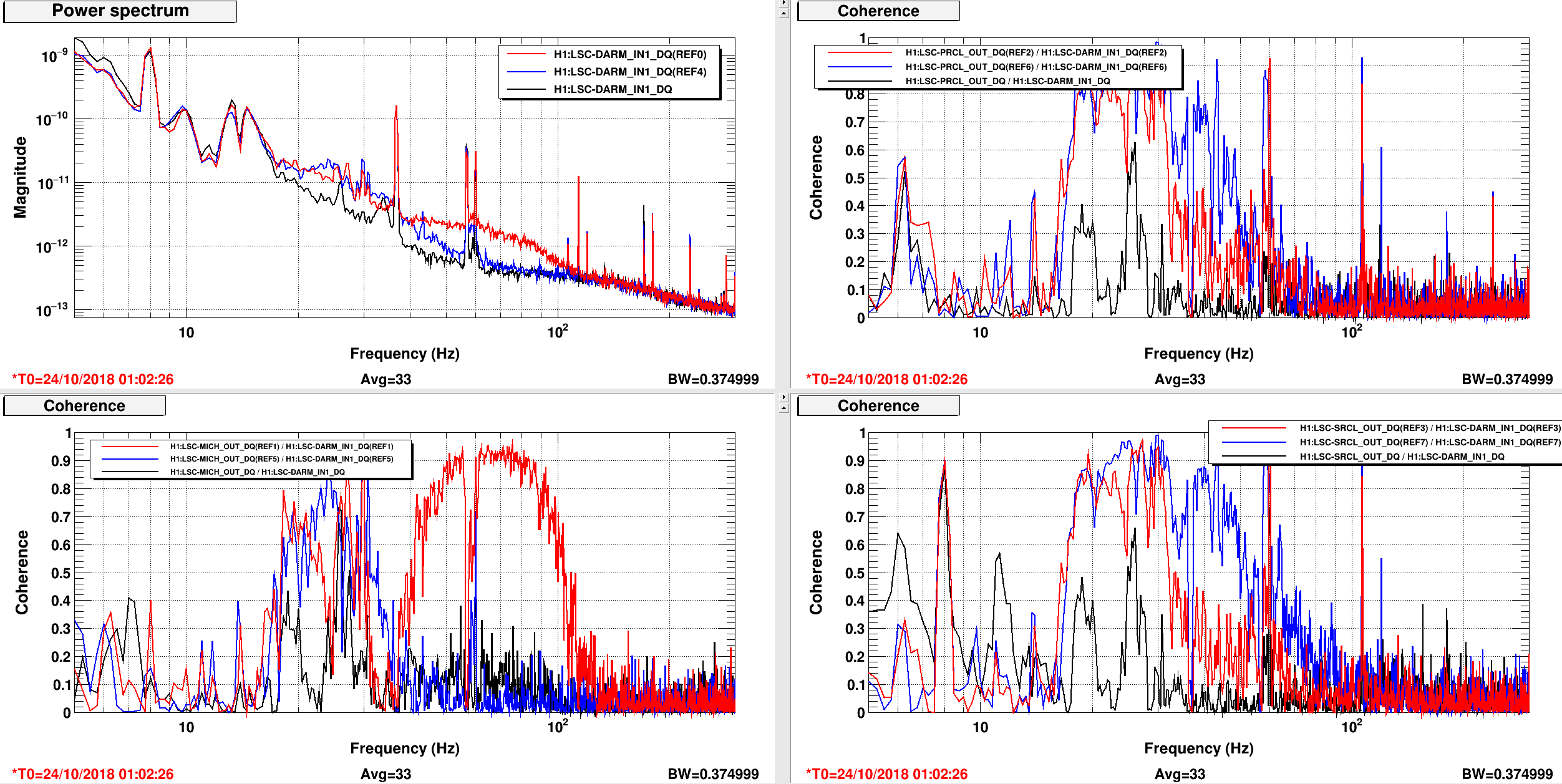
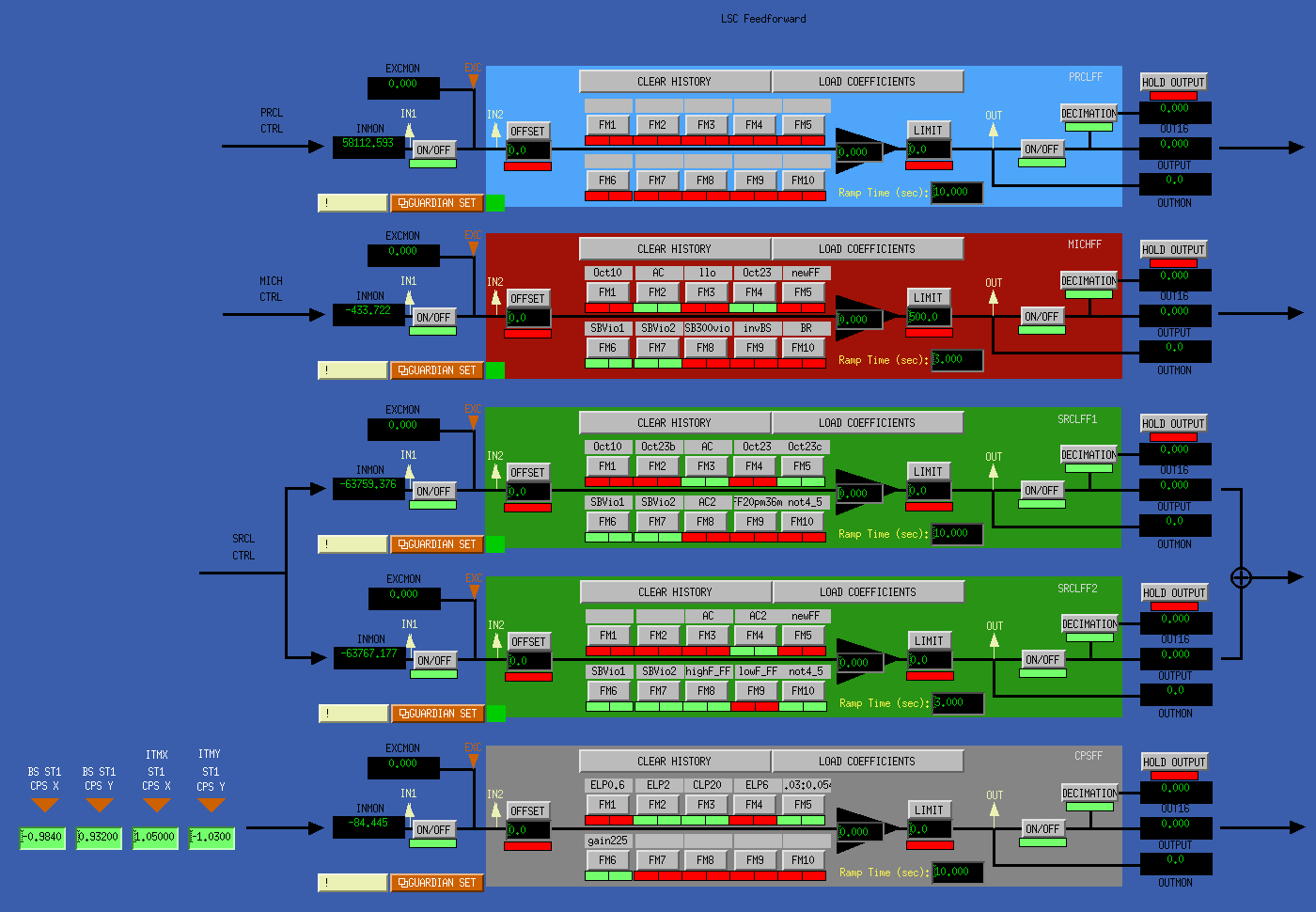
The configuration that gives the good MICH filter and the (tentative) good SRCL filter ois shown in the last attached screenshot.
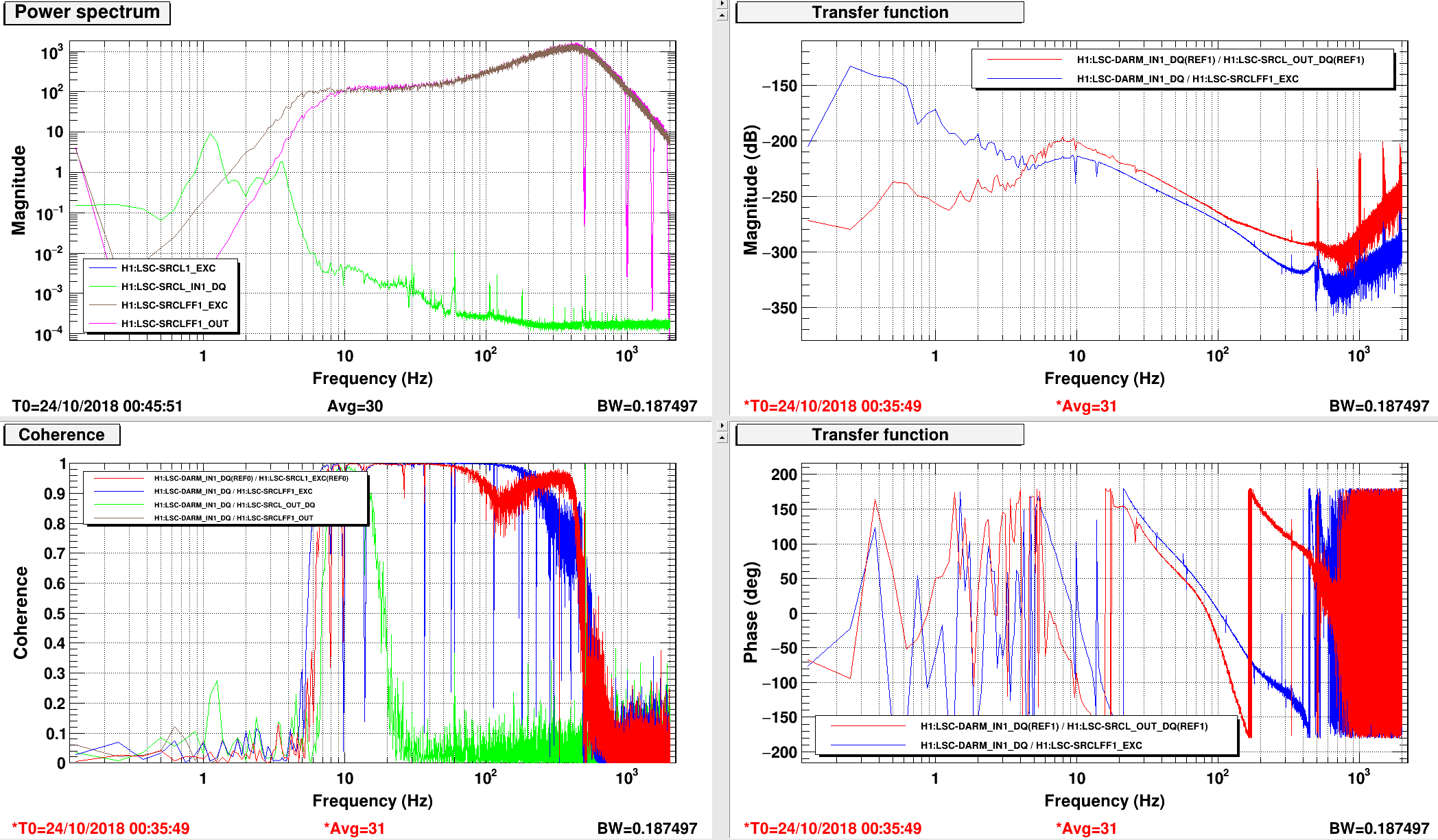


For Hang:
SRCL noise (MICHFF on, SRCLFF off) 1224376571 1224376692
SRCLFF noise (MICHFF on, SRCLFF off) 1224377188 1224377289
Thanks Gabriele for the time stamps.
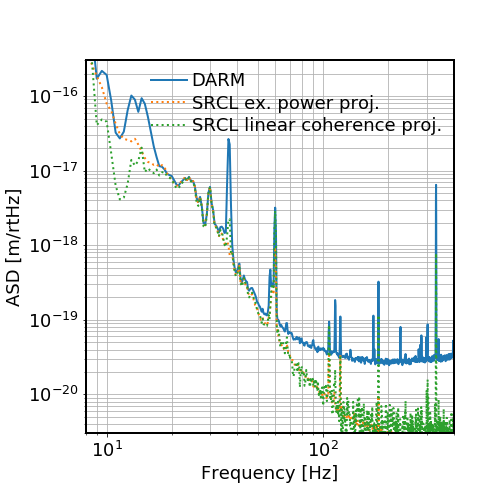
We used Gabriele's SRCL noise injection to study how much SRCL coupling is linear (which can be easily subtracted), and how much is nonlinear (due to non-stationary coupling, e.g.). The conclusion is that we do not see significant nonlinear coupling.
Please see the attached plot for the results.
We looked at two periods of data, one starting from gps 1224376598 (w/ SRCL injection) and one from gps 1224377643 (quiet). Each piece of data was 128 s long. We computed the SRCL to DARM projection based on both excess power projection (which captures NL effects) and linear coherence. Then we projected SRCL to DARM for the ''quiet'' time using the two coupling coefficients (orange for the excess power, green for the linear coherence). No significant difference could be seen, meaning that the NL component is sufficiently small.