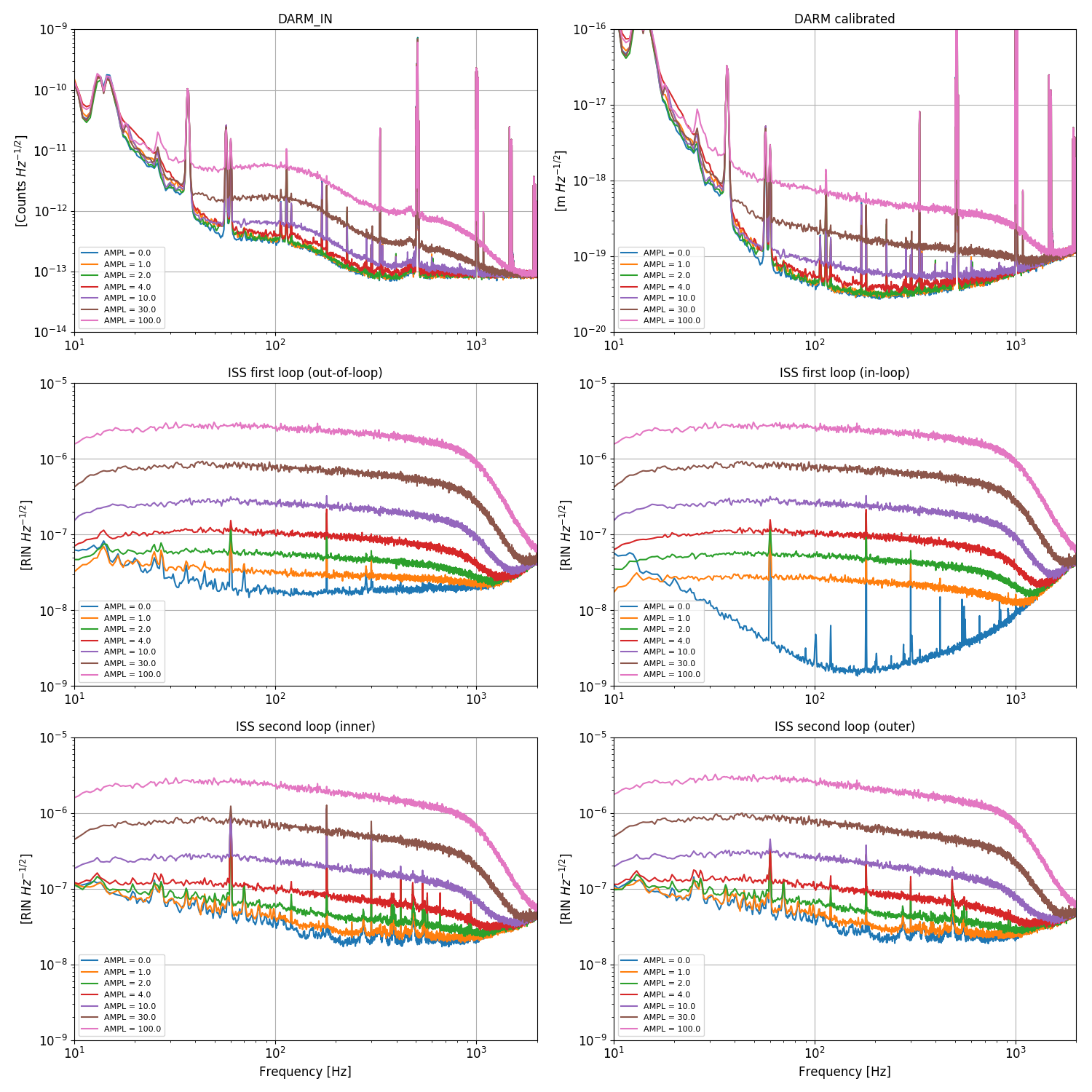
To investigate further the excess noise described in 44779, I performed some intensity noise injection, using the digital excitation path of the ISS second loop, with the ISS second loop open, but the ISS first loop closed.
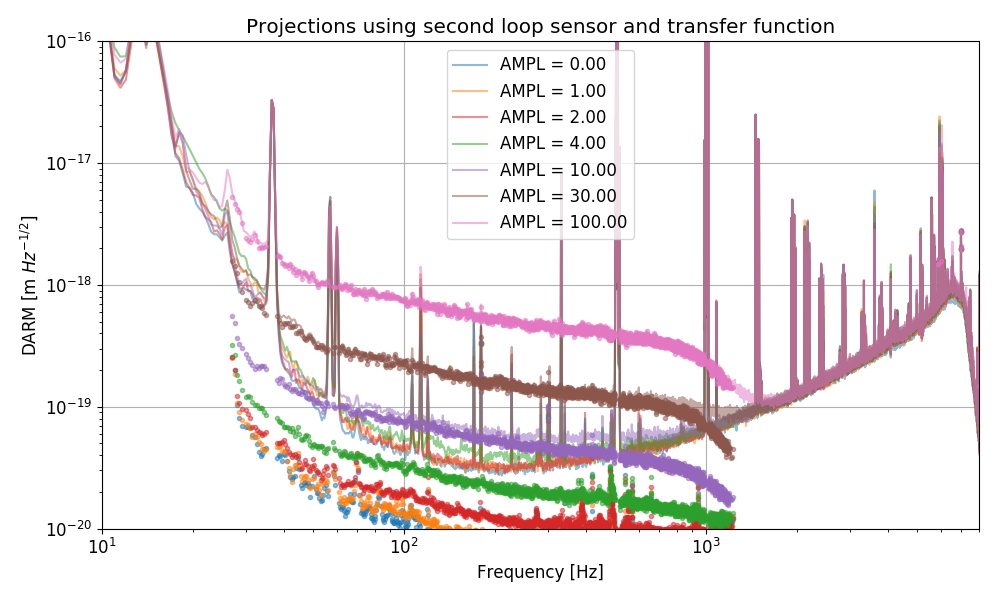
In summary, the coupling of intensity noise does not show any significant non linear or non stationary coupling, and the projected level is below the measured DARM sensitivity. Therefore the increase of noise described in 44779 is not compatible with the hypothesis that it's intensity noise.
Details
Injection times are below. Using a filter butter("BandPass",4,10,1000)zpk([10],[100],1,"n")
no noise 1224437621 1224437742
ampl 1.0 1224437764 1224437884
ampl 2.0 1224437901 1224438034
ampl 4.0 1224438051 1224438171
ampl 10.0 1224438184 1224438304
ampl 30.0 1224438322 1224438423
ampl 100.0 1224438433 1224438556
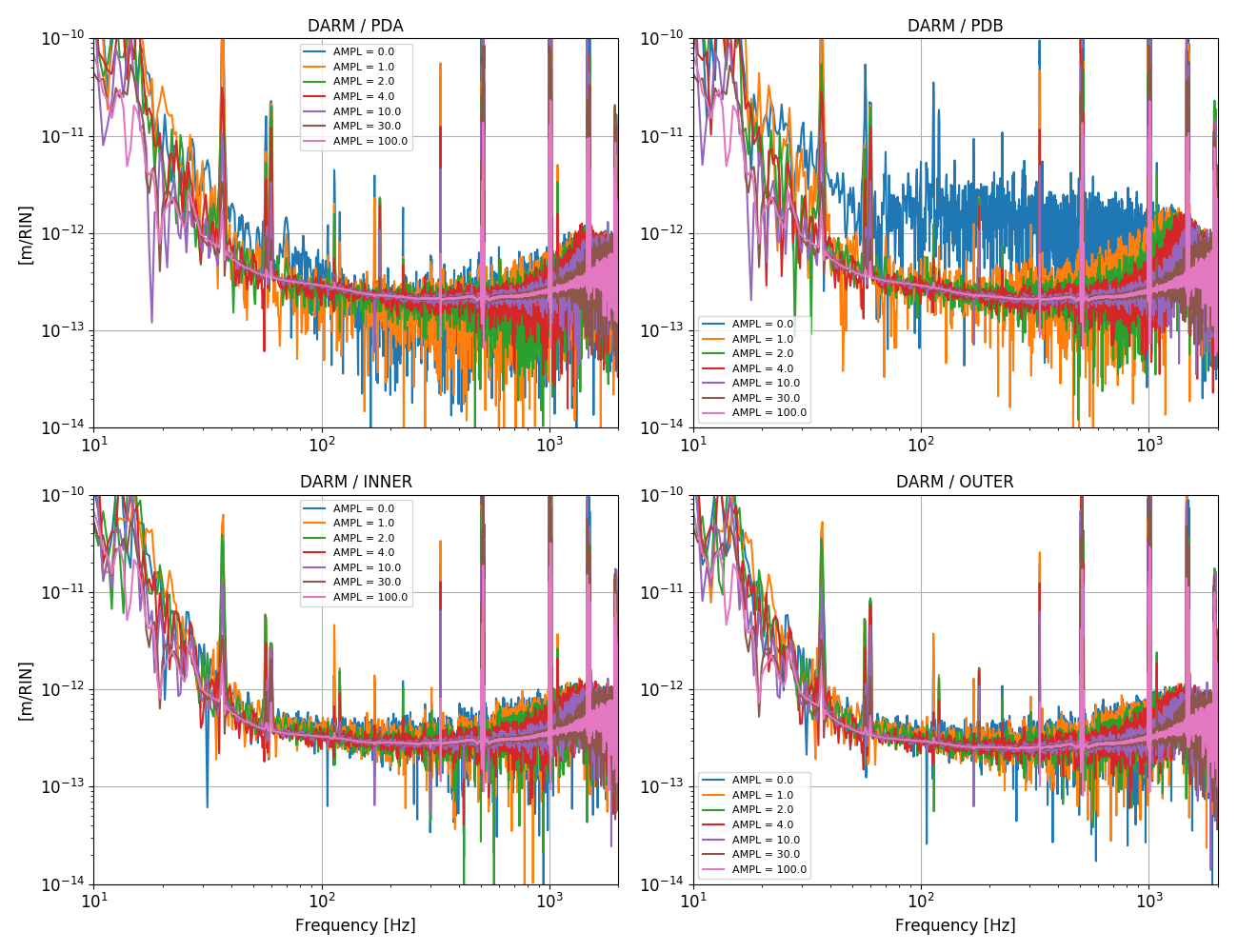
The first attached plot shows various signals during the quiet period and the injections. The noise is very well visible in all ISS first and second loop signals. The coherence with DARM is shown in the second attachment, and it increases with amplitude as expected. The third attachment shows that the transfer function is the same for all amplitudes, so there's no sign of non linearities.
The transfer function DARM / RIN (measured either at ISS second loop signal or at the ISS first loop out-of-loop sensor) is shown below (and data is attached as an ASCII file. Format: 5 columns, frequency, real and imaginary part of DARM/ISS_secondloop, real and imaginary part of DARM/ISS_firstloop, NaN where the measurements had no coherence).
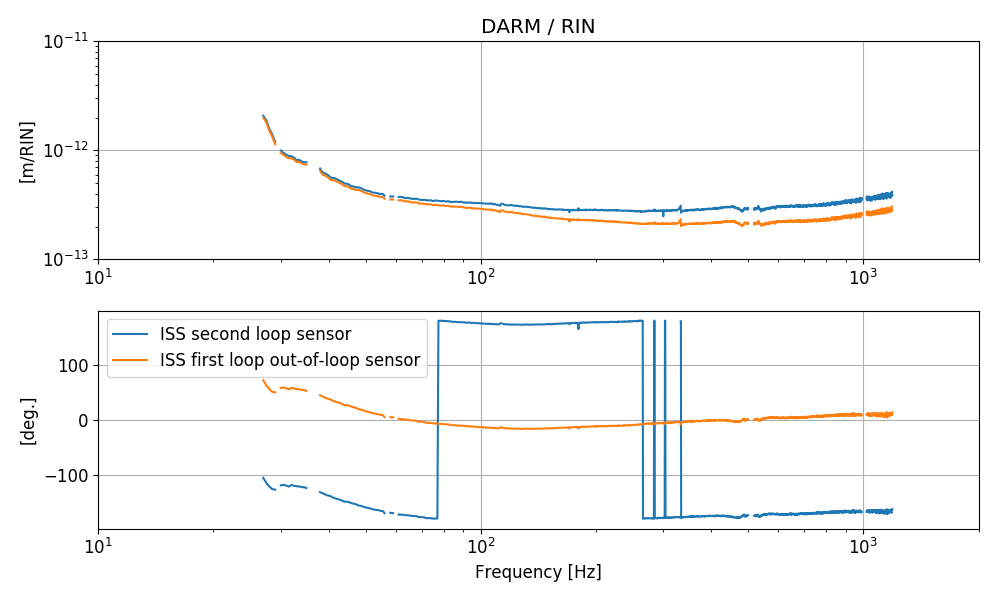
Using those transfer functions I projected the RIN in normal conditions into DARM. The result is shown below. There is more noise in the ISS second loop signal, so that projection is higher.

Intensity noise is about a factor of 5 lower than the measured DARM.
The last attached plot shows the projection into DARM using the ISS second loop transfer function, during the noise injections. The DARM noise levels are predicted correctly, so again there's no sign of large non linear behaviors.