In addition to Hang's study reported in 44780, here we show that
- SRCL coupling to DARM is mostly made up of two components:
- a low frequency 1/f^2 coupling that dominates below 100 Hz
- a flattish component that dominates above 100 Hz, and up to 500-600 Hz
- The two components have different modulations
- The coupling modulation is correlated moslty with DHARD, SRC1 and MICH pitch motion
First of all, during the noise injection reported in 44772 (with MICH and SRCL feed forward on), we can see that DARM noise is largely increased, but the averaged coherence of DARM with SRCL is relatively low (0.8) considering that the noise dominates the DARM background by a large factor.
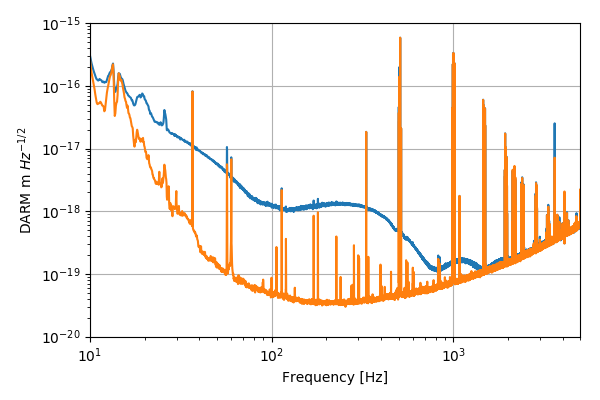
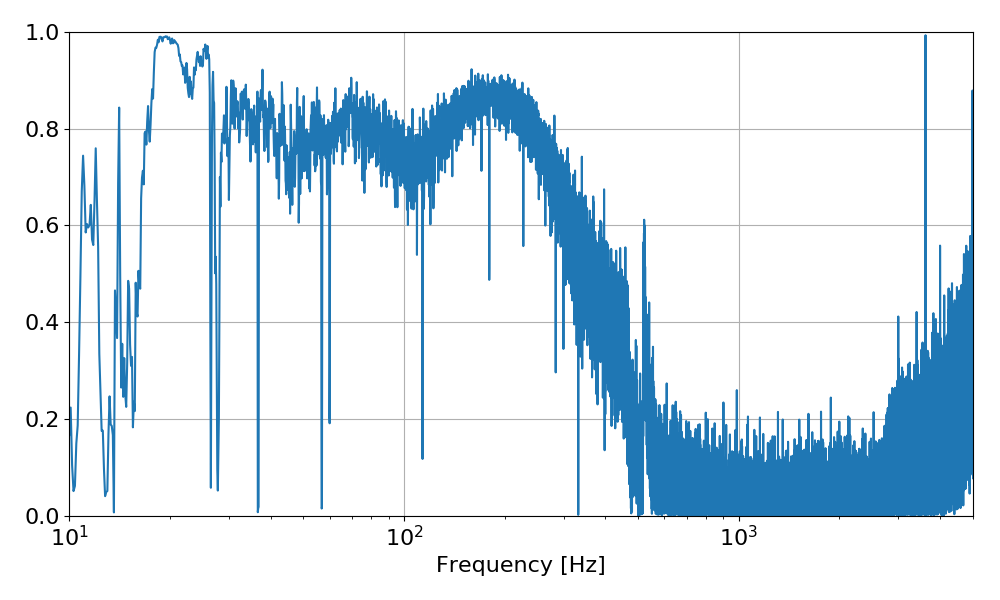
We can compute a "cohero-gram" and a 'transfer-function-gram" by computing the coherence and the transfer function over short times and stacking it up like a spectrogram:
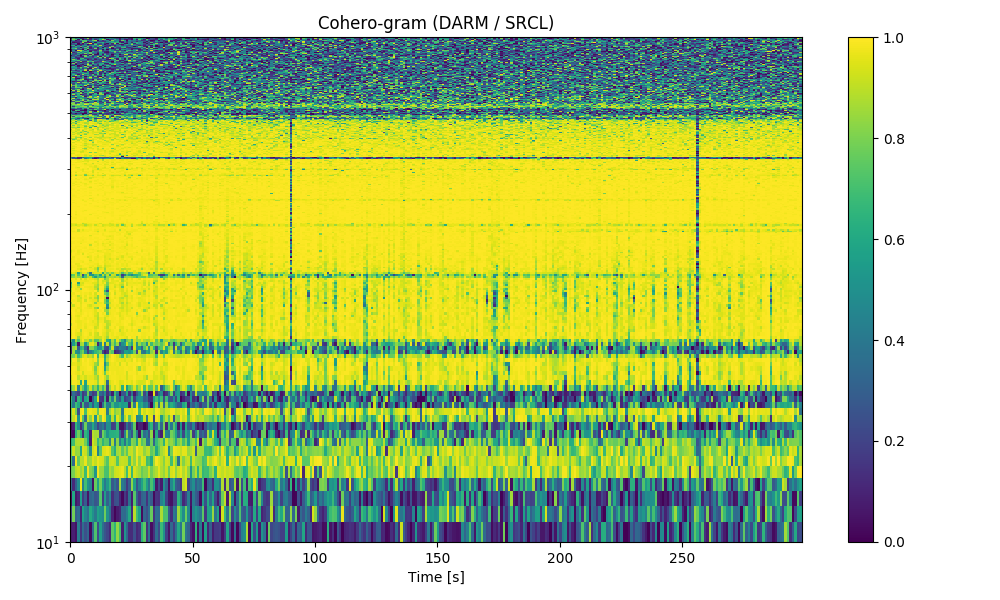
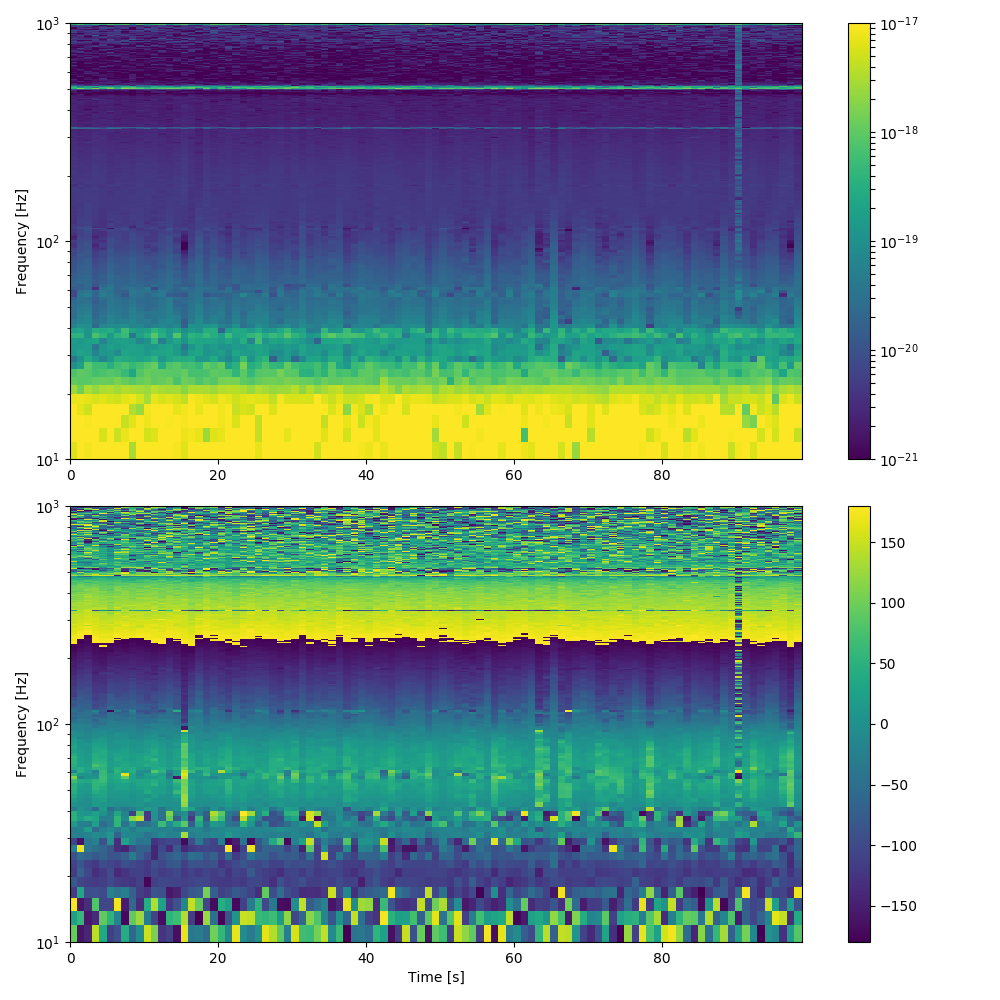
Clearly the coherence is not constant, and sometime drops to zero, and also the transfer function shows variability. Note that those measurements are taken while injecting SRCL noise. We can also make an animation of the transfer function as time passes. This is shown in the attached movie file (I can't find an easy way to embed it here).
To be more precise, we can take the DARM band-limited RMS in the 40-60 Hz region (first component of the SRCL noise coupling) and in the 200-300 Hz region (second component of the SRCL noise coupling). Then we can compute the PSD os the band-limited RMS: this gives us an idea of what are the main frequencies at which the noise coupling changes. Moreover, we can compute the coherence of the BLRMS time series with all angular error signals, and found out which ones are the most important, as shown below
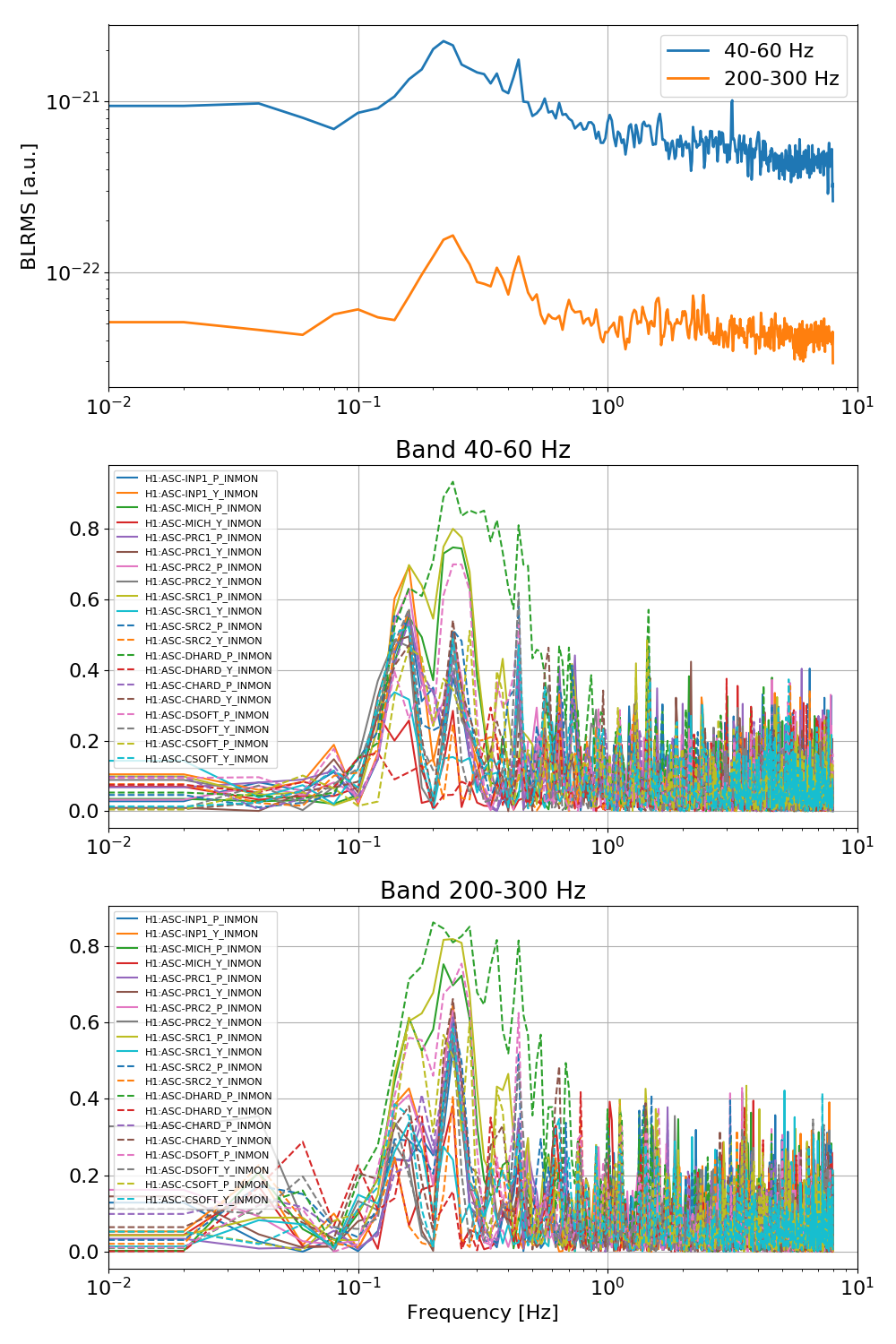
So it looks like that tightening the controls for DHARD_P, SRC1_P and MICH_P would help reducing the modulation of SRCL noise, and hence improve the feed-forward performance.

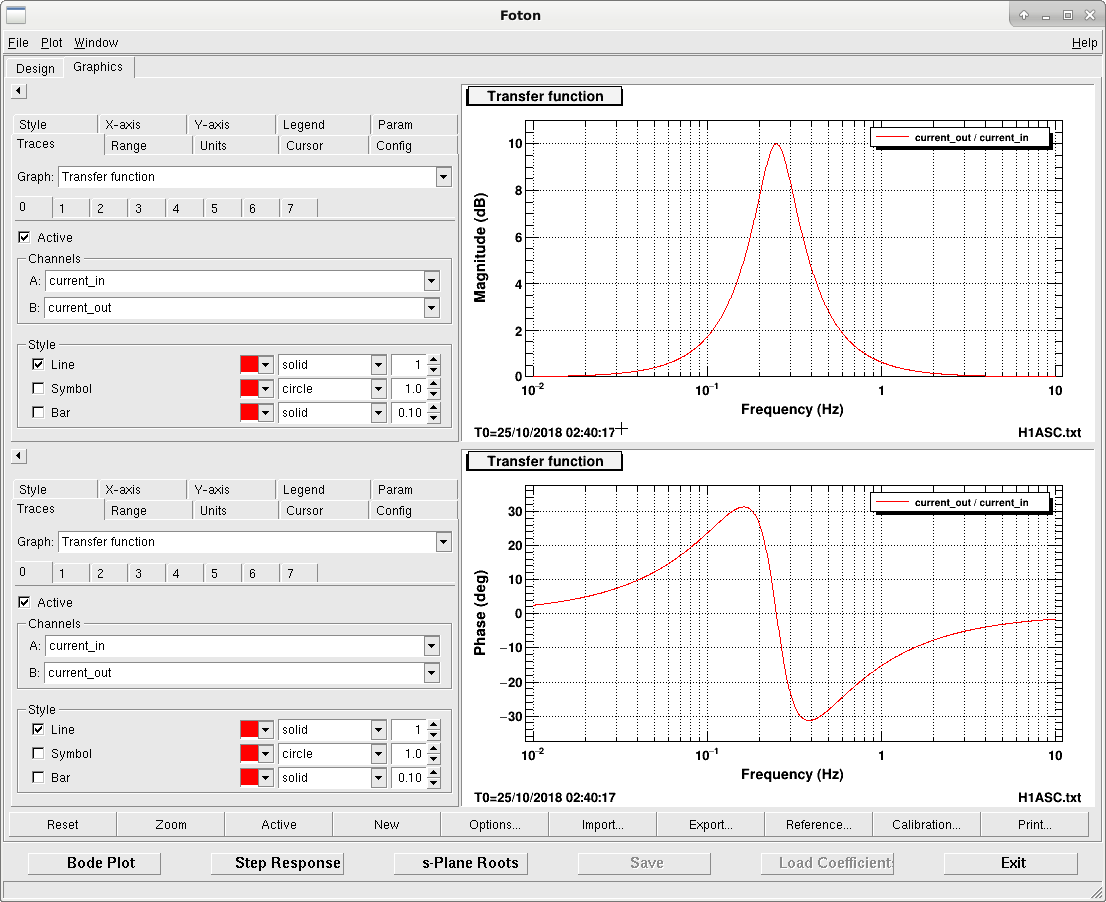
To reduce the DHARD PIT motion at the microseismic ~ 0.25 Hz, we added a resonant gain in the DHARD PIT filter bank (FM4).
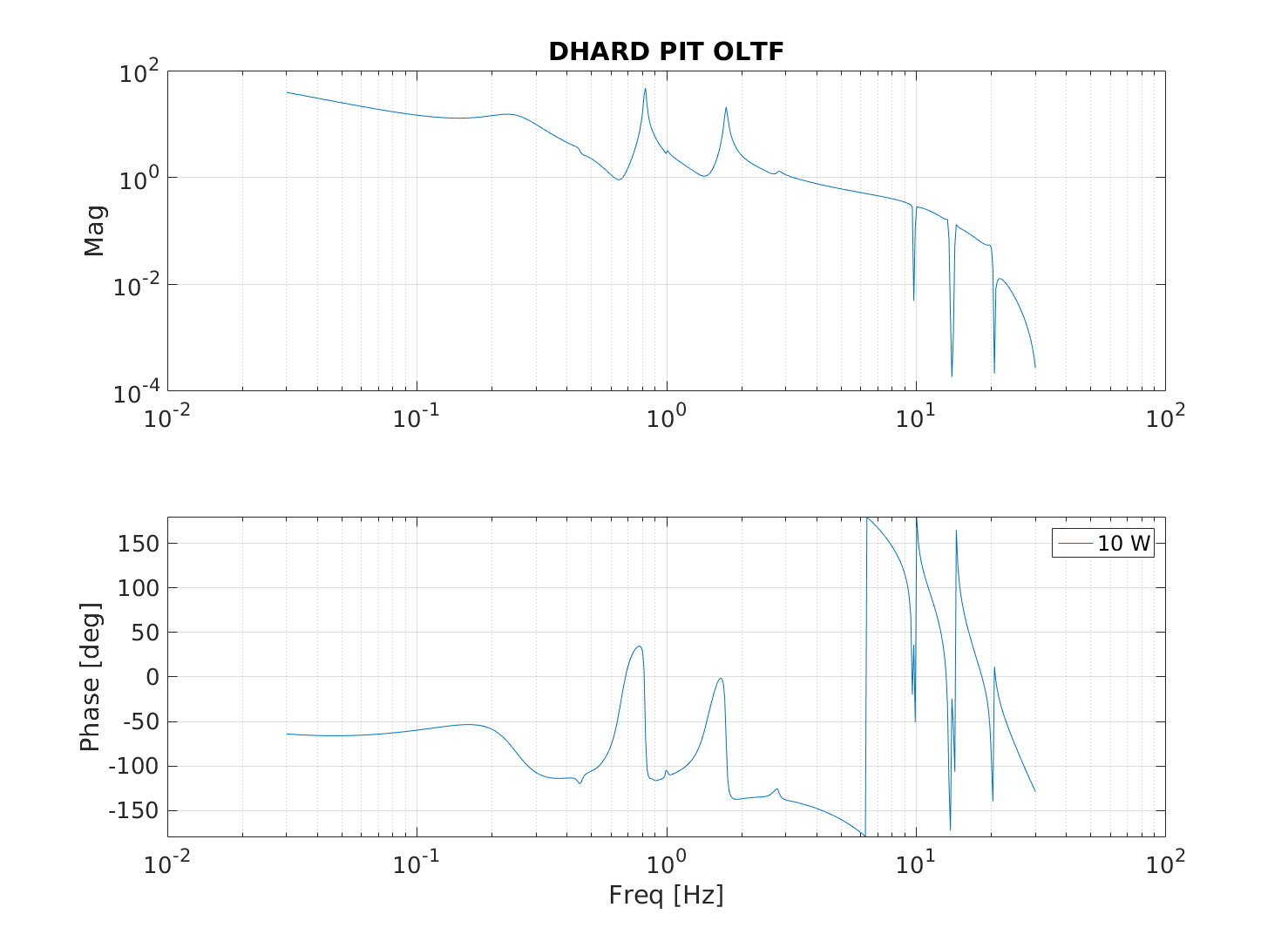
The filter shape is shown in the first attached plot. It gives 10 dB more gain at 0.25 Hz. We can engage the filter without causing any angular instabilities, which is consistent with our model prediction (Fig. 2).
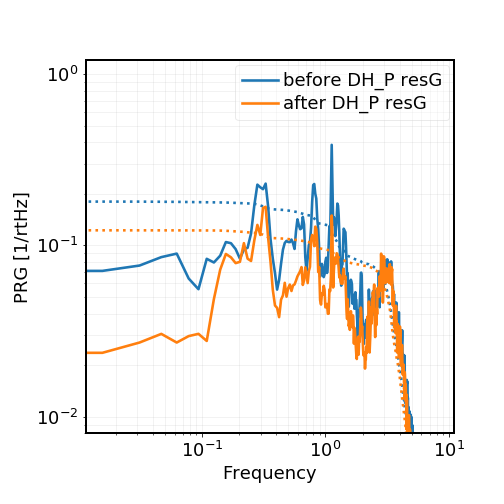
After turning on the res g, the interferometer seemed to be quieter w/ less power fluctuation (see Fig. 3).
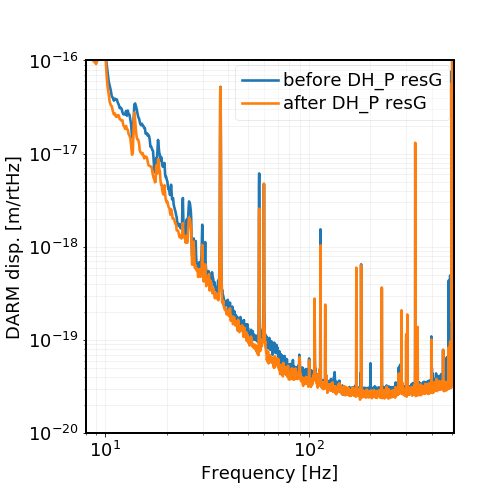
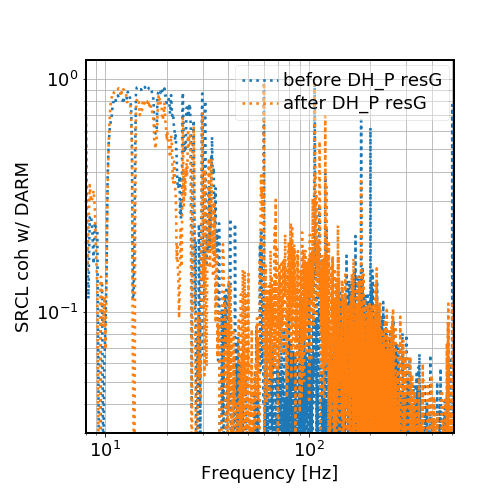
The DARM noise also seemed improved (Fig. 4), whereas for SRCL's linear coherence w/ DARM, we saw it reduced in the 10-30 Hz range but in the around 80 Hz band it seemed to get worse (Fig. 5). Nonetheless, in those bands the SRCL coupling is mostly nonlinear (or at least the coupling is non-stationary) so the linear coherence might not be representative.
The caveat is that for the last 3 figs, I only looked at 2 pieces of time: gps 1224465018 (before turning on res g) and gps 1224469218 (after res g), each lasts 512 sec. A more comprehensive study looking multiple times would be nice.