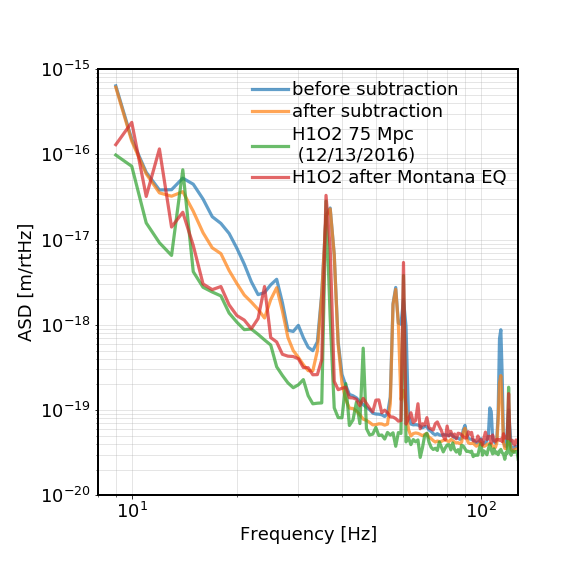
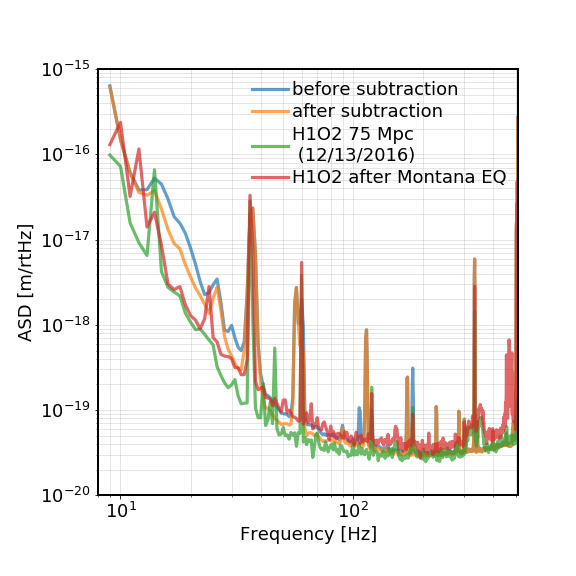
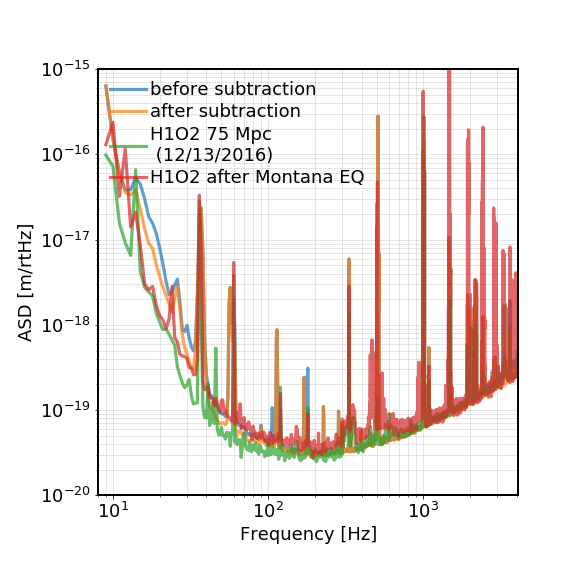
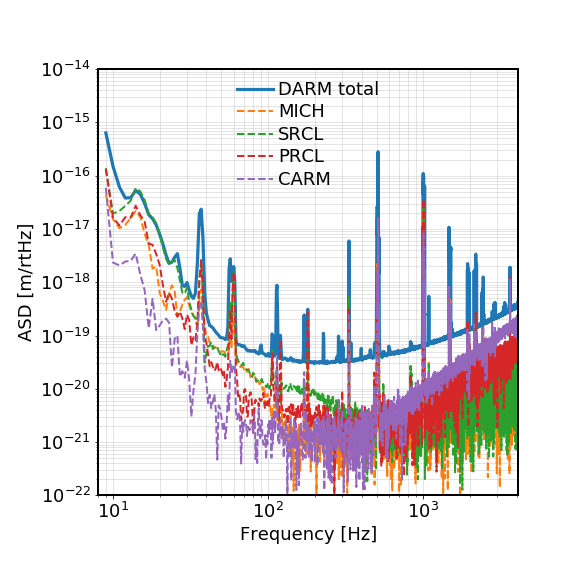
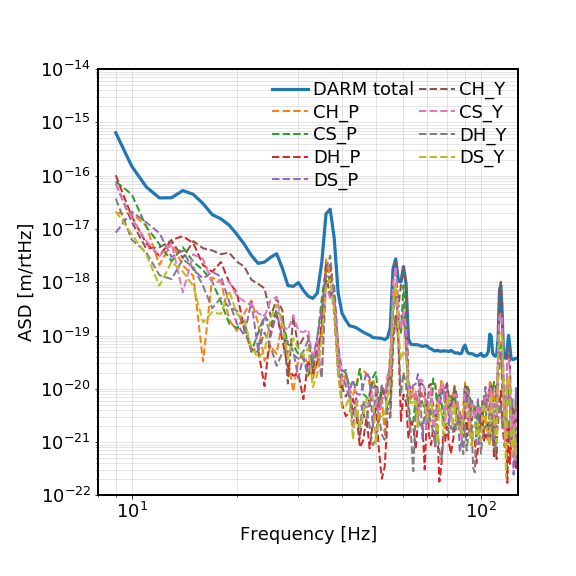
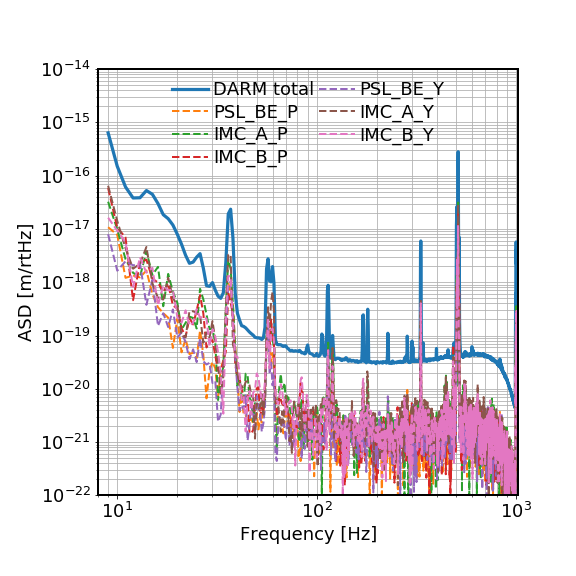
We did more DARM noise projection based on f-domain MISO coherence (i.e., linear couplings). The noise showed up in this study are in principle removable, ideally using online FF in real time, or using offline noise subtraction as did by Jenne et al. for O2 data.
This time we studied 3 different freq bands:
1). 8 ~ 128 Hz (LF), including all the LSC (MICH/SRCL/PRCL/CARM), arm ASC (C/D HARD/SOFT), and jitter (PSL bullseyes & IMC WFS) channels as the witnesses.
2). 8 ~ 512 Hz (MF), including all the LSC and jitter channels.
3). 8 ~ 4096 Hz (HF), including all the LSC channels.
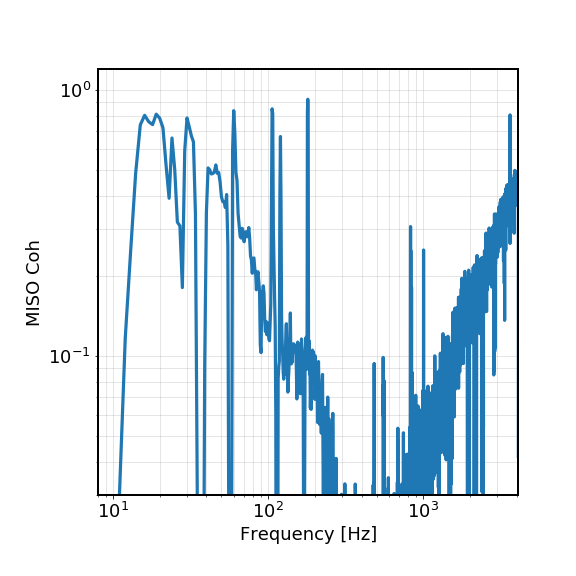
The noise projections to DARM are attached for each freq band. Also attached are the MISO coherence with DARM for the HF case (as LSC channels dominates the linear couplings for now), and noise projection for the LSC channels for the HF band, jitter channels for the MF band, and ASC channels for the LF band.
Some observations:
i), While our current real-time DARM noise is very similar to the post Montana EQ level from 40 to 100 Hz (which I believe Sheila et al will show in more details), there is room for improvement in that band by removing linear couplings.
ii). Right now SRCL dominates DARM sensitivity below 40 Hz, and it contributes roughly equally as LSC-MICH in the 40-80 Hz region. In the 100-300 Hz range we can still see a significant amount of SRCL in DARM. Thus to improve BNS range, we should definitely improve our SRCL FF.
iii). A significant amount of frequency noise/CARM is linearly coherent with DARM above 1 kHz. We should fix this excess HF freq noise but in the worst case we can still remove it by doing CARM FF/offline subtraction.
iv). CHARD Y is the largest contribution for the ASC noise. For other DOFs we are not yet able to see them with the current high SRCL noise.
v). No significant amount of jitter noise showed up.
=========================================================================================
Details: the data we used for this study were starting from gps 1224541306 for 256 secs. For each FFT we took 1 sec (i.e. 1 Hz BW) of the data with 50% overlaps between adjacent pieces. We had ~ 500 averages for this study, thus we can see coherence down to ~ 1/500 =0.002 level. This further means we can probe linear noise projection to DARM roughly 20 times below its sensitivity.
The analysis code lives in
/ligo/home/hang.yu/Desktop/LSC/DARM_NOISE/darm_coh.ipynb