Came in a early to squeeze in ETM charge measurements. Here are some notes:
- 7:27am PDT: H1 ISC lock taken down (after NLN for ~13hrs).
- Patrick took SEI CONFIG to a NO-BRS state for Maintenance activities
- Procedure Typo: Step 1c should be "bottom right of the SUS-ETM medm screen" (not left); procedure updated. ETMx L3 HVMon values needed an HV toggle and went to a solid 179. ETMy stayed low.
- Started the measurements and looked at the excitations seen on the HV Mons via dataviewer (the ESD DQ channels). They were about +/- 400V & this is apparently good (last week Patrick saw something like +/-10V
- 8:00 EY BSC10 Vac pump (Kyle)
Below are the slider values & brief notes/checks of the measurements for both ETMs as I was running. I ended up running the full script which had 5-measurements for ETMx & ETMy. As long as we had three good measurements for an ETM, then we are good. A good measurement basically shows a matlab plot with an "X" on it. Attached are measurements for ETMx & ETMy.
Alignment slider values & brief notes/checks on measurements as I was running the procedure:
ETMx: Pit: +102.3 & Yaw: -131.0
- Meas#1 had flat pitch = BAD, yaw had "X" = GOOD
- Meas#2 had pitch "X" = GOOD, yaw had "X" = GOOD
- Meas#3 Pit "X" = GOOD , yaw "X" = GOOD
- Meas#4 Pit "X" = GOOD , yaw "X" = GOOD
- Meas#5 check? but we have 3 good ones above
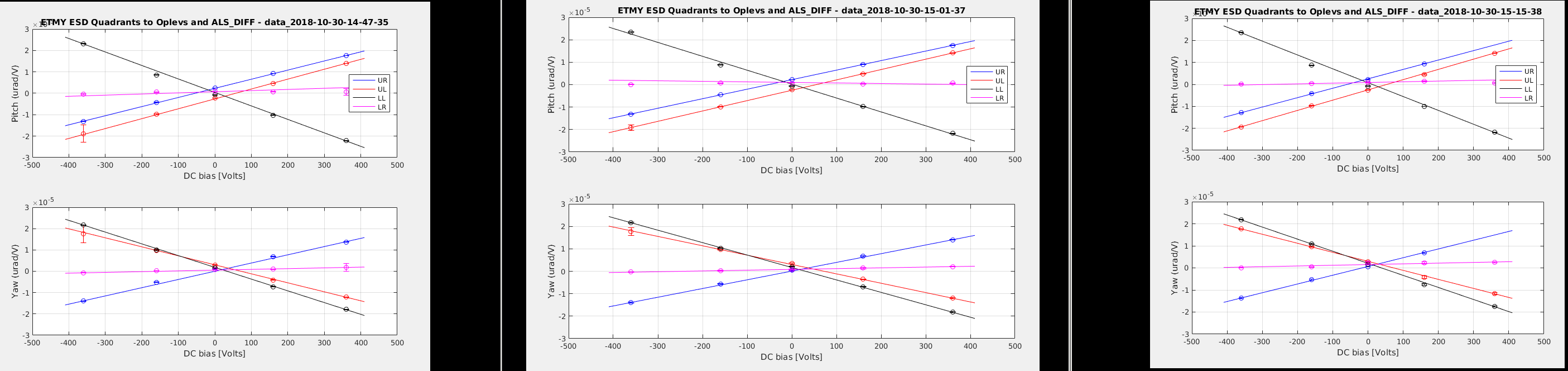
NOTES for ETMx: See attached plot with 3-good measurements + 1 bad one. For the ETMx one, the first measurement did not look good for Pitch ( w/ no "X" and all four quadrants were a flat 0 urad/V); the next 3-measurements looked good.
ETMy (w/ ESD LR quadrant bad!): Pit: +122.3 & Yaw: -125.9
- Meas#1 had pit "X" = GOOD, yaw had "X" = GOOD (LR bad!)
- Meas#2 had pit "X" = GOOD, yaw had "X" = GOOD (LR bad!)
- Meas#3 had pit "X" = GOOD, yaw had "X" = GOOD (LR bad!)
- Meas#4 & #5---> didn't check since we had 3-good measurements.
NOTES for ETMy: See attached plot with 3-good measurements. For the ETMy, mainly had an "X", but the ETMy LR quadrant was 0 urad/V. This is a known failure for the the ETMY ESD (FRS#10543).

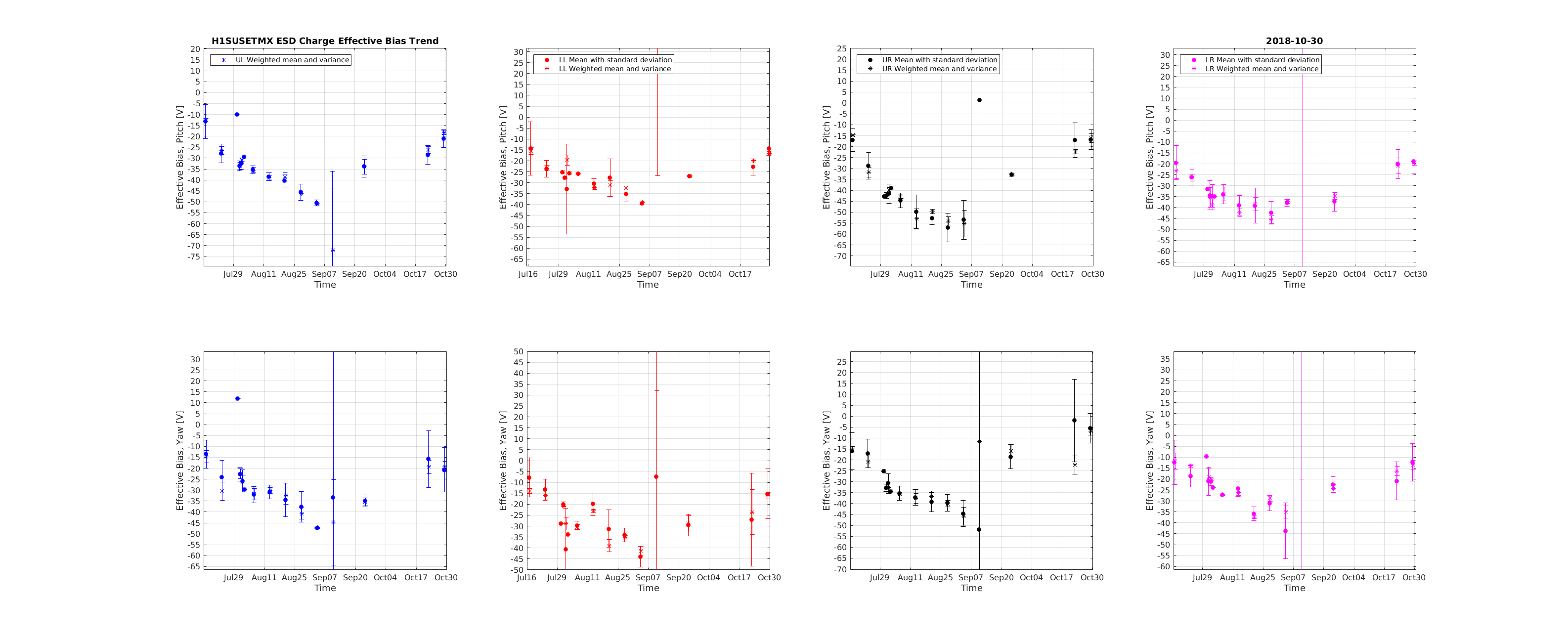
I've added today's data to the long trend plots of effective bias voltage for each quadrant, see first attachment for ETMX and second attachment for ETMY (sorry about the annoying axes on ETMY). No surprises: the same trend on EX due to the induced polarization caused by the bias voltage, and fairly flat for EY.
Measurements taken before and after the ETMX 20-bit DAC install show the same actuation strength (within error bars), which is good. The channels these scripts store and calculate the drive voltage from are the L3_ESDOUTF out channels.
I think I might need to update the calibration the scripts for the other types of charge measurements, which, if I remember right, read out the MASTER_OUT channels but I haven't done this yet.