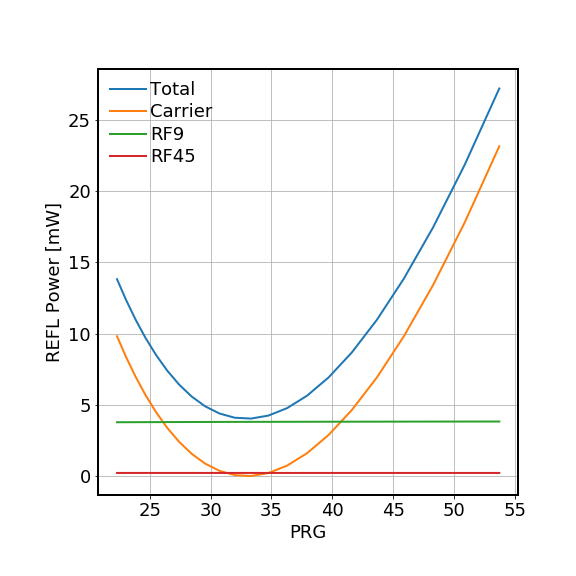
We did some FINESSE modeling to see the power/noise/optical response at the REFL/POP port in the NLN state.
=====
In the first plot we show REFL port power as a function of power-recycling gain (PRG). In addition to the total power, we also show the contributions from the carrier, RF9, and RF45 individually. The simulation result is very similar to the analytical estimation did in LHO:44410 (the RF45 contribution in this entry is lower than previously estimated as we assumed the NLN here and thus here we have extra 6 dB reduction in RF45 mod. depth). However, the measured REFL power (LHO:44947) is lower than the model by about a factor of 2...
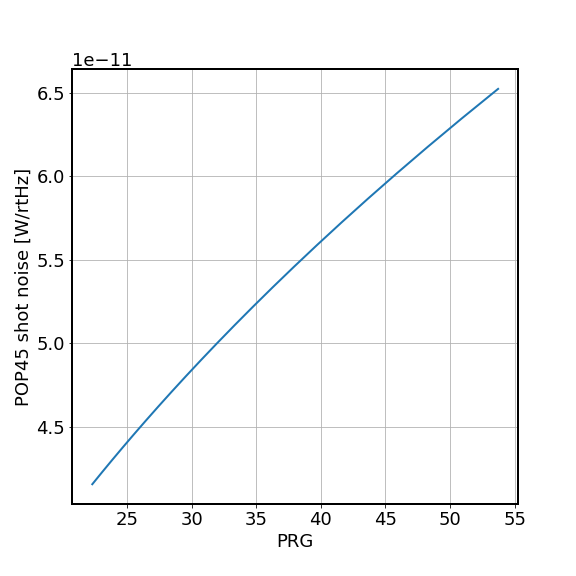
Also note that as the carrier is no more critically coupled, the shot noise level (in [W/rtHz]) will go up by almost factor of ~ sqrt(4) = 2 due to the increased amount of REFL power. However, the signal strength for, e.g., CARM will only go up by ~ sqrt(46/33) ~ 1.2. Therefore we might expect to lose a factor of 2/1.2 ~ 1.7 in CARM sensitivity...
=====
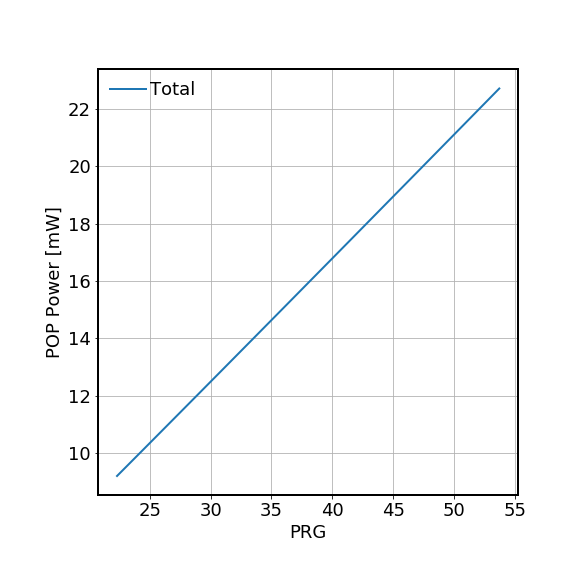
For the LSC_POP DC power the model and measurement seem to agree well. See the second plot.
=====
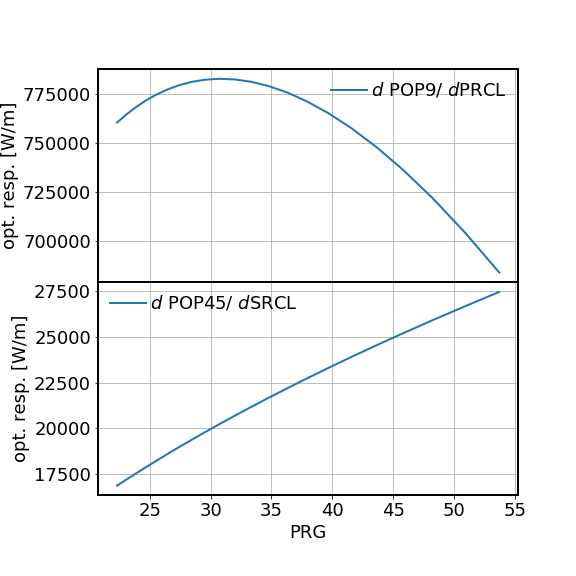
In the third plot we show the expected optical response for POP9 to PRCL (top), and POP45 to SRCL (bottom). Those values are calibrated to [W/m]. For PRCL we see the response decreases as the PRG increases. This is expected because as the PRG goes up, the difference in the PRC finesse as seen by the carrier field and by the RF9 filed gets reduced. For POP45 to SRCL, the signal strength increases as we improve the PRG.
=====
In the forth plot is the shot noise level of the POP45 signal in [W/rtHz].
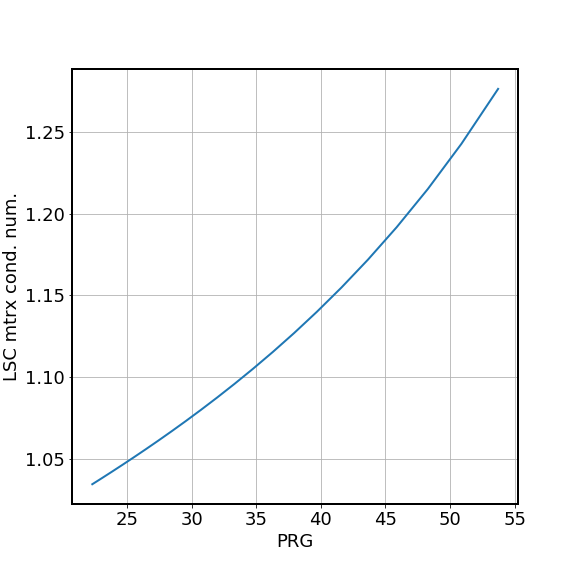
We also consider how well we can invert the response matrix of POP9/POP45 to PRCL/SRCL as the PRG changes. The condition number of this response matrix is shown in the fifth plot. Here to compute the condition number, we normalized the response such that the max. resp. to a dof is normalized to 1 (such normalization is equivalent as we having a freedom to choose an overall scalar at the input matrix). For example, the normalized resp matrix at PRG of 46 is given below,
| norm'ed resp matrix | POP9 | POP45 |
| PRCL | 1 | -0.17 |
| SRCL | 0 | 1 |
which leads to a condition number of 1.2. The larger the condition number, the harder the inversion of matrix (and thus the higher the sensing-noise-limited sensitivity).
=====
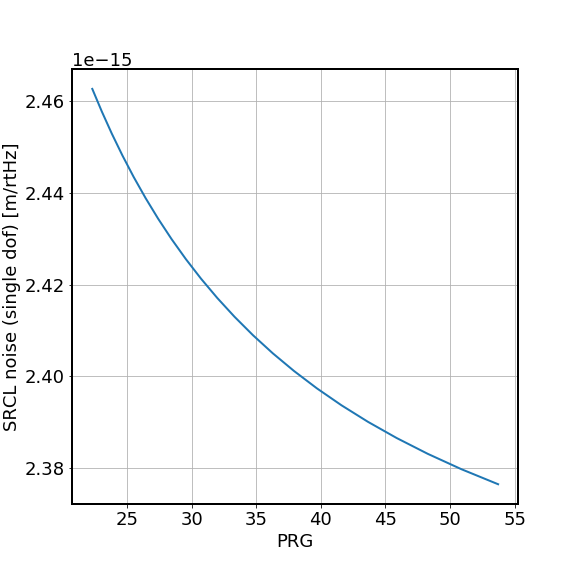
In the last two plots we showed the SRCL noise. In the second last one we simply take the POP45 noise in [W/rtHz] divided by its response to SRCL in [W/m]. In this case we see that the shot-noise-limited SRCL sensitivity improves slightly. However, this assumes that we do not need to do any matrix inversion, which is unrealistic as we do not have a significant gain hierarchy between the corner dofs.
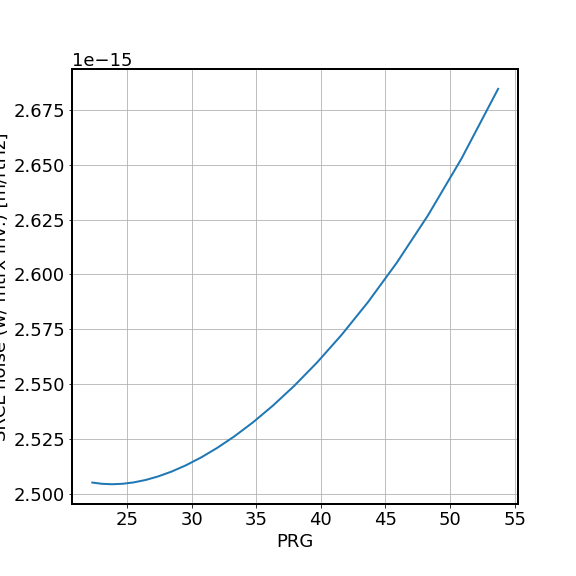
In the last plot we show SRCL noise, taking into account that the condition number gets worse as the PRG goes up (by multiplying the single dof shot noise with the sqrt of the matrix condition number as an approximation). However, the SRCL noise is worsen by only a few %. Effectively it should not change from now to O2.
=====
Parameters used in the simulation:
T_prm = 0.031, T_itm = 0.014, T_srm=0.325. The PRG variation is achieved by varying the common losses of the arms.
For the modulation depth, we assumed Gamma_9 = 0.19 and Gamma_45 = 0.25 * (-6 dB) = 0.125, as in the NLN we reduced the RF45 mod. depth by 6 dB.
We assume that 1.25% of the power refl'ed from the ifo is delivered to the refl PD. For POP, we assumed T_pr2=230 ppm and 9% of the pop beam goes to POP QPD.
Perfect mode matching is assumed for this study.