
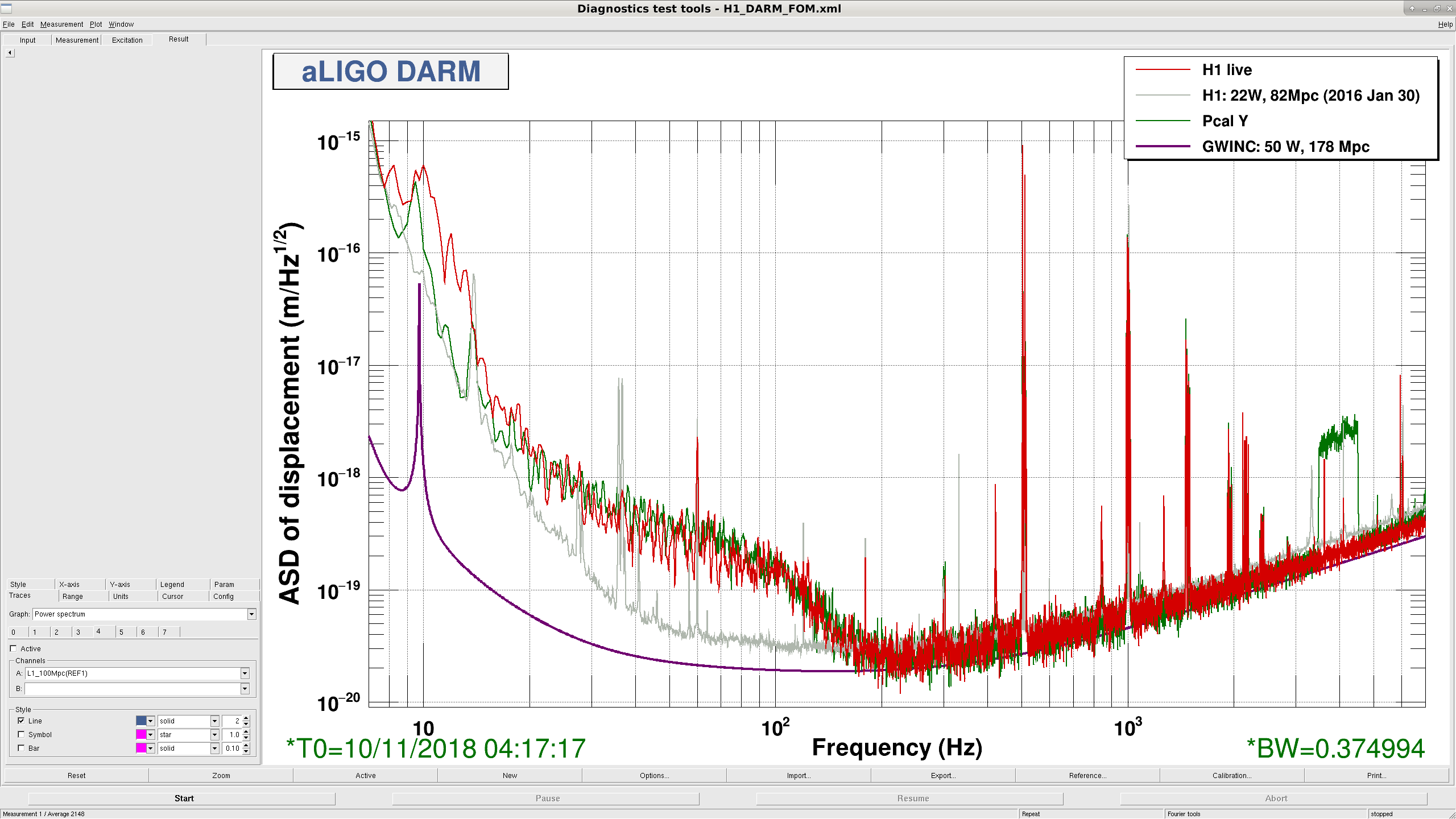
From Nov 10 2018 09:13:41 UTC to 09:19:27 UTC, the interferometer heroically rode out a fairly large earthquake for as long as it could.  The ASC performed beautifully for about six minutes, handling the seismic waves as if they were the GW stochastic background.

While this free seismic noise injection was happening, we saw the same exact scatter shelf in DARM that we saw earlier when we were injecting frequency noise around the OMC dither line.
Green in the attached plot is DARM during the frequency noise injection, the linear coupling visible from 3.5 to 4.5 kHz, the nonlinear seen at DC.  Red is DARM during the earthquake.  Grey is our reference.
It could simply be elevated ASC controls noise, but it was eerily close to the same OMC noise we had just seen.  Could OMC ASC be responsible?

We have also been having timing system errors H1:SYS-TIMING_Y_PPS_A_ERROR_FLAG audible updates every two minutes.
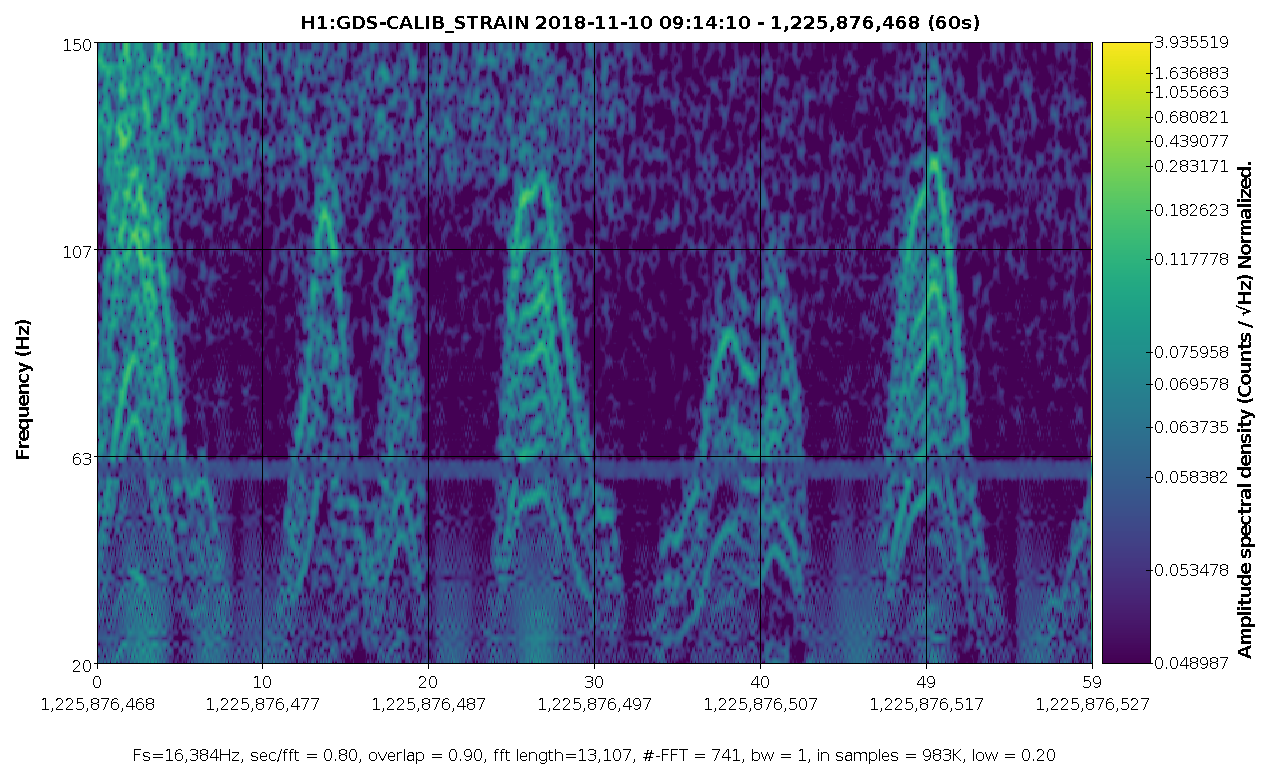
Attached is a spectrogram of the heroic earthquake rideout time, so it's definitely scattering as the knee in the spectrum suggests. Livingston has in 41482 seen scattering fringes associated with too much motion of OM3. When I looked at the OMs the motion didn't seem quite right to explain this. But using only length degrees of freedom no suspensions that I looked at matched the fringes well.
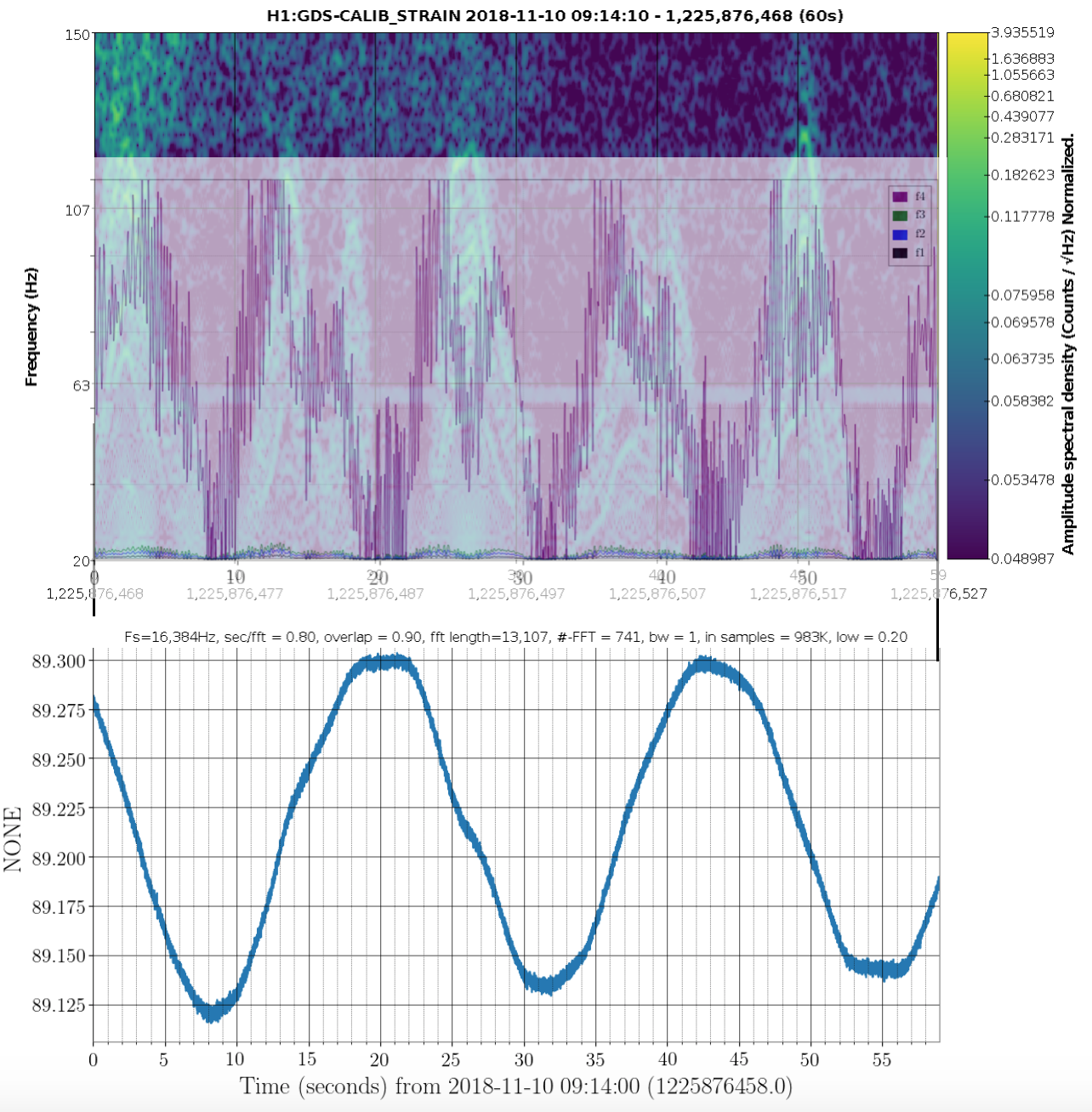
Reading the alog linked from the original entry 45180 a drive to OMC PZT2 led to low frequency noise in DARM (that resembles a scattered light shoulder as well). There is discussion there of frequency noise being down-converted. But I wonder if it could be that the OMC mirror is actually moving enough to make fringing? To figure that out I'd have to know the calibration of the OMC PZT2 channel (which I don't yet). But I do think it's interesting that if I assume OMC PZT2 is proportional to length, and if I lowpass it at 7Hz, take its derivate and scale it, it resembles the fringe frequency during the earthquake better than any of the suspension length channels I looked at. The figure shows the spectrogram from above, the timeseries of H1:OMC-PZT2_MON_DC_OUT_DQ, and the scaled derivative of that channel overlayed as a transparency. Admittedly, very far from conclusive but maybe it makes sense to look again at the OMC PZT2 injections with scatter in mind.
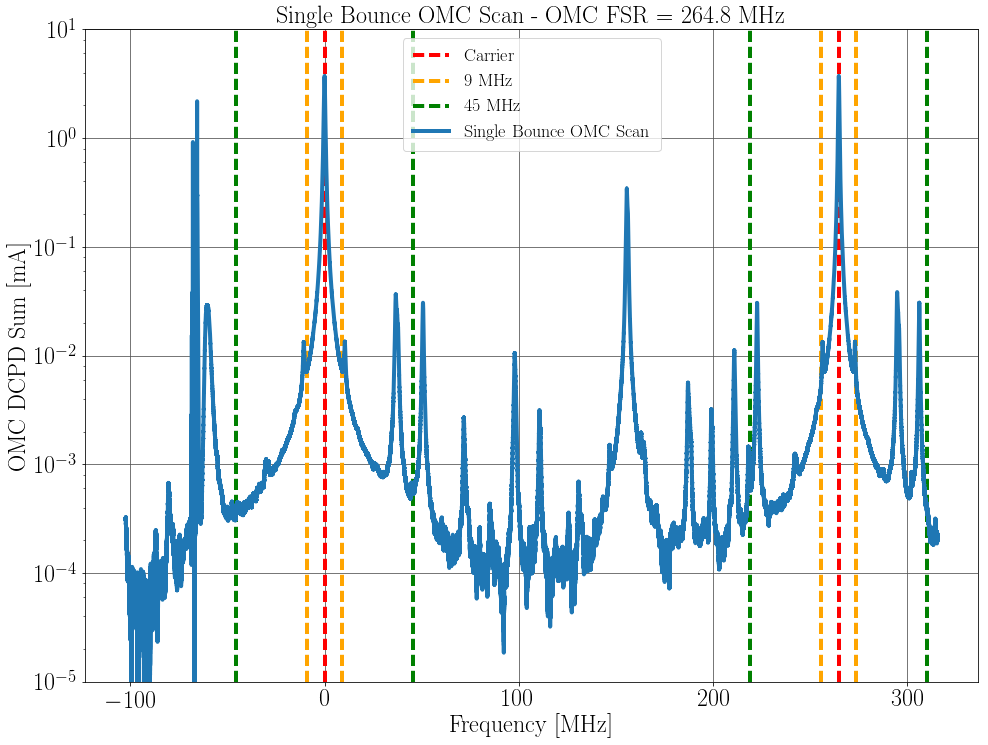
I approximately calibrated OMC PZT2 back in July: It was about 6.69 MHz/V, using the FSR Koji reports of 264.8 MHz alongside a single-bounce OMC scan.
The reported length of the OMC is 1.132 m, so the PZT calibration is also 2.69 * 10-8 m/V.
The PZT can be a nonlinear actuator, of course, so don't take these numbers too seriously, but they are better than nothing.

As far as frequency noise downconversion, the current wisdom from Sheila is that the OMC dither signal is masked by excess frequency noise at 4.1 kHz, so increasing the OMC dither improves the SNR of the dither-locking loop and reduces the OMC controls noise, which can pollute DARM at low frequency, but generally doesn't.

It's unclear to me how exactly frequency noise at 4.1 kHz can cause the scattering shelf to rise, but it is clearly happening.
It would be interesting to see if the fringing from the 12 Hz line is the same as the fringing from the earthquake, and if the fringing from the frequency noise is the same as the earthquake.

Here's a table of the excitation times from Sheila's alog 45180 Friday:

Curve Color     Description                             Time
----------------------------------------------------------------------------------
Yellow curve    12 Hz with low OMC dither amplitude     Nov 10 2018, 03:32:17 UTC
Brown curve     12 Hz with high OMC dither amplitude    Nov 10 2018, 03:54:18 UTC
Pink curve      Freq Noise Injection, low OMC dither    Nov 10 2018, 04:18:15 UTC
Cyan curve      Freq Noise Injection, high OMC dither   Nov 10 2018, 04:21:15 UTC

I think it's likely there are two different noise couplings. It would be good to double check the spectrograms, I wouldn't expect to see scattering shelves in the data from 45180 since that is a bilinear coupling where the 12Hz line is dominating the rms.
It might be that we could avoid this noise in time when there are large earthquakes by rolling off the OMC length loop faster.