
Time-domain non-stationary subtraction
This is a follow-up on my previous entry 45403. There I computed the "non-stationary transfer function" between the SRCL noise (modulated by ASC signals) and DARM, and showed that it is possible to subtract in the frequency domain the SRCL coupling to DARM. I also showed that using the modulated signals allowed me to improve upon the stationary linear subtraction.
Here I start from the coupling transfer functions computed in the frequency domain, fit some of them using vectfit3 in MATLAB, then implement those fit as time-domain digital filters, and finally show that I can get a reasonably good subtracted time series. This corresponds to item (1) in the "Next steps" section of 45403.
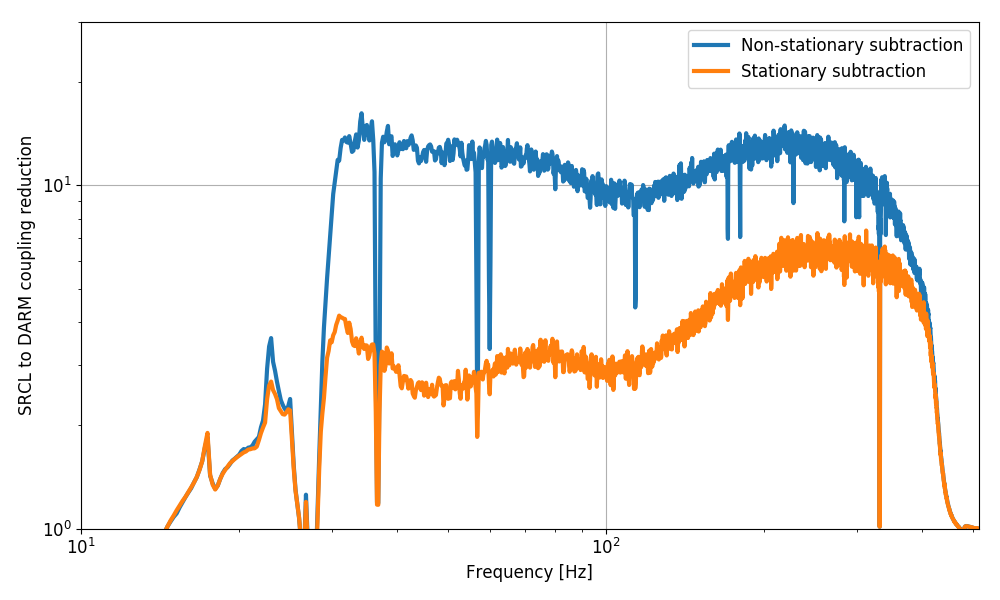
In summary, a simple stationary subtraction of SRCL would reduce the SRCL to DARM coupling by a factor 2.5 to 6 depending on the frequency. The non-stationary, time-domain subtraction can improve upon that, resulting in a SRCL to DARM coupling reduction by a factor 9 to 15 depending on the frequency.
Details
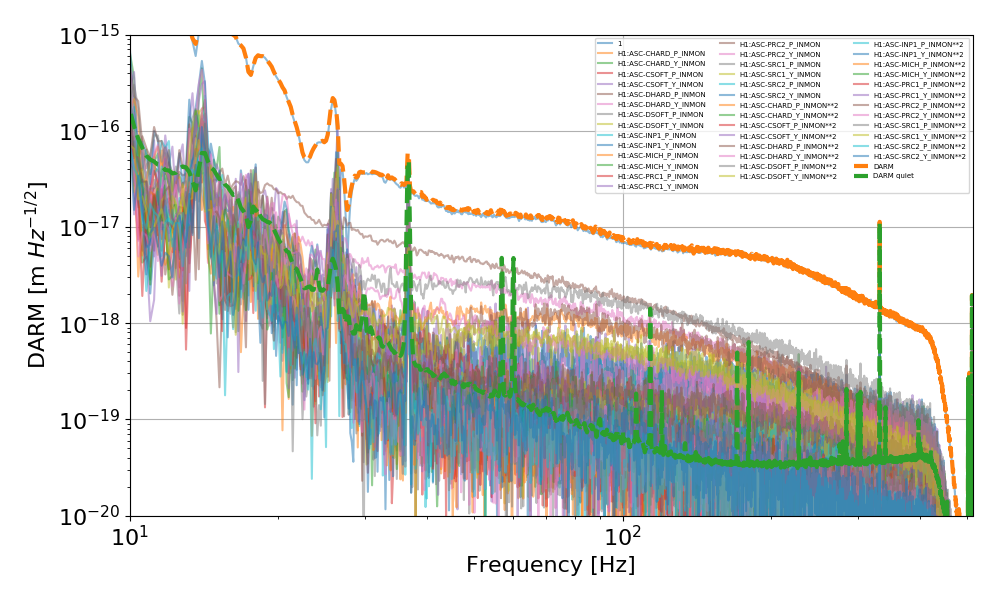
First of all, the very busy plot below shows the contribution to DARM of each of the terms in my subtraction scheme. So the legend indicates what modulation is applied to the SRCL signal. This is a busy plot, and it's meant just to give a rough idea of which terms are the most important.
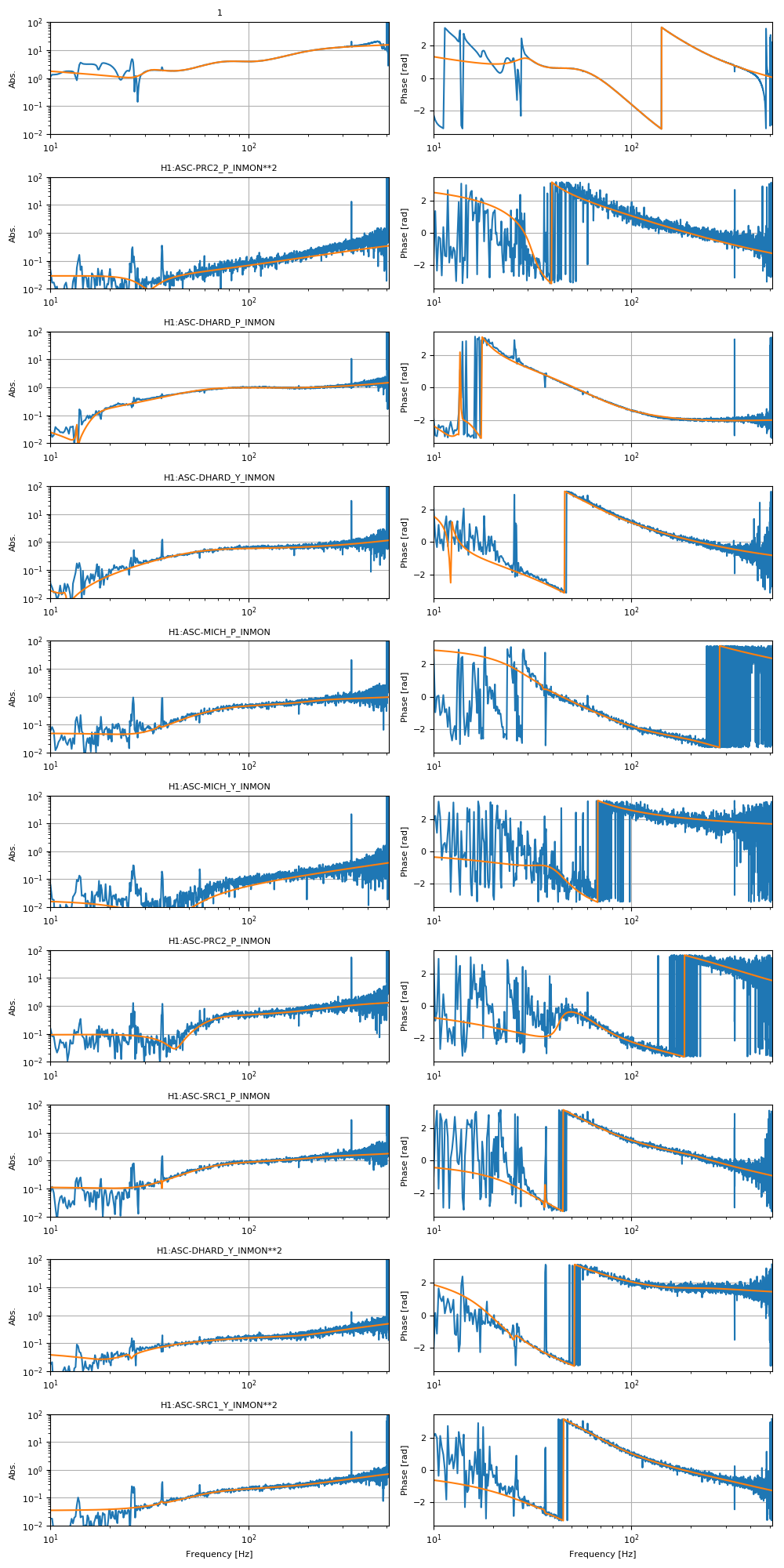
I selected only a few of those terms, namely those that looked like the largest contributors. No automatic selection yet. Then I used my MATLAB implementation of vectfit to fit those transfer functions (that are from modulated SRCL to whitened CAL-DELTAL_EXTERNAL). The results can be seen below (left column absolute values and right column phase of each fitted TF, blue is the f-domain data from 45403 and orange the fit). Some of the fits might be improved if desired, but they're not too bad for now.
The fitted poles and zeros have been converted to digital IIR filters, and those used to compute a time-domain subtracted time series. The results can be shown in the spectra below. For comparison, many curves are shown.
Start by looking at the thick blue trace, which is the original DARM noisy signal during the SRCL injection, and by looking at the thick green trace, which is the time-domain-subtracted signal, including the fitted non-stationary contributions above. For comparison, the dashed green trace shows the optimal subtraction in frequency-domain (same as shown in the summary plot of 45403).
For further comparison, the thick red trace shows the subtraction you can get by including only the stationary SRCL to DARM coupling. This is comparable to the frequency-domain result, shown in the dashed red trace.
Finally, the purple trace shows a reference DARM noise spectrum when there was no SRCL noise injection, and the orange trace is the spectrum of the time series that is subtracted from DARM.
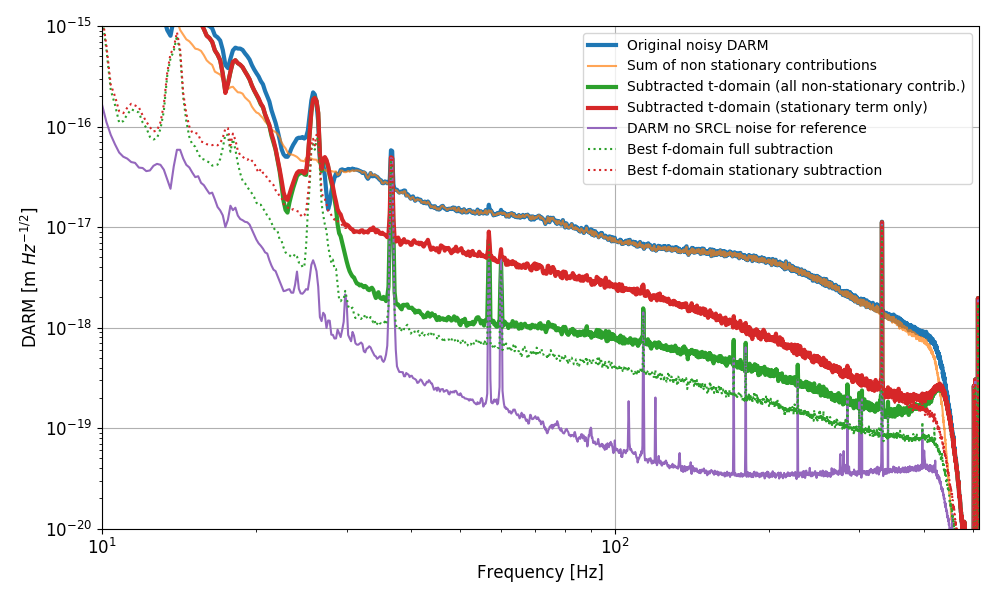
The residual SRCL to DARM coupling is mostly due to mis-fit and residual modulation due to neglected ASC signals, since my time domain subtraction does not match the optimal frequency-domain result.