Hugh w/ many thanks to JeffK for super patience schooling.
With the new L4Cs inside the HAM1 Optics Table and the option to run the the interface chassis with an extra 10x gain available, the signals were cast into ADC digitization point voltages and compared to the ADC noise and its saturation level.
Bottom Line: *) These sensor will run with the analog gain in the high state. *) V1 signal does not look like V2 & V3 below 100mHz. *) The H1 signal does not look like the vertical sensors, naturally; but, I'm not sure it looks right.
Details:
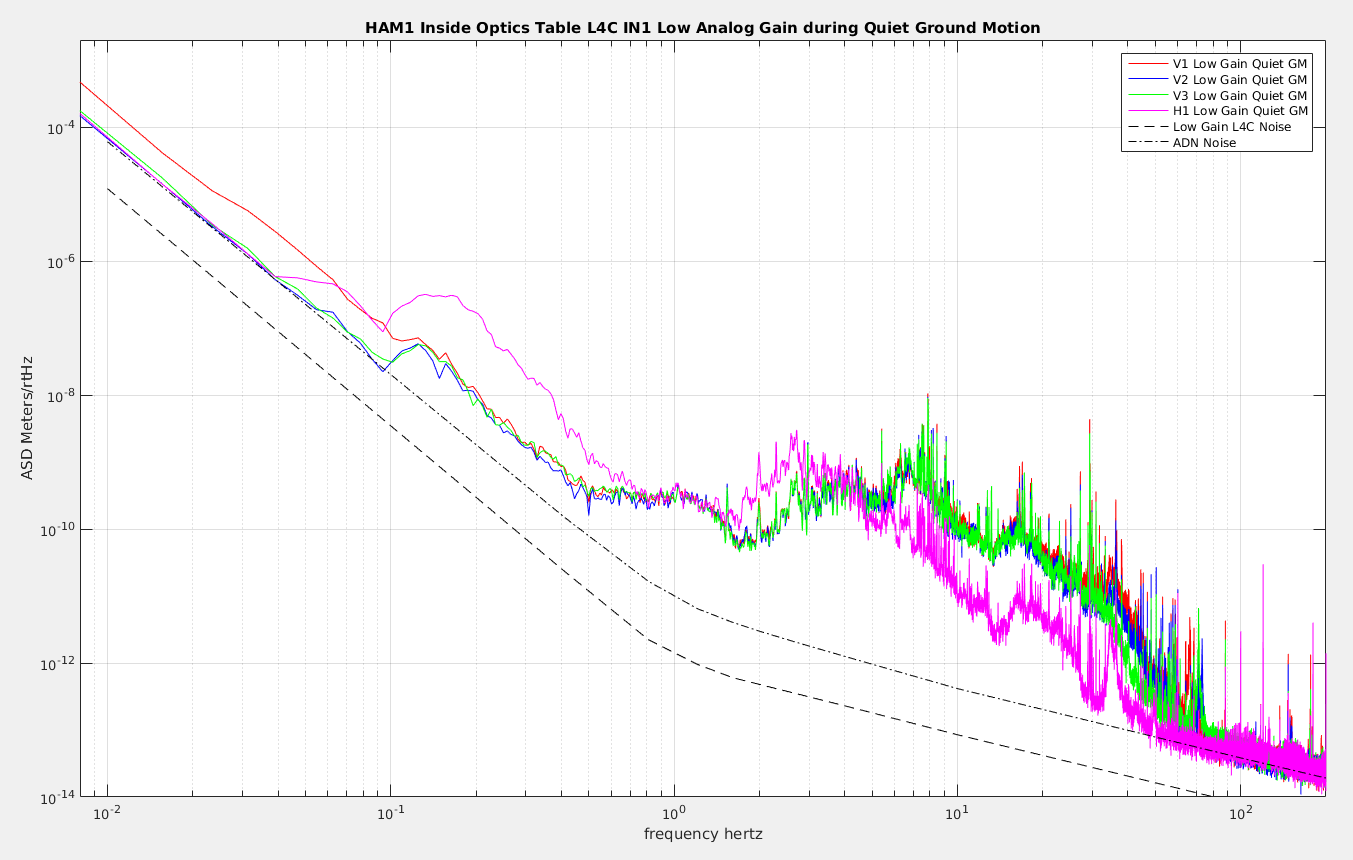
First plot is the IN1s with LOW analog gain during quiet ground motion.
Calculation is: IN1.cts x ADCv/cts / 44[podpreamp] / 2[sensor chassis gain] / 275v/m/s[L4C cal] / 2pif x zpk(pair(1,45),[0 0],(2pi) ^-1). This should put the counts to meters.
This looks reasonable when compared to the L4C Noise but happy if anyone looks closer at the details.
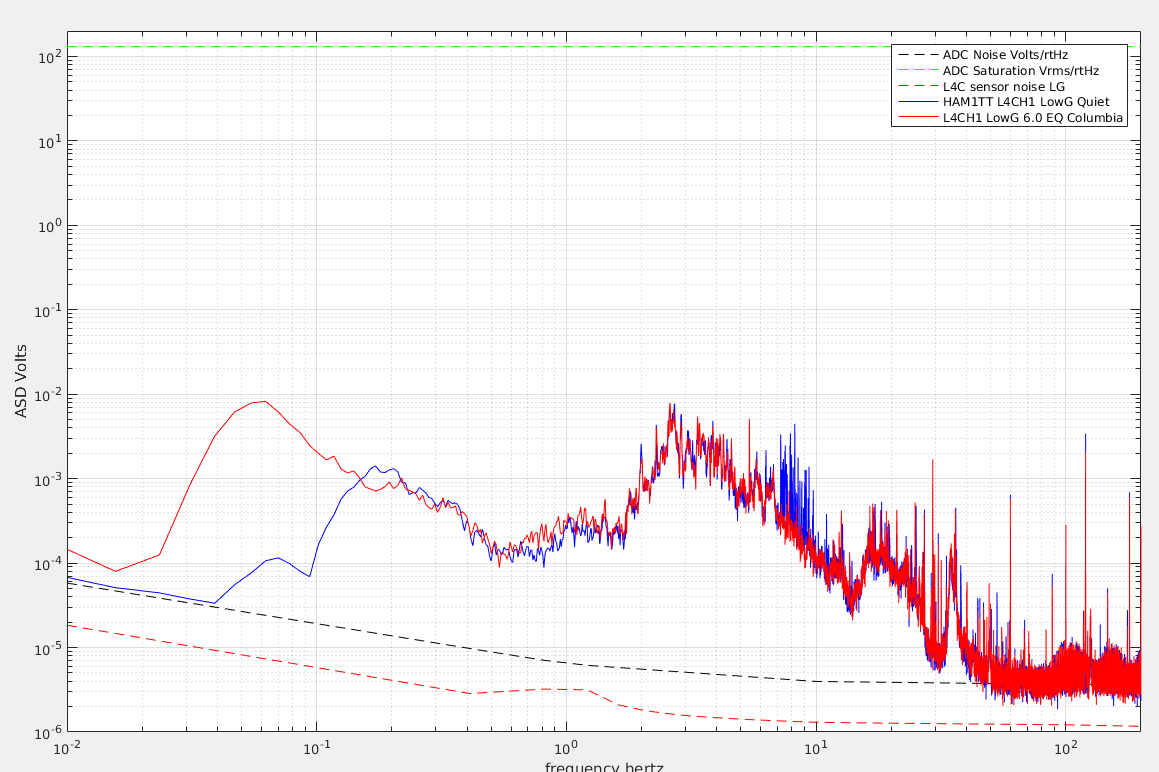
The second plot shows the H1 signal (just because it had the largest signal) while the sensor interface was in low gain cast back to volts at the ADC. Periods of quiet ground motion and during a 6.0 EQ in Columbia are shown. This is not too big an earthquake for us at LHO with the 30-100mHz BLRMS hitting just 1500nm/sec. Also on the plot are the L4C noise curve when in low gain, the ADC Noise, and the ADC saturation level comparable to the DTT effective noise BW. Note where the sensor's curve dances with the ADC Noise curve.
The third plot shows similar to above except the sensor interface is in high gain and the earthquake is the very large 7.0 in Alaska pushing the LHO ground motion to 30000 nm/sec in the low band.
So, conclusion: In low gain, the L4C is limited by the ADC noise at low and high frequencies; and, in high gain, there is still 2 orders of magnitude of headroom before saturation even during very large ground motion. Conclusion, run in high gain.
These data and the matlab script resides in /ligo/home/hugh.radkins/Matlab/HAM1_TT
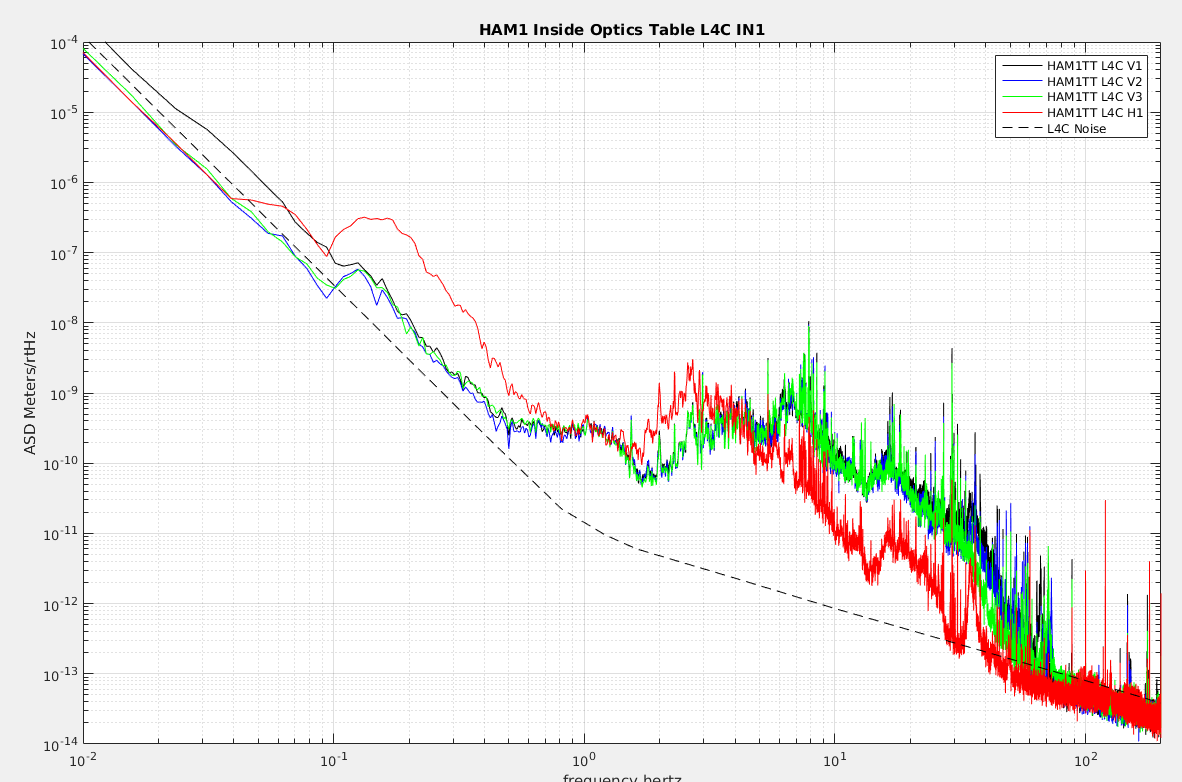

The first plot above has an error, thanks to JeffK for pointing out something I should not have shrugged off. When the sensor curves dip below the sensor noise curve should be a jab to look closer, as Jeff did. The Noise curve is incorrect in that it is the case of high analog gain. Here below I attach the same but with the low analog gain L4C noise and the ADC noise curves. As Jeff and I had seen before, in this state, the ADC noise limits the sensor signals.