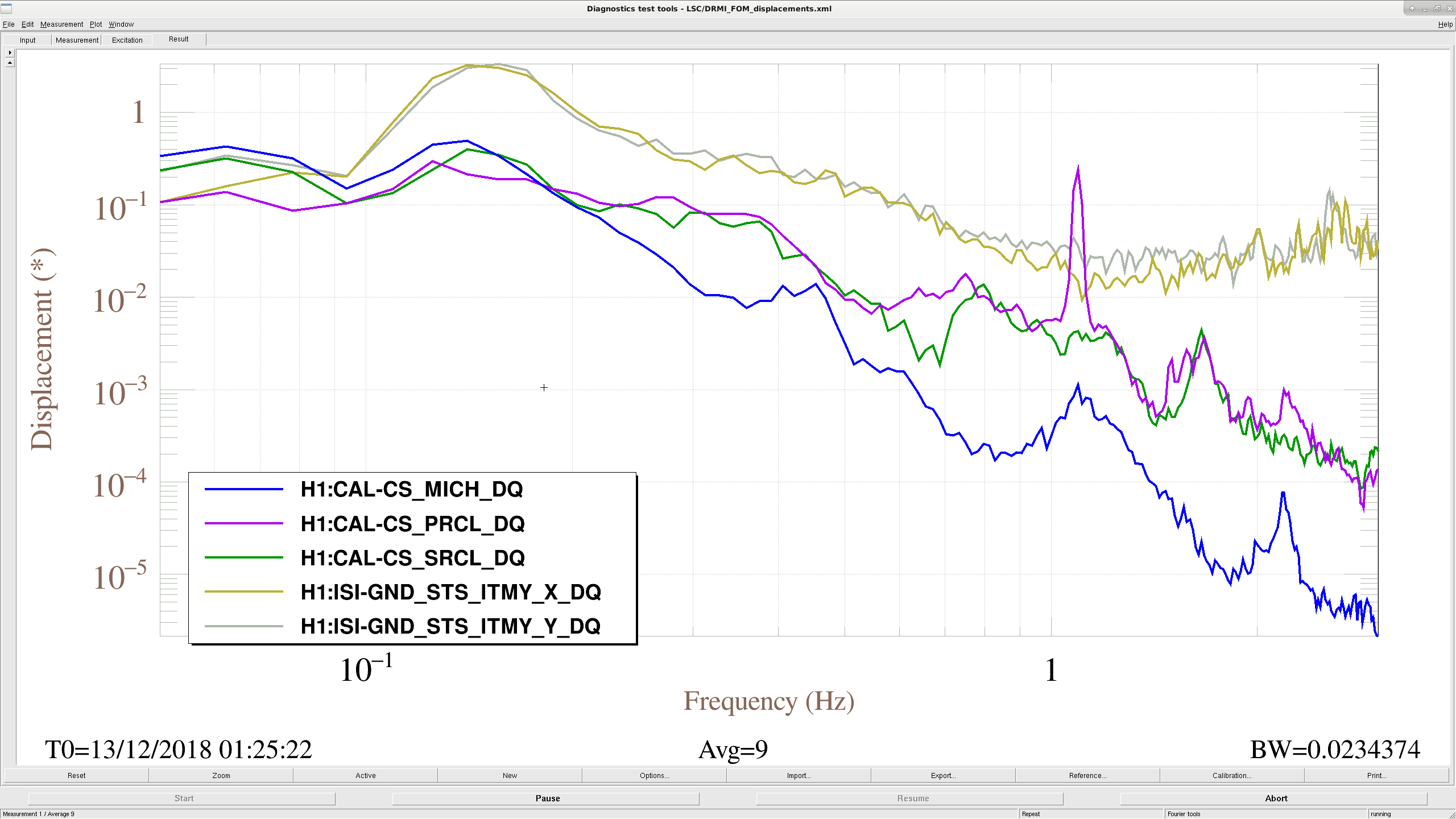
Since Sunday, each day we are spending many hours waiting for DRMI to lock. As people are well aware of, the DRMI here seems to go through phases of good/bad locking. Good locking is where the acquisition time is mostly < 10 minutes. When its bad, it may be 30~60 minutes. As is usual, we sit around wondering if its "the alignment", "the wind", or the "the microseism".
In the LVEA, the common mode rejection of the slab is ~1000 at the microseism peak, so most of the 0.1-0.3 motion that we see in the DRMI comes from differential motion induced by the SEI and SUS.
As an example, I'm attaching the LSC control signals from a DRMI lock earlier tonight, compared to the ground motion. It seems like we're getting around a factor of 10 suppression for MICH/SRCL, but only a factor of 4-5 in PRCL. But actually, its probably even worse. The CAL-CS channels don't take into account the M1 offload (what is the M1 crossover frequency for the length control on SRM and PRM?).
At LLO, Arnaud is looking into some improvements to the ISI controls to make the PRC/SRC HAMs follow the BSCs better. If the main microseismic impact to DRMI locking is the PRC velocity, we would win a lot just by getting a 2x reduction at the microseism.

Part of the reason the SRCL length is lower at the microseism might be the work I did a couple weeks ago on HAM4. PRCL sees similar coherence with ground Z motion at the microseism. Arnaud had talked about trying similar feedforward to HAM3, but it was unclear if improving PRCL would make MC-L worse. I haven't found any alogs documenting either way, so far. Looking at a couple locks over the last week, I would guess that MC-L is dominated by other stuff at low frequency, so maybe it doesn't matter so much when the arms are locked.
If I could be allowed to try doing some ground Z to HAM3/PRCL sensor correction, I would need about an hour or so to get and tune the ISI drive to PRCL transfer function. I can likely do any on/off tests without bothering anyone.
Attaching a couple plots comparing SRCL and PRCL, before and after my work on HAM4.
First plot are just spectra, blue & green are before, light blue & purple are after. PRCL seems unchanged, but SRCL has ~3x less motion at the microseism after turning on the extra HAM4 sensor correction. It is worth noting that the PRCL microseismic motion is higher, for the case with the HAM4 sensor correction on, so the improvement to SRCL is probably better than shown here.
Second plot shows the coherences from the ITMY STS Z to PRCL,SRCL and MC-L. MC-L changes, I don't understand why. PRCL, is more or less unchanged, but SRCL goes from about .95 coherence before, to basically nothing at the microseism. I think it is worth trying this for PRCL.
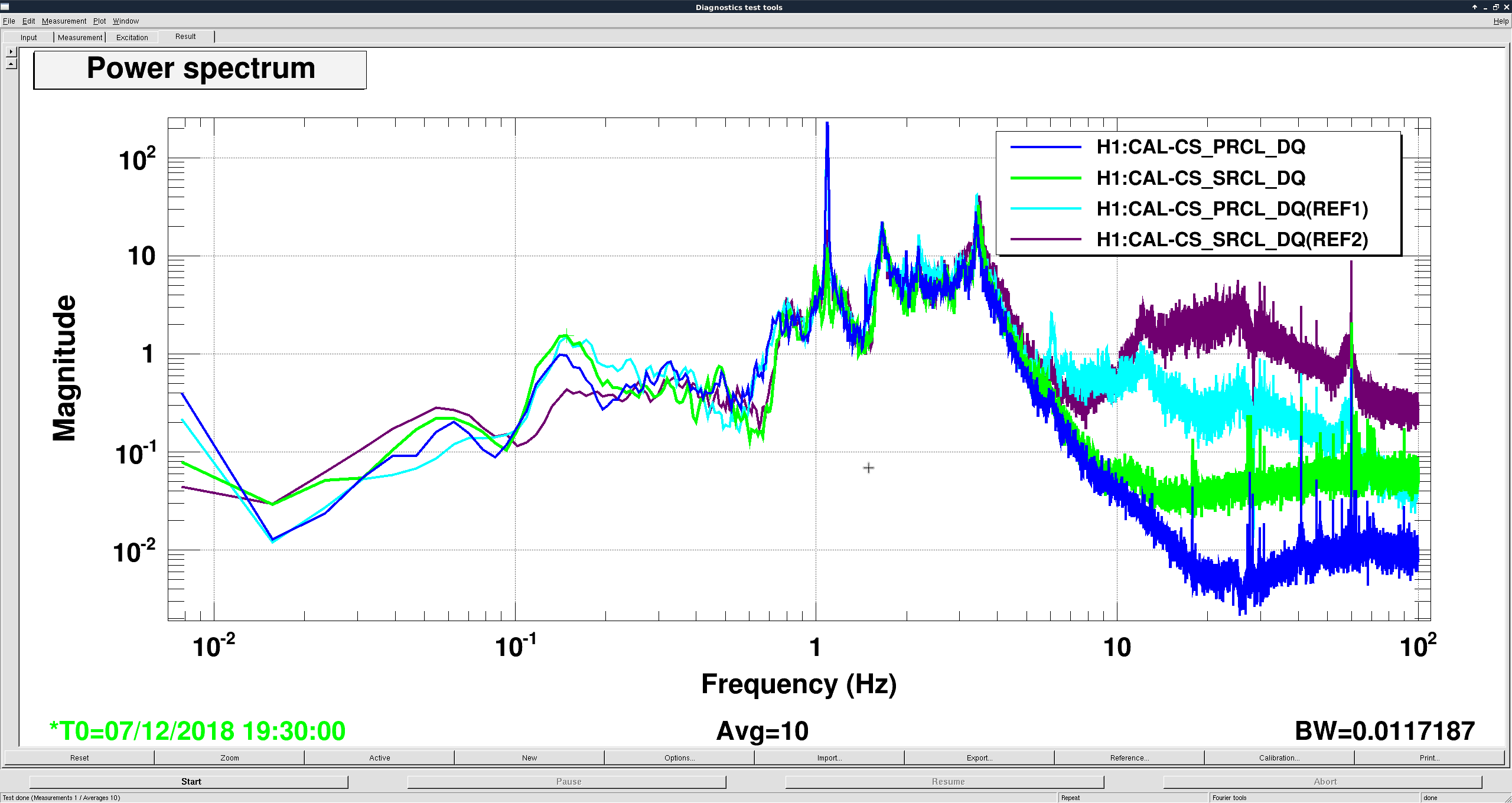
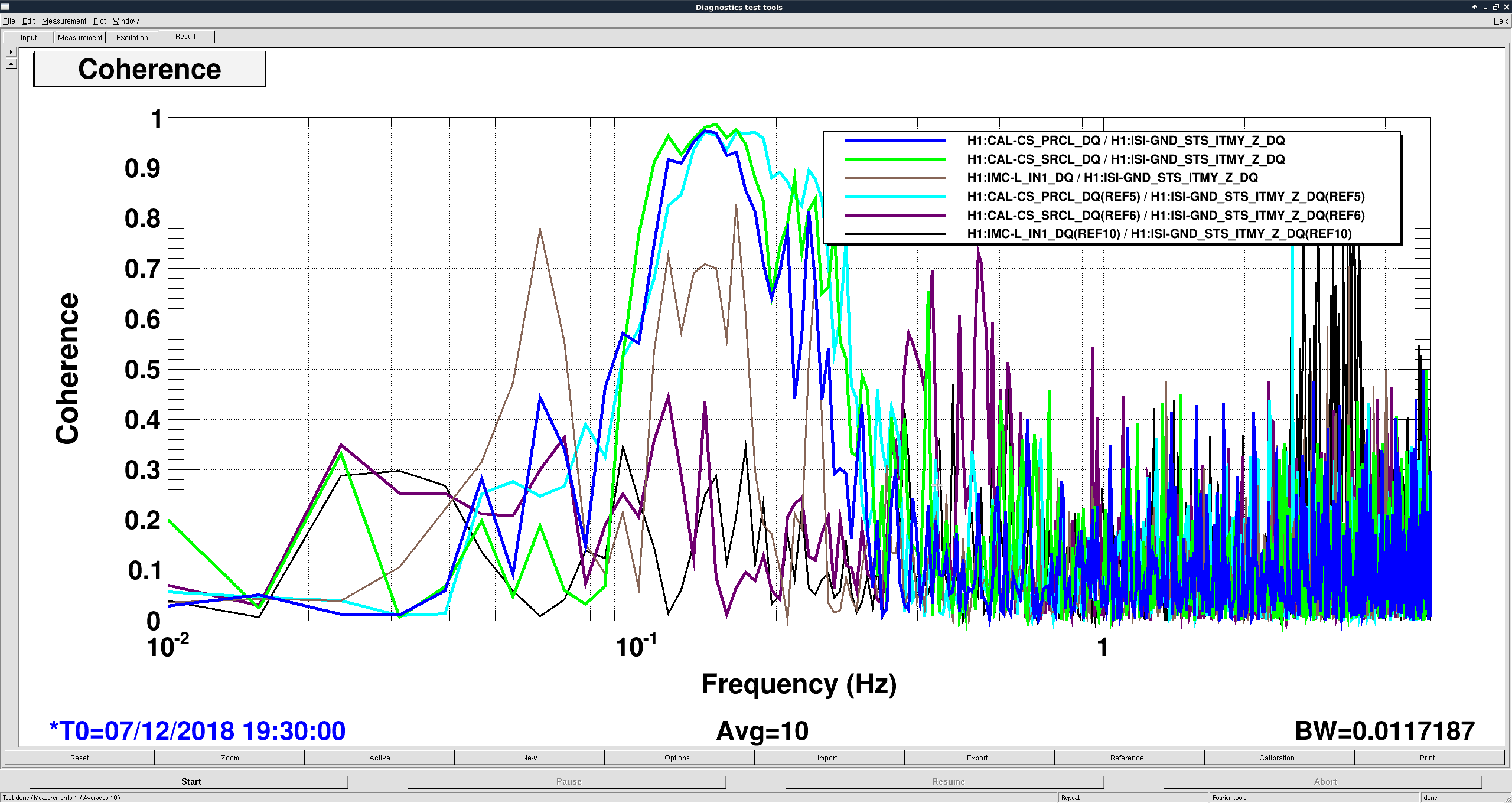
This is how DRMI looks now with the added HAM3 GND Z to X sensor correction. PRCL is now down to the same level motion as SRCL.