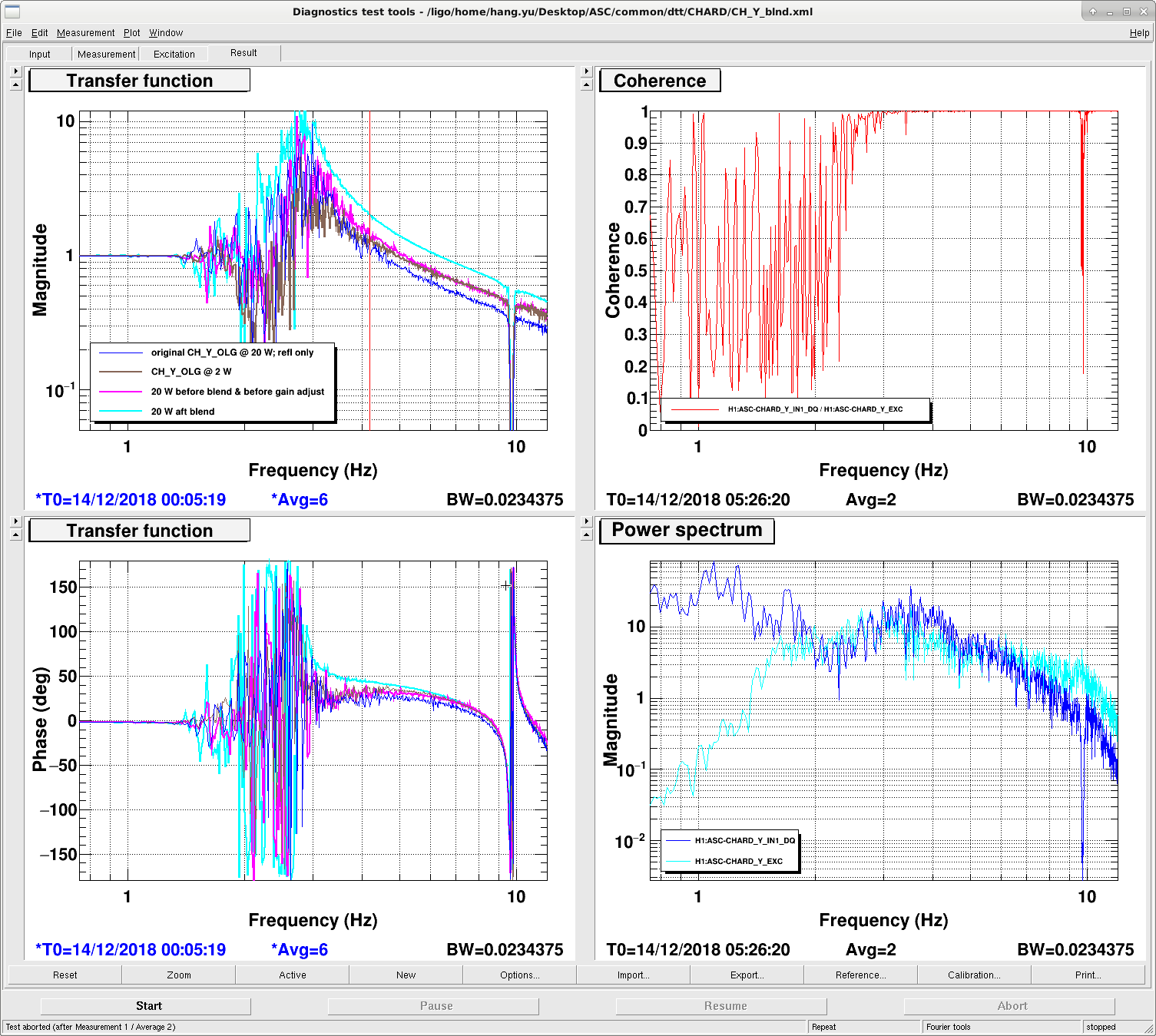
We noticed that the CHARD YAW OLTF at 20 W before the CHARD blending state had too small a gain. By design it should had an UGF of ~ 6 Hz. However, the measured yaw loop had only a UGF of 4 Hz. More over, it also lost a large amount of phase (only 20 deg) at ~ 4 Hz. Please see the blue trace. As a comparison, the DHARD YAW (which should be almost identical to CHARD YAW) had a phase of ~ 80 deg at the similar state.
As a first step we went back to 2 W and remeasured the CH Y OLTF. Please see the brown trace, which seemed similar to the 20 W result below 4 Hz but behaved better above 4 Hz. To bring its UGF to 6 Hz we modified the CH Y DC gain from 2 to 2.5.
Then we powered up to 20 W and remeasured the CH Y OLTF, corresponding to the pink trace (using only a combo of refl sensors: RF9_A_I + 0.2 * RF9_B_I + 1.3 * RF45_B_I). Note that we had already increased the DC gain to bring the 2 W OLTF to have 6 Hz UGF. Thus from 2 W to 20 W we lost about 20 % REFL WFS response to CH Y. We then increased the DC gain to 2.8 when the input power > 18 W.
After this gain adjustment at 20 W we then engaged the CHARD blending filter. The DC part still uses the REFL 45 signal while the AC part uses the signal from a combo of TR QPDs. This corresponding to the cyan trace in the figure. As we had modified the overall DC gain before the blending, we thus decreased the CH Y B gain to 0.77 to bring the UGF staying at 6 Hz.
Also notice that as we engaged blending, we recovered about 20 deg of phase at around 3-4 Hz, as shown from the comparison between the cyan and the pink curves.