
Daniel, Nutsinee
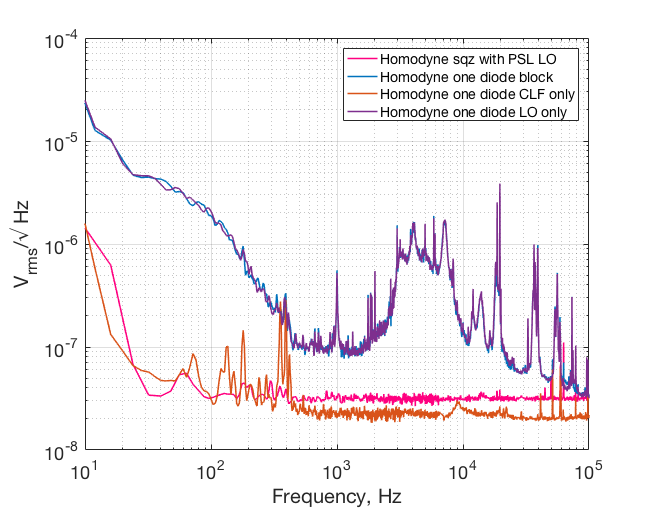
Yesterday we tried to see squeezing while PSL is locked with PSL LO just to see if we see the same excess noise at ~1kHz that we saw in DARM during the last squeeze injection (alog45767). I quickly balanced the Homodyne and tweaked the fringe visibility so it was within 90% range (measured 95% out of PD2). I didn't optimize the temperature or measure the non-linear gain since we just wanted to see the excess noise. We saw ~1.5dB of squeezing at ~4mW input to the OPO and ~0.7mW CLF input to the coupler (the CLF locking signal was at about the same strength I would say, roughly about the same CLF power went through as the night we injected into the IFO). The noise looks okay. Whatever we saw in DARM that night didn't exist on the homodyne. We also looked at single homodyne noise with one diode blocked. Most excess noise seems to have come from the PSL LO itself.
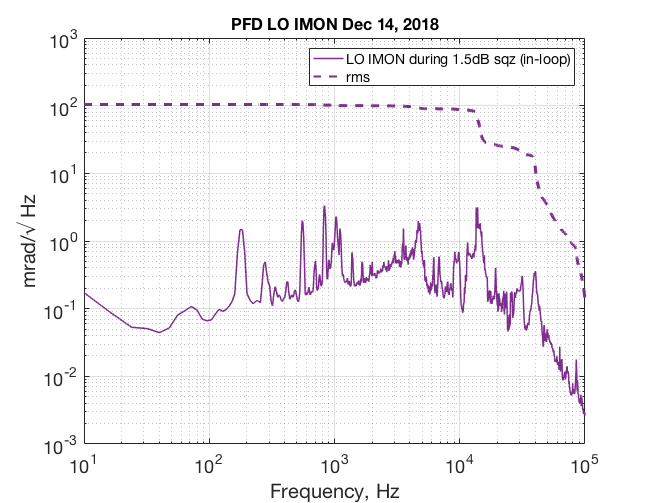
For the record, here's an LO in-loop error signal measurement.
Here's what it looked like the night we injected squeezing into the IFO.
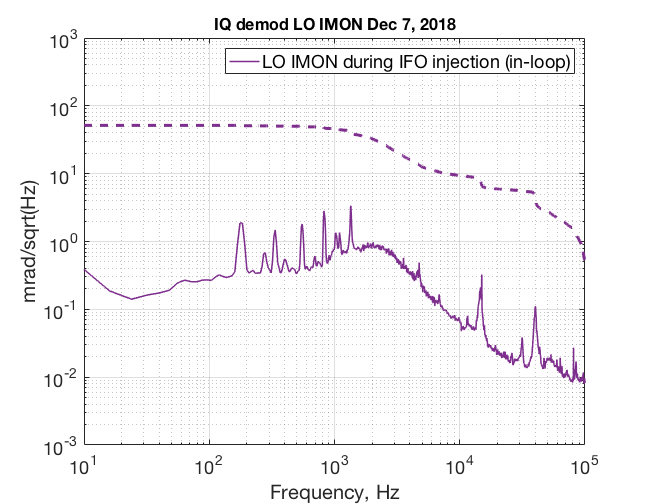
Both of these are in-loop measurement. I forgot to write down the gain/boost settings for Dec14 data. Once I have that I'll post an out-of-loop measurement so we can compare apple to apple. The (OMC) LO measurement looks more like (PSL) LO measurement from October 12 (alog44575). These peaky features are new and we think it comes from CLF (some how, electronics cross talk?). They also show up in OPO locking signal. Sheila suggested we try to lock with the old scheme (OPO error signal feed back to itself) and see if the contamination still exists. That is easy enough to do.
How we lock SQZ angle (LO loop):
If the 3MHz signal comes from IFO AS_A, B, then it goes into an IQ demod board. If the signal comes from Homodyne, it goes into a PFD (we used PFD because we had a lot of excess noise which we thought came from PSL LO fiber, PFD gave us more range). The error signal (I) goes to LO common mode board (input1 for OMC 3MHz, input2 for HD 3MHz). the slow signal goes to OPO PZT, and the fast signal goes to TTFSS additive offsets. Depending on gain setting, the UGF can be cranked up to 60kHz (alog44484).