craig.cahillane@LIGO.ORG - posted 07:02, Thursday 20 December 2018 (46085)
REFL A/B 9 Phasing, REFL A 9 Cabling, digital offsets
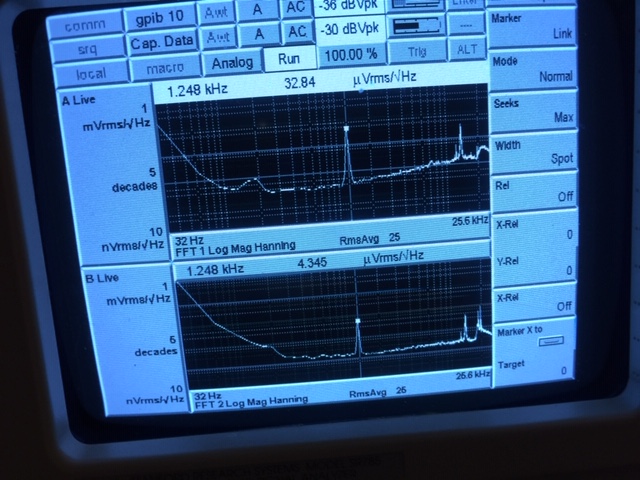
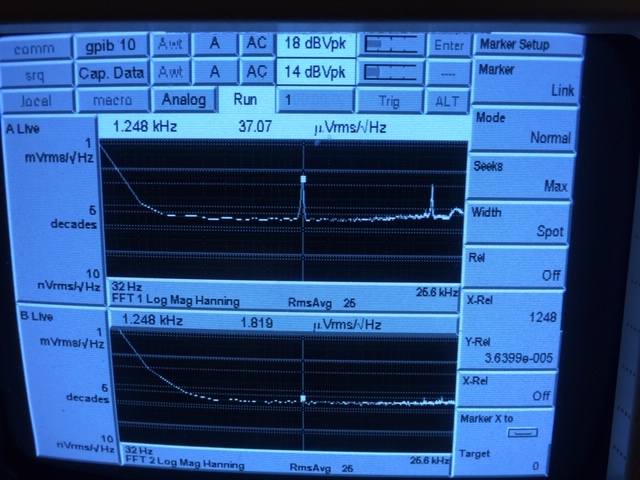
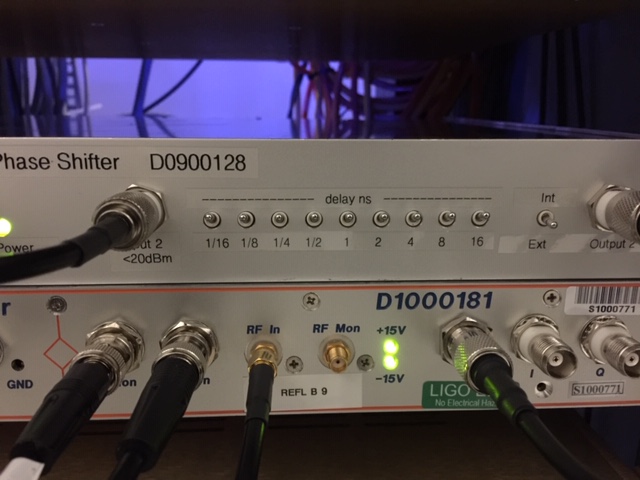
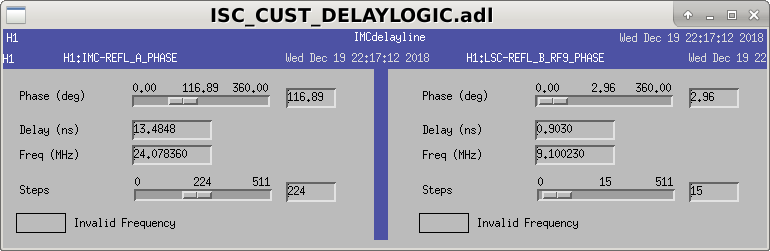
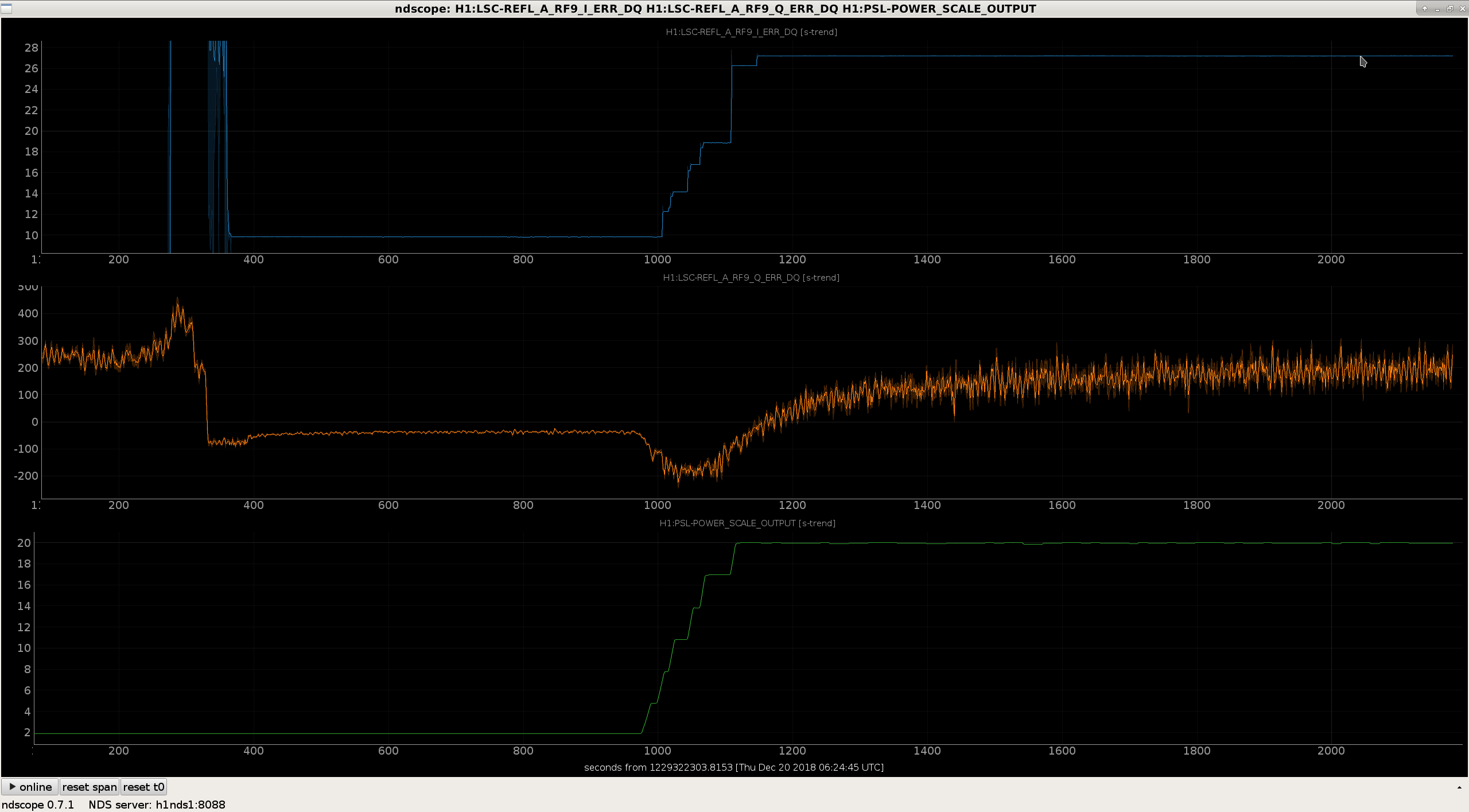
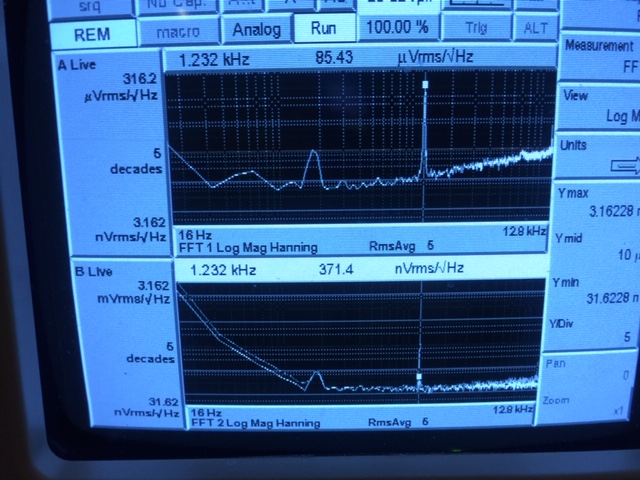
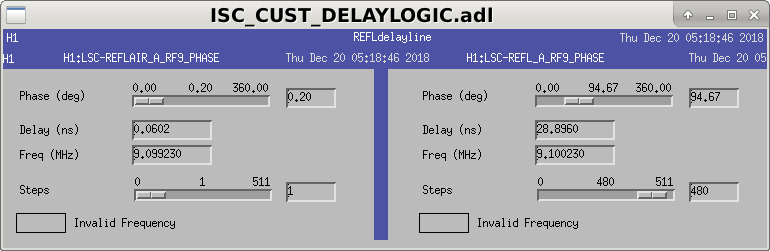
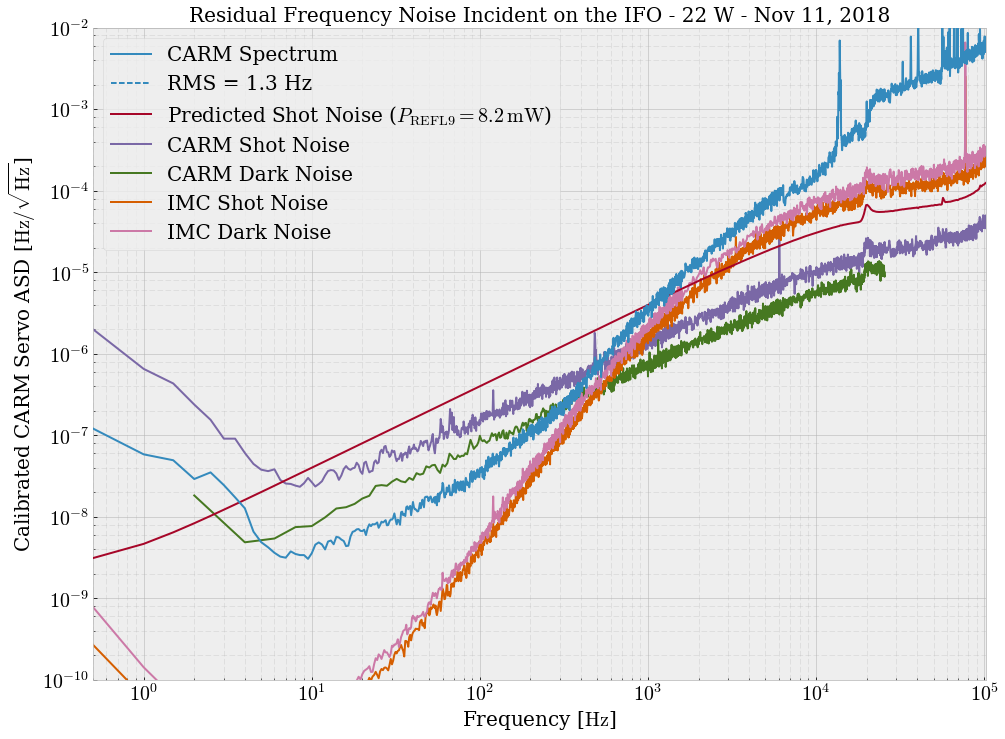
I phased LSC REFL B using an excitation at 1234.3 Hz into the Common Mode Board EXC1 and reading out the REFL_B_RF9 I/Q demod monitor and an SR785. Initially, the LO delay was set to Internal, using the physical switches for delaying (JPG 3). All switches were on, giving 32ns of delay, or 105 degs of phase. I switched the LO delay to External, and found a minimum response in Q at phase of 3 degs. I am guessing that the change from Internal and External gave us ~100 degrees of extra phase. I am only now appreciating Keita's previous work on this, where it's possible that REFL B has some frequency dependent demod phase. I'll take some transfer function of Q/I and make sure that I didn't mess up Keita's phasing at low frequency. ------------------------------------------------------------------------------------------------------------------------------------------------------------------------------------------------------------------------------------ In the meantime, I am tracking down the CARM analog/digital signal chain. One highlight are Pic 4, where I found a TNC splitter connected to the output of the 2 channel demod board I-output. The one end of the splitter goes to the common mode board, while the other goes to an 8 channel whitening chassis. This trackdown is to think about whether our I and Q responses are balanced, and what can our Q phases tell us about the IFO thermal state, sideband imbalance, etc. Useful DCC of the PSL electronics: D1200666 ------------------------------------------------------------------------------------------------------------------------------------------------------------------------------------------------------------------------------------ We are wondering if the REFL_A_9_{I,Q} digital readouts can tell us about the CARM loop, because the digital channel REFL_A_9_I_ERR goes to 27.2 counts when the IFO is locked at 20 W, and not zero, even though the REFL A 9 digital phase is zero. It's clear REFL_A_9_Q_ERR is responding to thermal changes of the IFO (like the differential lensing Dan tuned last night). However, REFL_A_9_I_ERR behaves like a suppressed error signal with a bias that increases with input power and CARM loop gain, and does not change with IFO temperature (see pic 7). I checked the dark offsets, they are not responsible for the bias we see. ------------------------------------------------------------------------------------------------------------------------------------------------------------------------------------------------------------------------------------ I phased from H1:LSC-REFL_A_RF9_PHASE_PHASEDEG = 84.80 degs to 70.01 degs. I did this using the digital REFL_A channels, so this may not be perfect. EDIT: I rephased REFL_A_9 to 94.67 degrees during the last lock using the analog demod board monitors (pics 9 and 10), the phasing was significantly different than the digital phasing. ------------------------------------------------------------------------------------------------------------------------------------------------------------------------------------------------------------------------------------ I also tried an failed to see PCAL in the REFL_A and REFL_B spectra. Naively, if we believe this plot and the calibrated PcalY spectrum response at 8 Hz being ~1e-14 m/rtHz, we should see equivalent compensation by CARM amounting to 0.7 mHz/rtHz, meaning the 8 Hz line ought to be visible.The super massive CARM loop gain crushes the line at 8 Hz of course, but the displacement signal should be there at REFL.I forgot about the massive additional loop gain of MC2 at 8 Hz, there will be nothing at 8 Hz to see. And things don't look great at higher frequencies because the PCAL strength falls as 1/f^2 and the CARM optical gain falls like 1/f.
Images attached to this report