This is another look at the ASC sensing matrix$ that Hang and I have been looking at.
This attached plot shows the sensing matrix coefficients as a function of time. For this measurement, each of the 4 DoFs was driven at a different frequency in YAW. We then demod the ASC sensors as a function of time to see how the sensing matrix evolves. Some notes:
- The sensor data are scaled so that the line heights are similar. i.e., its as if some extra digital gain has been applied, but the same scaling is there for all 4 plots.
- at t=5, the power has just been increased to 20 W. The input power goes to 23 W and t = 30 min.
- The I & Q phases here refer to the audio demodulation, so the changing Q/I ratio is describing a change in the opto-mechanical response phase. This is NOT the same as a change in RF phase or Gouy phase.
- at 31 minutes in this plot we tried adjusting some input matrix to remove cHard from cSoft.
- at 47 minutes, the input power is increased from 20 to 23 W
the main effect here is that the cHard and cSoft couple more strongly into the PRC dOfs as the heating happens. So the matrix inversion will be power dependent as we were worried about. Might be that we'll have to do some SPOP norm to get it to be stable.
[$]: Reminder - the ASC sensing matrix is the thing that relates mirror angles (either in the mirror basis, or some interfero basis like chard, cSoft, MICH, SRC,..) to the signals read out by the angle sensors (WFS, optical levers, DC QPDs, etc).

based on the matrix measurements and examining the time series, we have more insight into instability. Now that we've fixed PRC2 somewhat, we looked at what happens next.
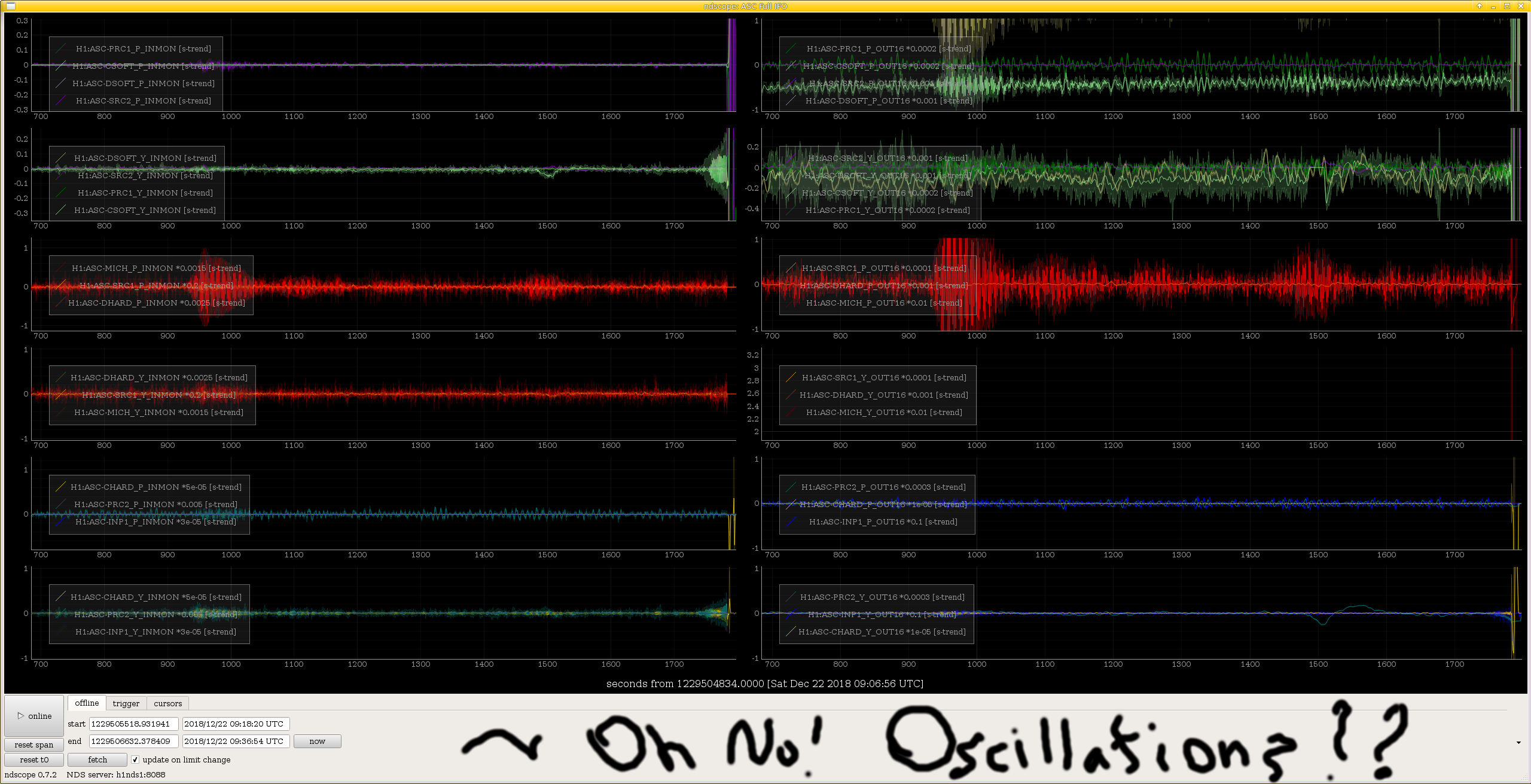
Going from 20-23 W produces a ~3 Hz instability in CSOFT. There is a "plant inversion" (which is often a bad idea*) filter in the CSOFT filter banks. This has a narrow notch at 3.12 Hz from 2015 which doesn't really do the job.
We experimented with blending the REFL RF with the trans mon CSOFT: we want REFL to be boss at DC and Transmon at AC (since it has better SNR). With too much RF, we ring up the 3.1 Hz oscillation. Without enough RF at low frequencies we get a ring up of the ole 0.5 Hz dP/dAngle. Next up is to implement a blend using complementary filters similar to ISI and also what Hang has done for the spot centering.
We were able to stay at 23 W with no trouble so it seems hopeful that we can get to 25 W with minor tweaks.
[*] if you are looking for a good book on feedback and controls that covers the basics and avoids too much math/theory, I recommend "Feedback Systems" by Richard Murray.
I adjusted the RF phases for the REFL WFS: 2 WFS w/ 2 RF frequencies each = 16 phases.
For REFL 9 MHz, I used a frequency noise excitation, since CARM uses the REFL9_I as an error signal. These segments all seemed fine.
For REFL 45, I used a PRC length excitation. Those were off by 10-20 deg, so that's probably an important improvement. The uncontrolled REFL45_Q signals are polluting the REFL45 WFS less during thermal lensing.
Here are the results:
| differences: | no differences for: | ||||||||||||||||||||||||||||||||||||||||||||||||||||||||||||||||||||||||||||||||||||||||||||||||||||||||||||
|---|---|---|---|---|---|---|---|---|---|---|---|---|---|---|---|---|---|---|---|---|---|---|---|---|---|---|---|---|---|---|---|---|---|---|---|---|---|---|---|---|---|---|---|---|---|---|---|---|---|---|---|---|---|---|---|---|---|---|---|---|---|---|---|---|---|---|---|---|---|---|---|---|---|---|---|---|---|---|---|---|---|---|---|---|---|---|---|---|---|---|---|---|---|---|---|---|---|---|---|---|---|---|---|---|---|---|---|---|---|
|
|
||||||||||||||||||||||||||||||||||||||||||||||||||||||||||||||||||||||||||||||||||||||||||||||||||||||||||||