
Hang, Dan Brown
- Soft dither is now combined with ENGAGE_ASC_FOR_FULL_IFO. We now directly AC couple the QPD soft loops when they switch on and DC point is set by the dither loops. Convergence now checks for the dither error point and not the soft QPDs.
- From DARM_TO_RF to CARM_OFFSET_REDUCTION something in EX is nearly saturating, the computer keeps shouting about it
- We updated the CHARD yaw input matrix which has made 25W very stable and 28W look promising although we didn't spend too long there. We pushed up to 30W and lasted ~20 minutes. We checked the LSC loops and they all seem fine and updated PRCL guardian gain scaling.
- CHARD yaw eventually became unstable again at 30W and we lost lock but got enough data to generate some more appropriate input matrices for 30W.
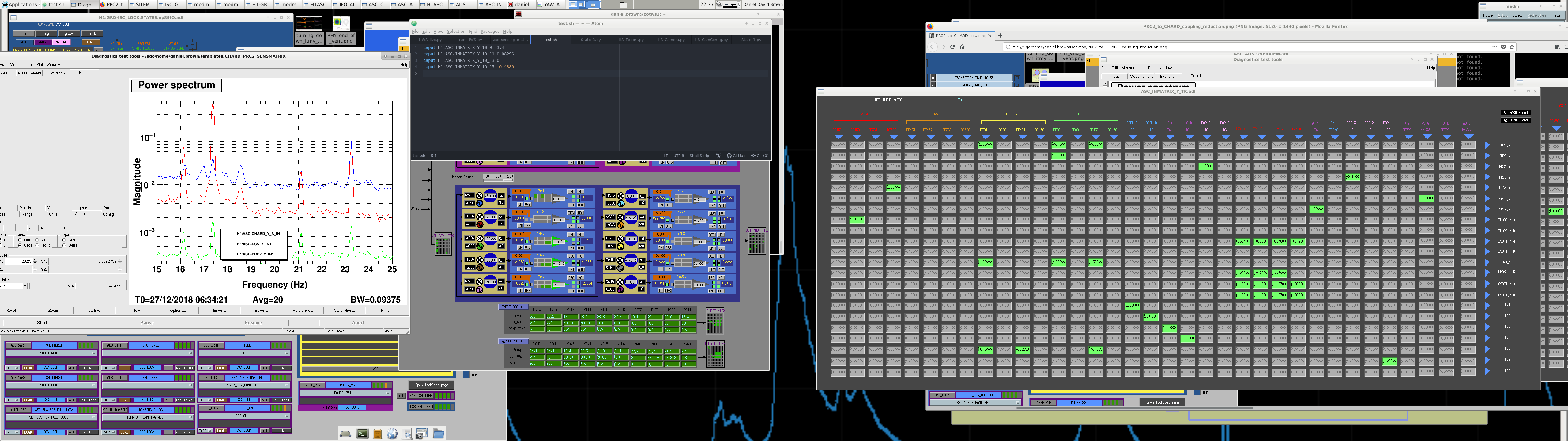
When powering up and thermalising the coupling of PRC2 into CHARD becomes orders of magnitude greater than CHARD back into itself which seems to be the cause of our 3Hz instabilities. At 25W we injected some lines in and looked at how the coupling changed, after it reached some steady state I took 5 minutes of data and processed it offline to compute a new input matrix for PRC2 and CHARD. I used DC5_Y to try out the new input matrix, as can be seen in the DTT window here, blue (new) is looking a lot better than red (old).
We lost lock trying to switch over the matrix, so just update the guardian with these new values. When engaging ful IFO ASC it is a lot more noisy then before, when you get to CHARD_BLEND though everything quietens down and the dither loops catch up.
| Name | Dec 27 2018 03:58:22 UTC | Dec 27 2018 07:49:13 UTC | ||||
|---|---|---|---|---|---|---|
| Value | Alarm Status | Alarm Severity | Value | Alarm Status | Alarm Severity | |
| H1:ASC-INMATRIX_Y_10_11 | 0 | NO_ALARM | NO_ALARM | 0.08296 | NO_ALARM | NO_ALARM |
| H1:ASC-INMATRIX_Y_10_13 | 0.2 | NO_ALARM | NO_ALARM | 0 | NO_ALARM | NO_ALARM |
| H1:ASC-INMATRIX_Y_10_15 | 1.3 | NO_ALARM | NO_ALARM | -0.4889 | NO_ALARM | NO_ALARM |
| H1:ASC-INMATRIX_Y_10_9 | 1 | NO_ALARM | NO_ALARM | 3.4 | NO_ALARM | NO_ALARM |
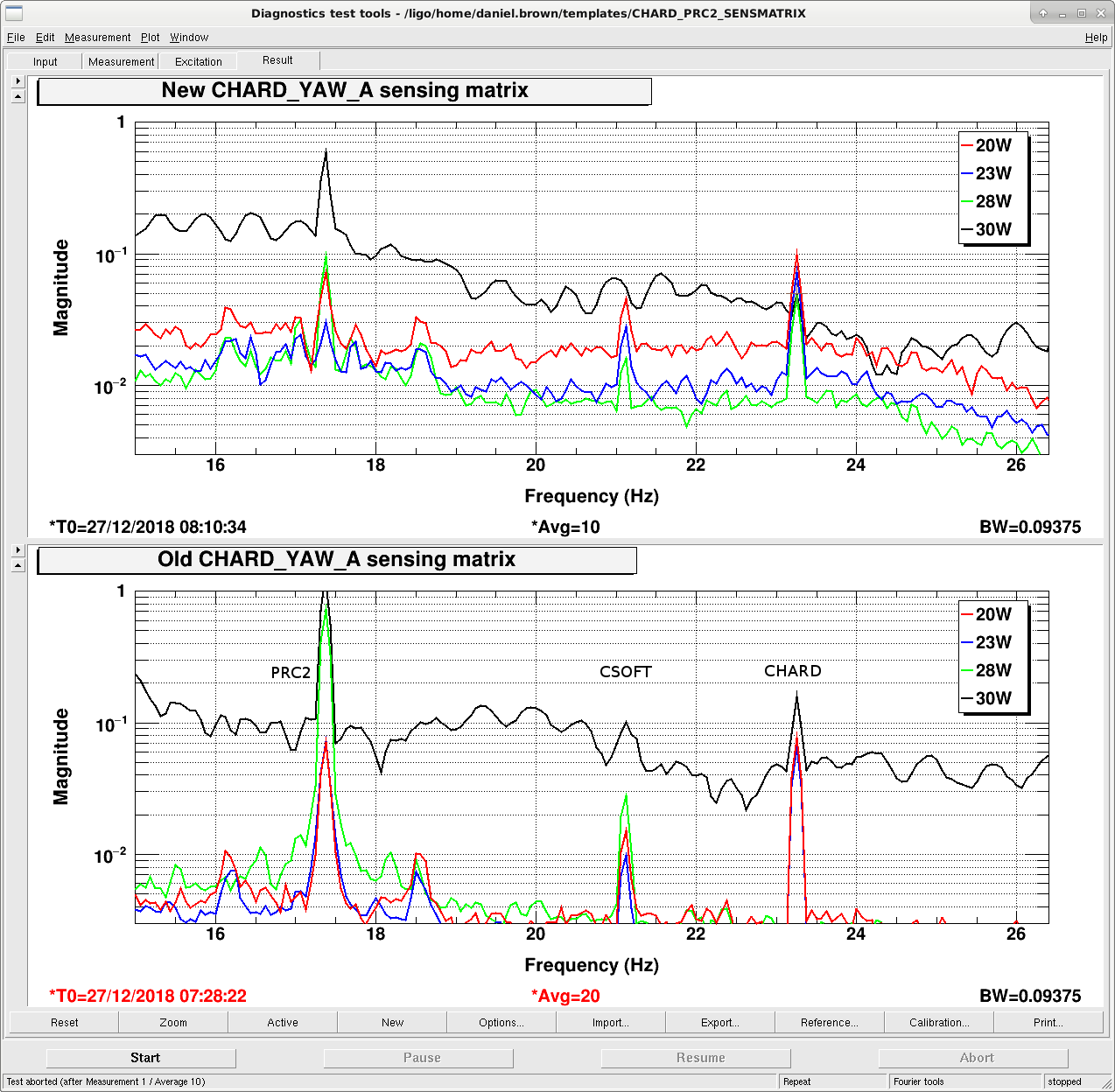
We put the old sensing matrix values back into DC5_Y to see how they behaved as we powered up in steps, a comparison is shown here. As can be seen the new matrix is overall more noisy than the old, however at 28W PRC2 is much lower than before. At 30W we didn't reach a complete thermal steady state as it got too bad, so we still need to fine tune this more tomorrow. The hope is we can get steady at 30W and then do some TCS tuning.
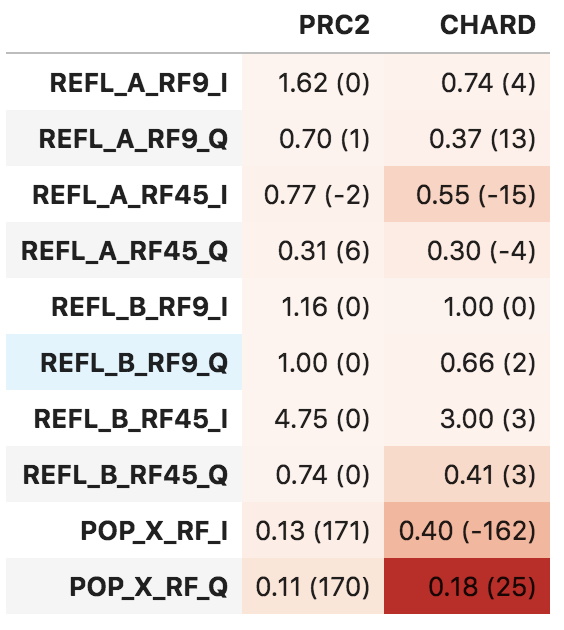
Here's the 28W sensing matrix. The darker the red the lower the coherence between the excitation and the measurement, cell values are "magnitude (phase in degrees)". The sensing matrix is gradually becoming degenerate as we go higher in power.
This input matrix may work:
| REFL_A_RF9_I | POP_X_RF_I | |
|---|---|---|
| PRC2 | 0.000 | -12.996 |
| CHARD | 1.000 | 12.996 |

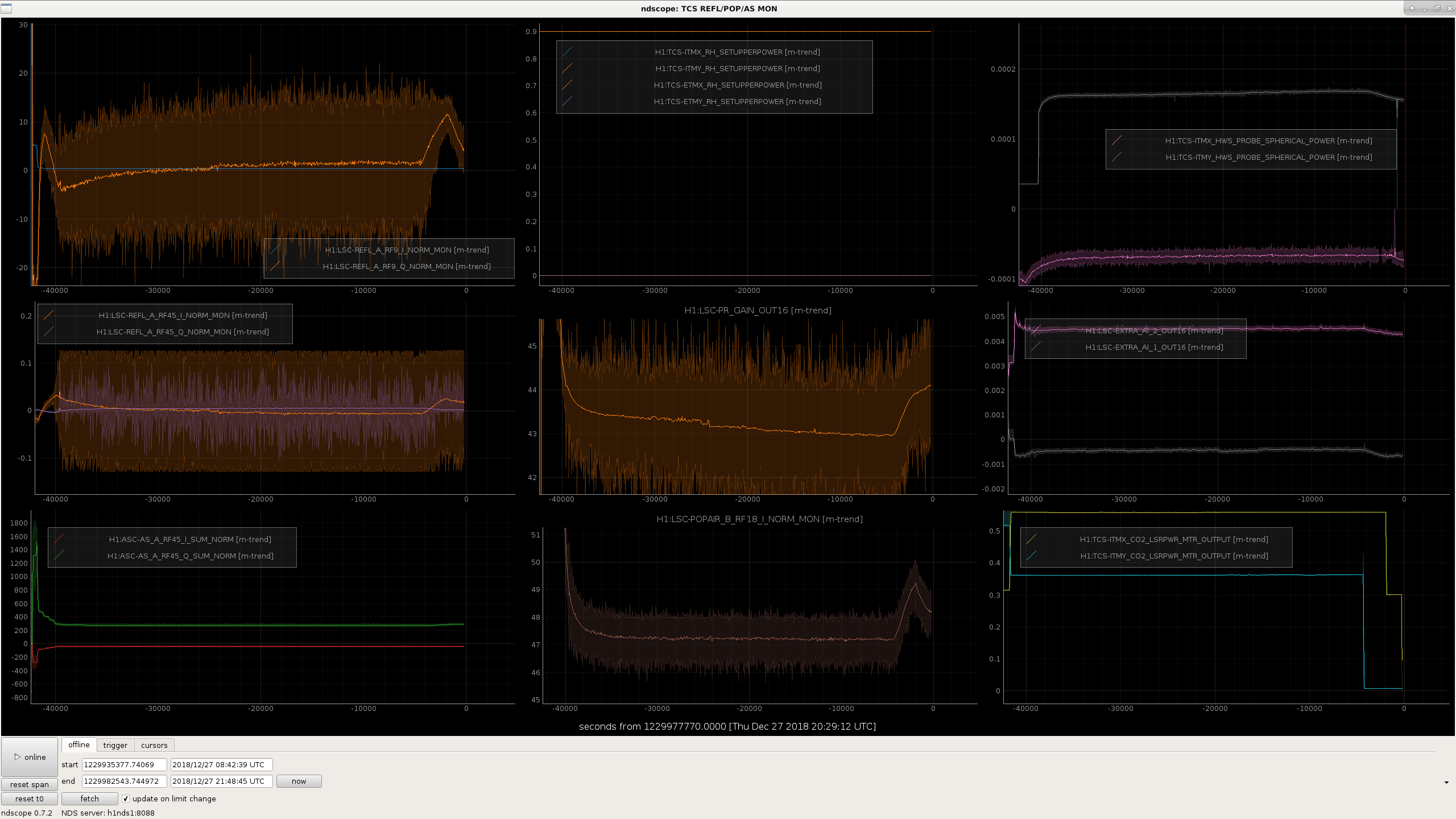
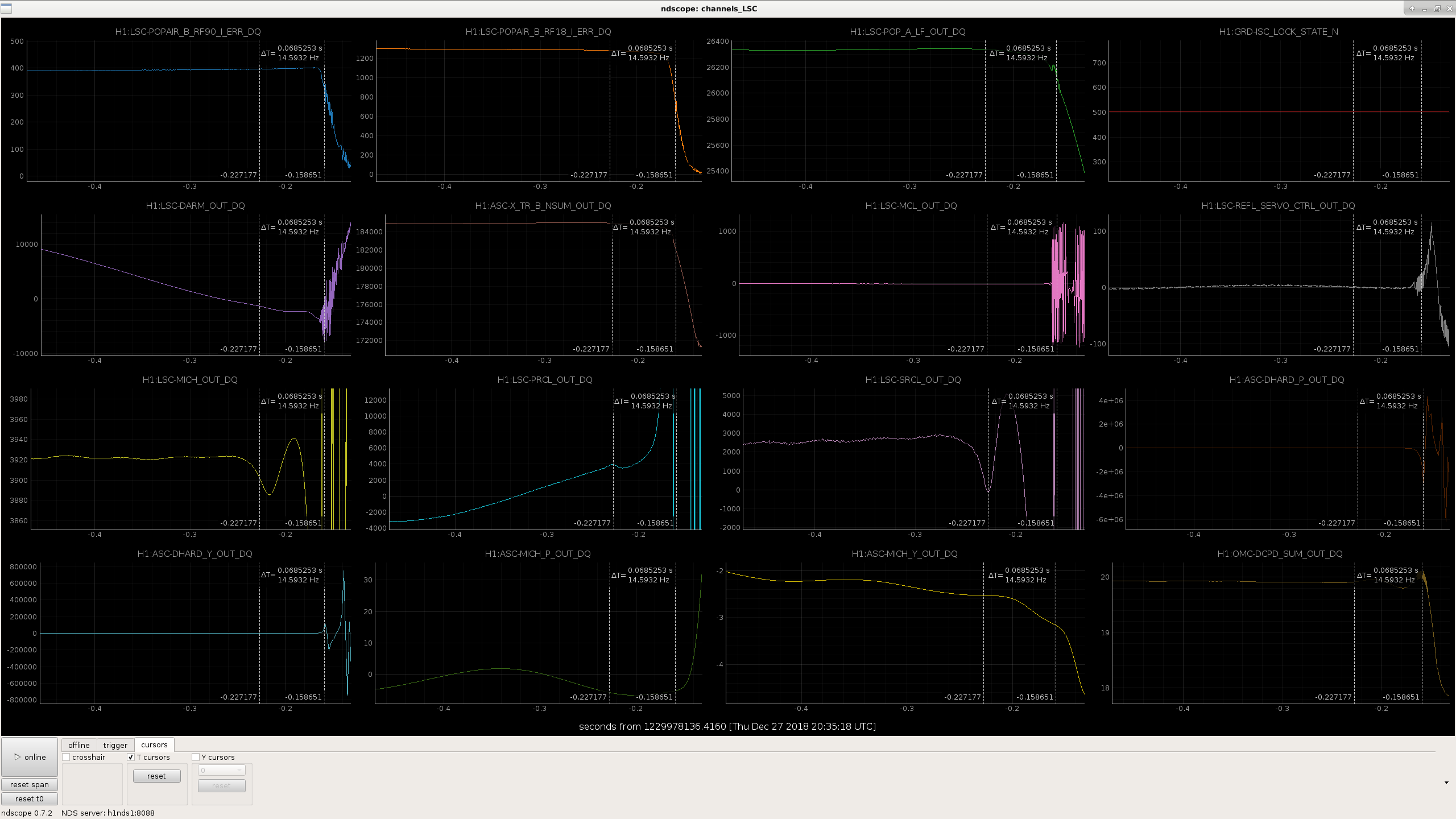
Overnight we stayed locked at 28W for ~11 hours or so. When I came in I started tuning some TCS and lost lock when the PRCL gain dropped too much. First plot is PRCL gain, second PRCL->SRCL, third SRCL gain (46082).
Dropping CO2Y down to 0W at 28W increased the PRC gain and RF18. REFL 9Q got much quieter but trended away from 0. I then tried decreasing CO2X from 0.6 to 0.3W. This had the inverse effect on REFL9Q and RF18, reducing both, but seemed to increased the PRC gain slightly. Not sure why REFL45 becomes so much noisier when we power up to 28W.
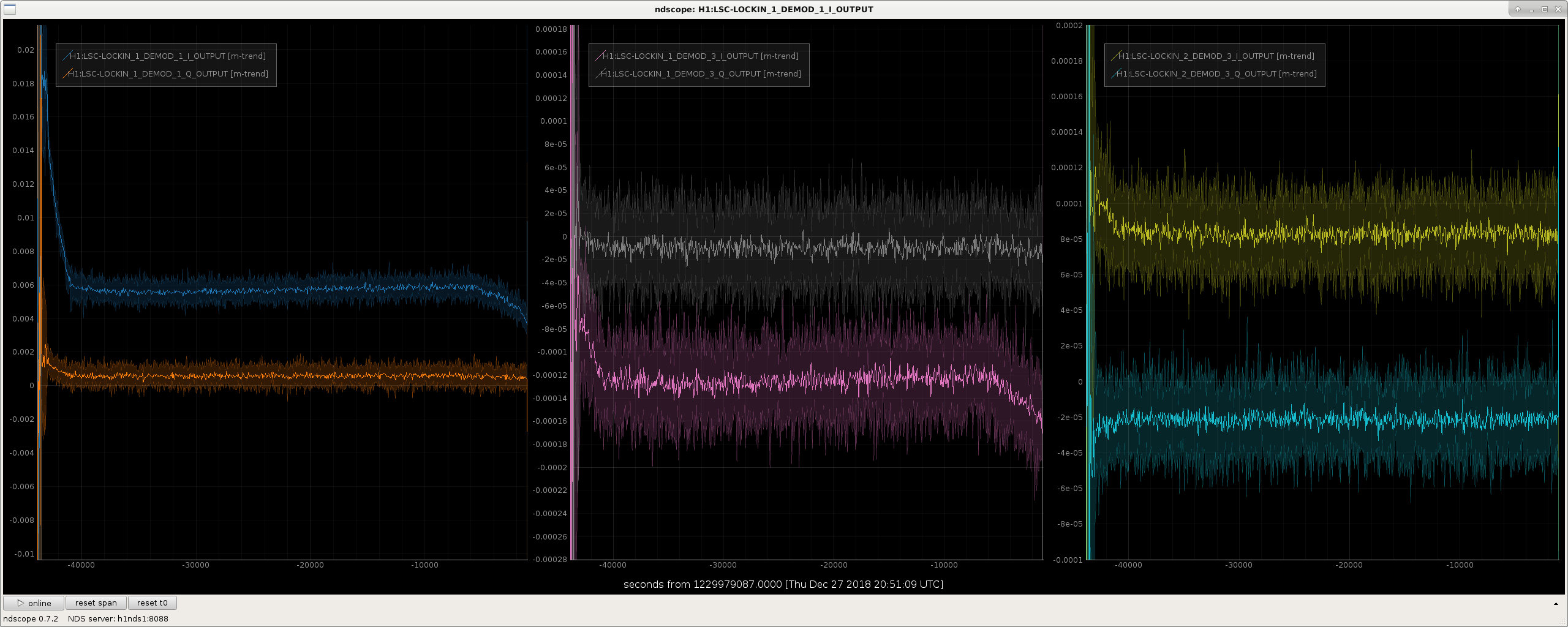
I removed the SRM dither code from ISC_LOCK in PREP_ASC_FOR_FULL_IFO and replaced it with the CSOFT/CHARD/PRC1/PRC2 lines so they switch on automatically.